Kimi K3.1 Pro: 2.8T open weights beat Opus 5.5 on agents
Moonshot published the full weights for Kimi K3.1 Pro on November 2. It is a 2.8T parameter mixture of experts with 104B active parameters per token, 93 layers, a one-million-token context window, and a native vision encoder. The license is Moonshot’s own, so this is not Apache, but the weights are downloadable and that makes it the largest open-weight model on the board today.
The benchmark table on the model card is the reason to care, because it stops being an open-weight story and becomes a frontier story. Against Claude Opus 5.5, Claude Fable 5.1, GPT-6 Astra and DeepSeek V4.1 Flash:
- Terminal-Bench 4.0: 65.7, against 66.4 for Opus 5.5, 58.2 for GPT-6 Astra and 42.3 for DeepSeek V4.1 Flash
- DeepSWE v1.1: 75.5, against 74.2 for Opus 5.5 and 67.4 for Fable 5.1
- Agentic HLE with tools: 70.0, ahead of every listed model including Opus 5.5 at 67.7
- BrowseComp: 92.1, ahead of GPT-6 Astra at 91.5
- Automation Bench: 73.3, against 69.5 for Opus 5.5
- Agents’ Last Exam (CLI): 44.2, level with GPT-6 Astra and ahead of Opus 5.5 at 40.7
- Long-horizon Kimi Code Bench 3.0: 61.2, behind GPT-6 Astra at 66.5
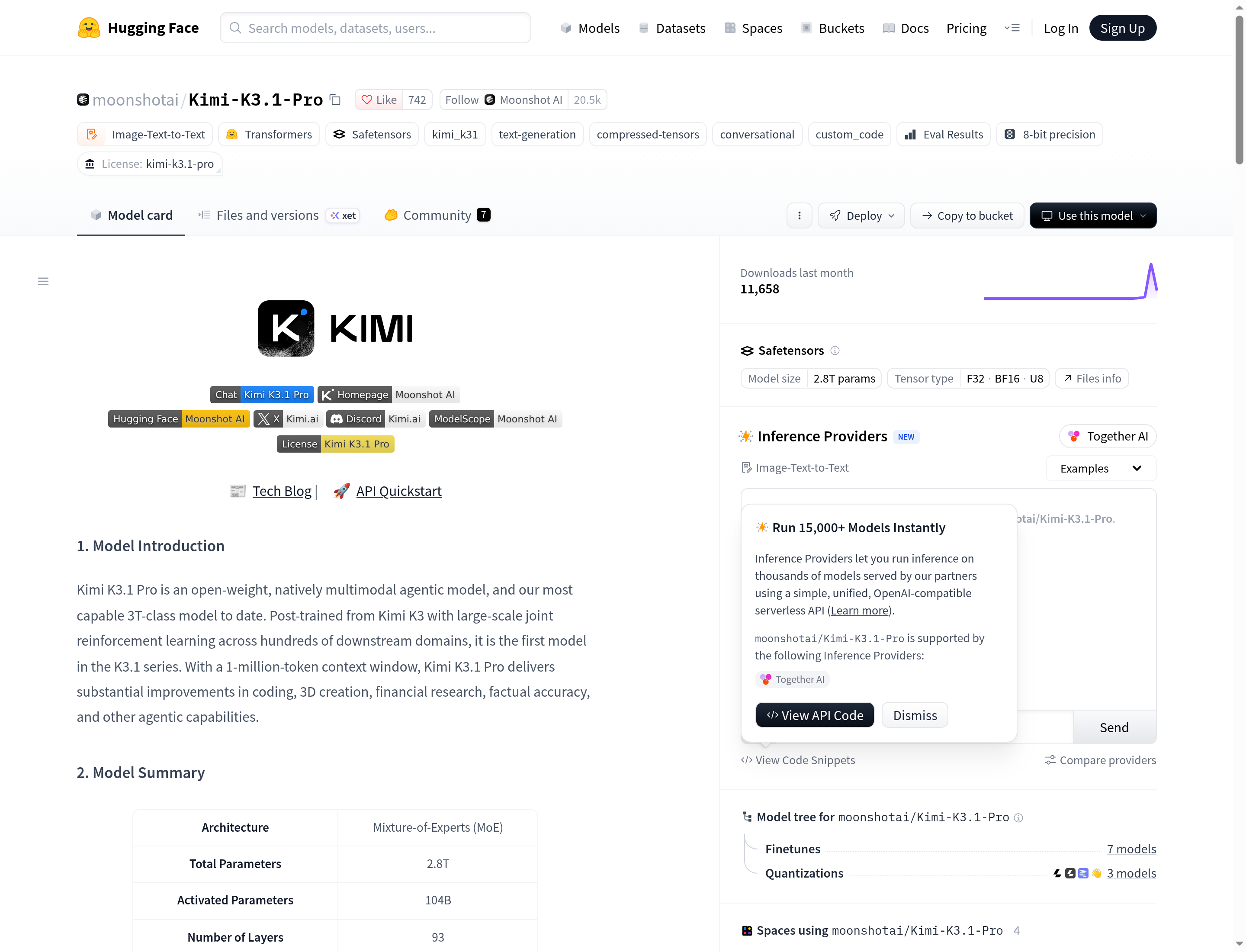
Caption: The model card, published November 2: 2.8T total, 104B active, 93 layers, 1M context, MXFP4 weights with quantization-aware training. Screenshot: Hugging Face.
So it is not a clean sweep. It loses Terminal-Bench 4.0 by 0.7 and the long-horizon coding bench by five points, and it wins handsomely on tool-augmented agentic search, automation and the reasoning-with-tools benchmarks. That shape is worth noticing: this is a model built for agents that call tools and use context, not for single-shot terminal heroics.
What the architecture buys
Kimi K3.1 Pro replaces Kimi K3’s full-attention layers with Gated DeepSeek Sparse Attention across 24 of 93 layers, keeping 69 KDA layers for the rest. There are 896 experts and 16 are selected per token, plus two shared experts. It ships in MXFP4 weights and MXFP8 activations, produced with quantization-aware training rather than a post-hoc squeeze.
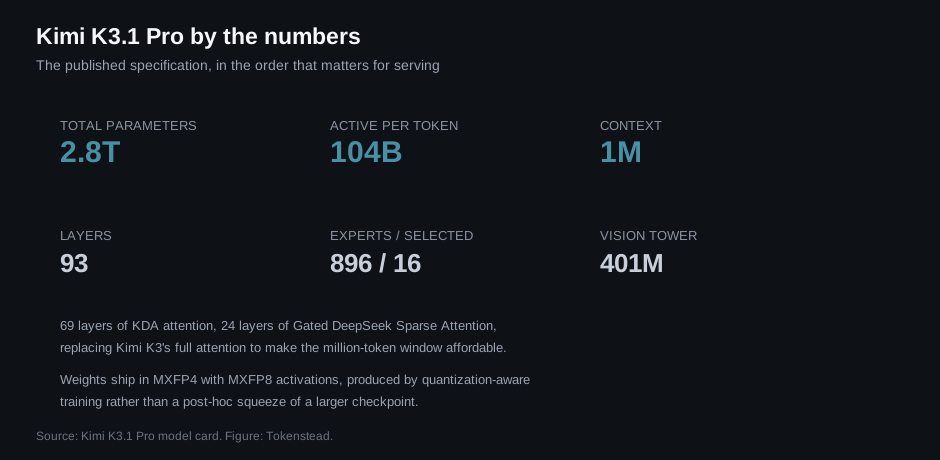
Caption: The shape of the model as published: 93 layers split between KDA and Gated DSA, 896 experts with 16 selected per token, and a 401M parameter vision tower. Figure: Tokenstead.
The hardware reality
Here the news gets less friendly. The published repository totals about 1.56TB across 96 safetensors shards in its compressed form. Nothing on this site runs it. A 2-bit copy lands somewhere near 700GB, which is a pooled 512GB Mac Studio plus friends, or a rented multi-node cluster.
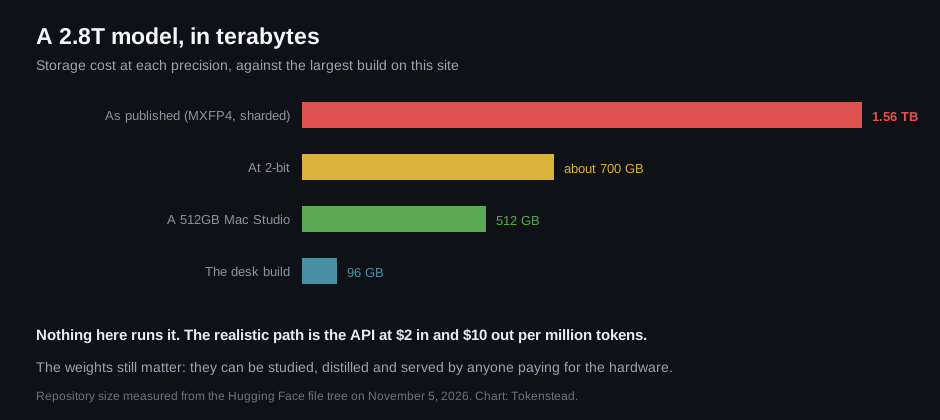
Caption: What a 2.8T model costs in storage at each precision, against the memory this site’s largest build actually has. Figure: Tokenstead.
The practical way to use it is the API, at two dollars per million input tokens and ten per million output, which is a price that makes a 2.8T model cheaper to try than to host. The open weights matter for a different reason: they mean the model can be studied, distilled, fine-tuned and served by anyone prepared to pay for the hardware, with no gatekeeper deciding who gets access.
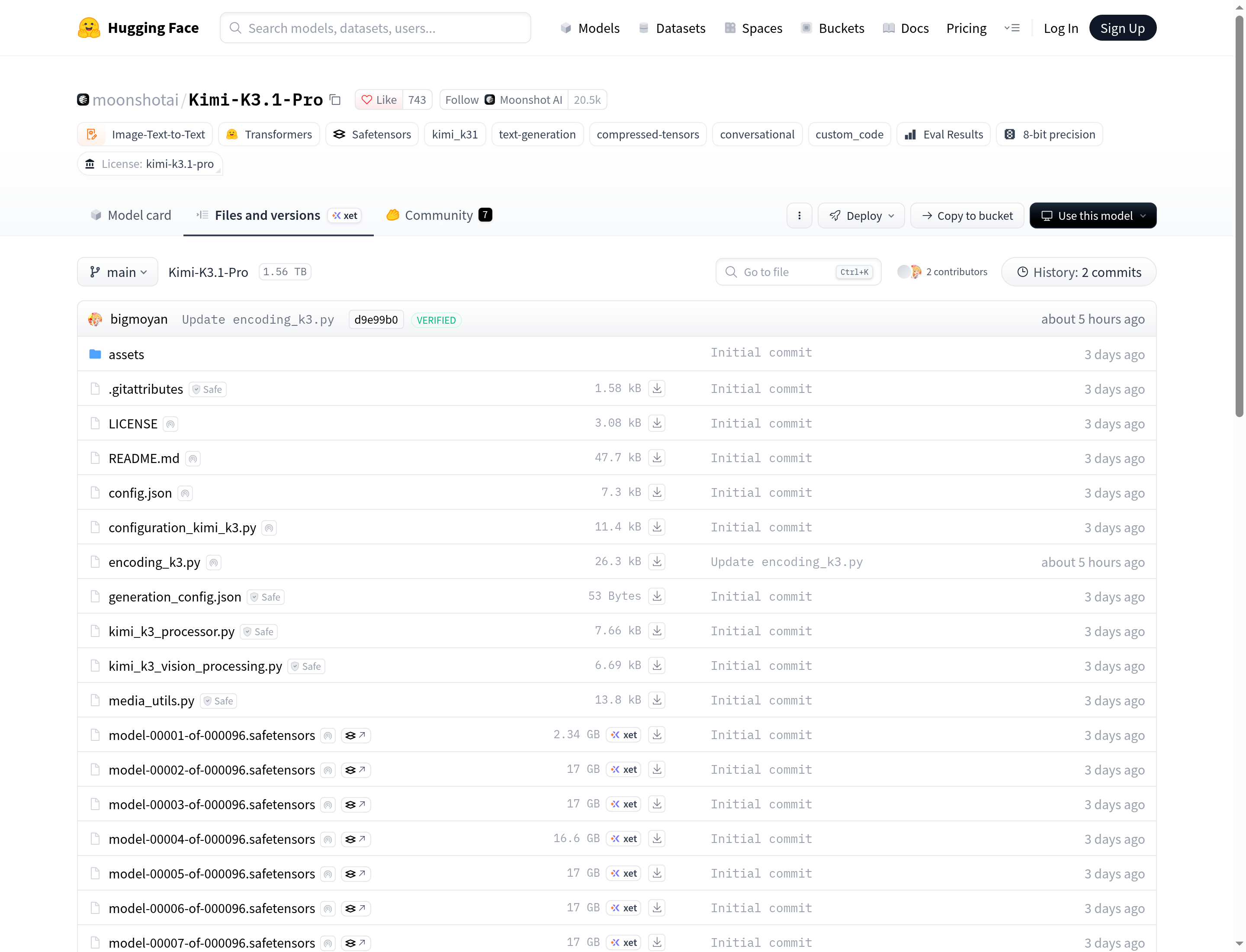
Caption: The published file tree: 96 safetensors shards, about 1.56TB in total, all downloadable. Screenshot: Hugging Face.
Where it fits
The K3.1 Pro release follows the pattern this site has been tracking all year. The strongest open-weight models are getting bigger, not smaller, and the gap between “open” and “runnable at home” keeps widening. Ripple-65B, published the same week, is the counterexample at the other end.
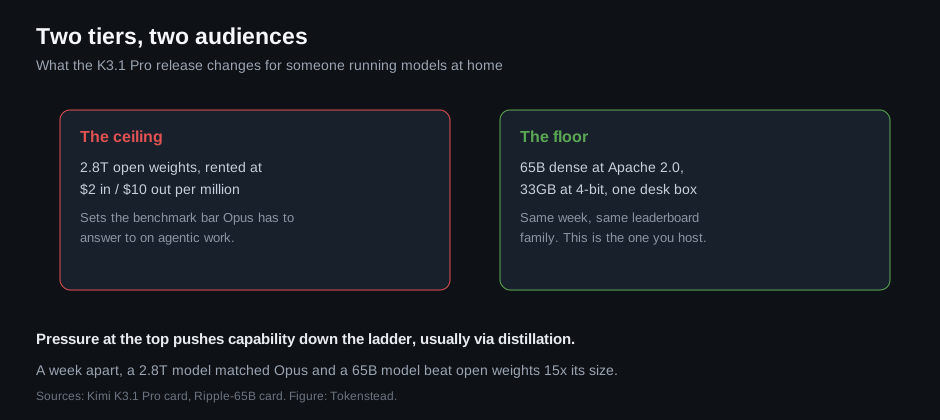
Caption: Two tiers, two audiences: a 2.8T model you rent per token, and the open-weight ceiling it now sets for everything below it. Figure: Tokenstead.
For a local builder the takeaway is indirect but real. Every benchmark that puts an open model level with Opus 5.5 on agent work pushes closed labs to defend their price, and the winner of that fight is whoever runs agents cheaply. Some of that lands in your rig via distillation and fine-tunes, which is how a 65B model ends up ahead of a 975B one on TerminalBench a week later.
Discussion
Be the first to commentStart a discussion
Got a take on this, a rig to show off, or a benchmark that says otherwise? Sign up and start the thread - your comment publishes instantly once you're in.