Memory squeeze: why every local AI build costs more
Apple guided its holiday-quarter gross margin down to 45 to 46 percent from 47.9 percent on its November 2 call, and new chief executive John Ternus called memory pricing “unprecedented” on the way through. Revenue for the September quarter was a record $114.5 billion, up 12 percent. The company that can negotiate better than anyone in the industry is telling you the component bill went up and is staying up.
That guidance is the clearest signal yet of what happened to local AI hardware this autumn. The squeeze is not about GPU dies. It is about memory, and it hits every tier at once.
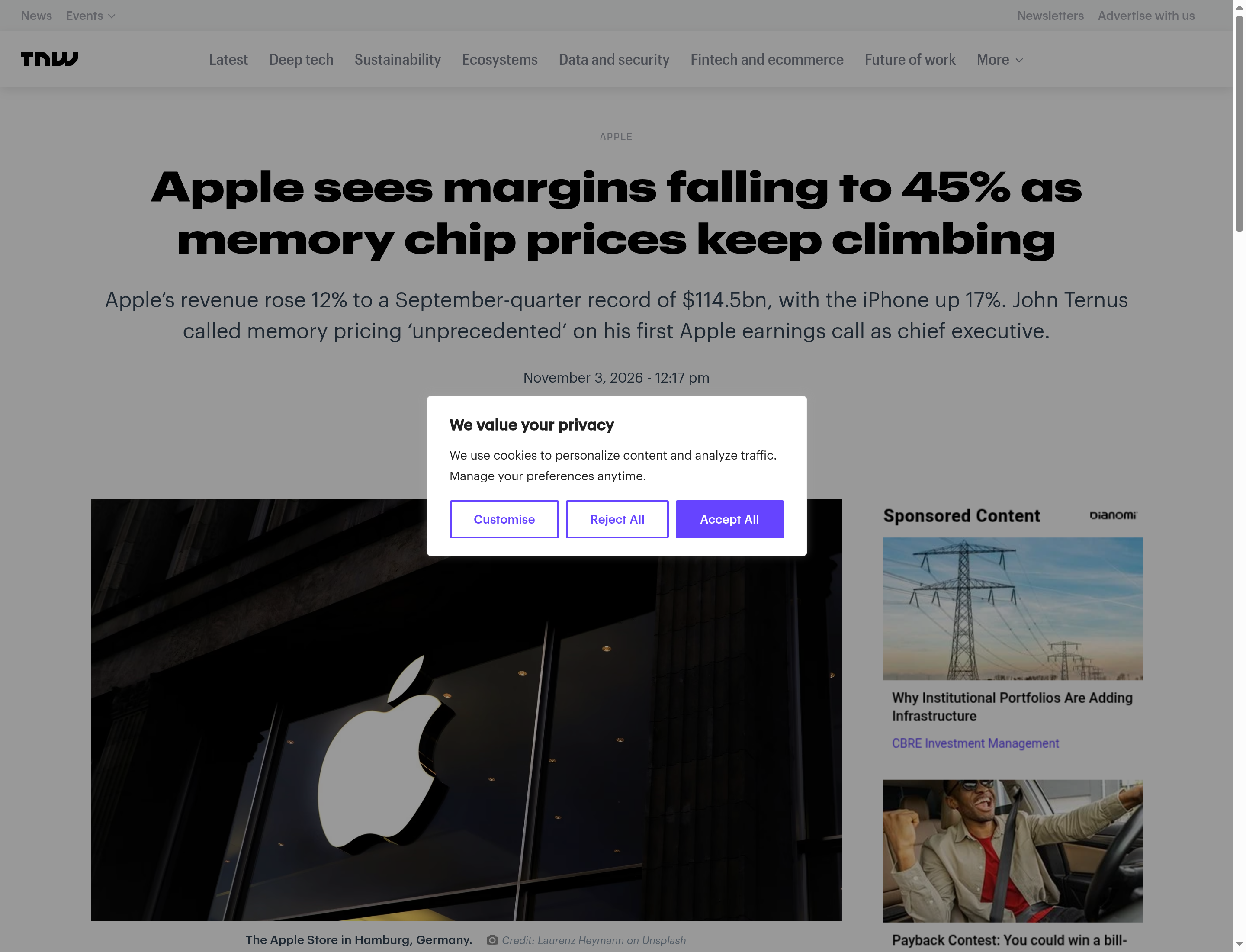
Caption: Apple’s holiday guidance: 45 to 46 percent gross margin, down from 47.9, with memory named as the cause on the November 2 call. Screenshot: The Next Web.
What the cards cost now
TechSpot’s October survey of ten markets found the RTX 5090’s lowest US price at $9,400, roughly 370 percent over the $1,999 launch MSRP, and up 36 percent from September’s $6,890. The ten-market normalized average came to $7,240, about 262 percent over launch. The wider market was up 11 percent in October alone.
This site repriced its own builds when that snapshot landed. The quad-5090 server rig moved from $27,180 to $37,600, and the $30k flagship from $16,794 to $19,399, because the price of the one part that matters doubled.
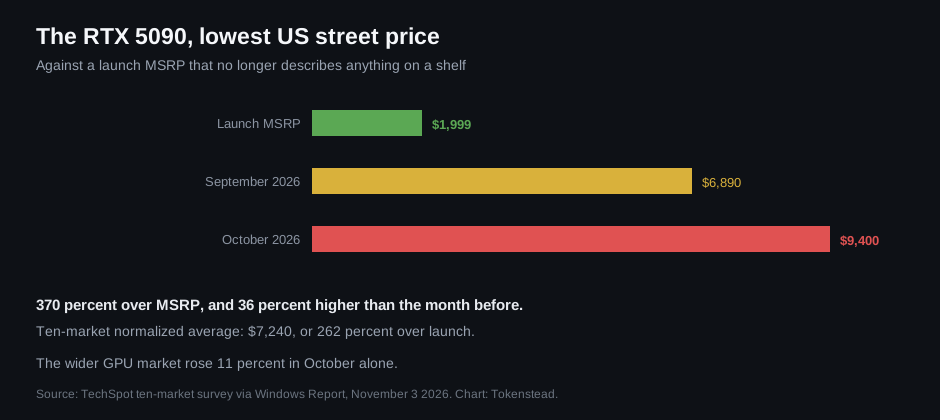
Caption: The 5090’s lowest US street price across the year, against a launch MSRP that no longer describes anything sold. Figure: Tokenstead, from TechSpot’s survey via Windows Report.
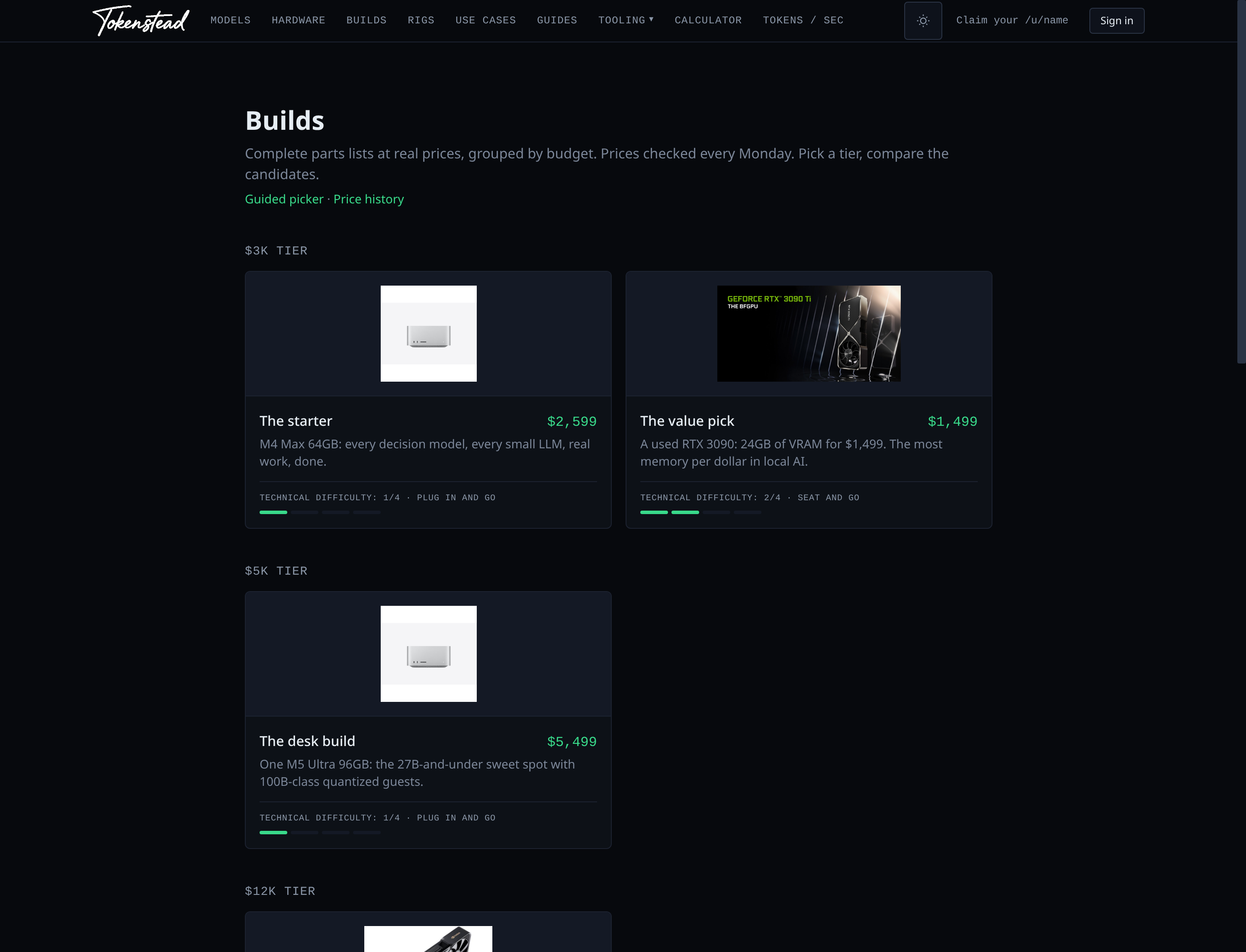
Caption: The builds page after the reprice. The quad-5090 entry now costs more in GPUs alone than the whole build did in September. Screenshot: Tokenstead.
The supply response, and why it is five years away
SK hynix’s NAND subsidiary Solidigm is reportedly planning two fabs at the Marcy Nanocenter in Oneida County, New York, the company’s first US NAND manufacturing. Per TrendForce, citing Seoul Economic Daily: the first phase would produce 100,000 twelve-inch wafers a month, each fab is estimated at $40 billion to $50 billion, and total investment could reach $100 billion. New York State is reportedly weighing up to $50 million for site preparation. SK hynix says no final decision has been made.

Caption: TrendForce’s report on the Solidigm plan: two New York NAND fabs, $40 to $50 billion each, 100,000 wafers a month in phase one, and no final decision yet. Screenshot: TrendForce.
Line up the timelines. A fab that breaks ground next year produces wafers years after that. The memory your next build needs is being priced today by capacity that exists today, and the demand curve behind it is AI data centres, not gamers. Nothing about a $100 billion announcement helps anyone buying a GPU this quarter.
What to do about it
Three things follow from the numbers, and they are the reason this piece is worth writing rather than just reading a price index.
Buy memory capacity, not compute peaks. Unified-memory machines are exposed to the same DRAM market, but they buy you the thing that decides which models run at all. A 96GB or 128GB box ages better than a card you cannot afford to add.
Treat the used market as a real tier. The $1,499 used 3090 on this site’s value-pick build is the only entry whose price has not tracked the new-card market, and it holds 24GB.
Watch the software side. The week the 5090 hit $9,400, an open source engine shipped that runs a 125B model on a 12GB card by streaming experts from system RAM. Every dollar of memory inflation increases the value of not needing the memory in the first place.
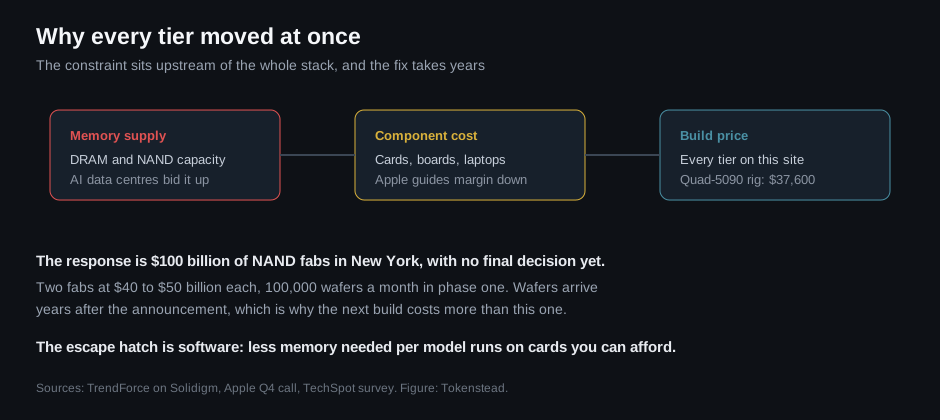
Caption: Why this cycle moves every tier at once: the constraint sits upstream of every build, and the response timescale is measured in fabs, not quarters. Figure: Tokenstead.
The forecast side is worth holding loosely. TrendForce expects Q4 contract DRAM up 10 to 15 percent and NAND up 15 to 20 percent, and forecasts have been wrong in both directions this year. The measured facts are the $9,400 card, the 47.9 to 45 percent margin guidance, and the $100 billion of NAND capacity that does not exist yet.
Discussion
Be the first to commentStart a discussion
Got a take on this, a rig to show off, or a benchmark that says otherwise? Sign up and start the thread - your comment publishes instantly once you're in.