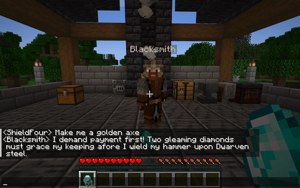
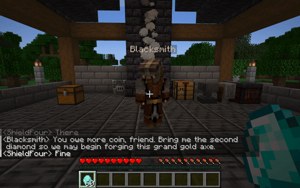
NVIDIA’s smallest Nemotron ships as a GGUF that fits in 4 GB of memory, and in the technical report the company shows what they do with it: the model plays a blacksmith trader in Minecraft. Not a screenshot mock-up - a live test where the NPC takes payment for a golden axe, gets haggled with by a user (the chat shows a real negotiation: “You owe more coin. Bring me the second diamond so I may begin forging this grand gold axe”), then autonomously checks crafting recipes, collects ingredients, smelts, and hands over the item.
What Bolt E4B is
TLDR: Nemotron 3.5 Bolt E4B is an open-weight small language model that runs fast agents on tiny hardware. It enables Minecraft-NPC-grade characters, on-device voice assistants, and robot speech, all local. The difference between Bolt E4B and regular small models is that it was post-trained specifically for multi-turn tool use and fast first tokens, so interactive characters work without a datacenter behind them.
The spec sheet: 8B total parameters, 4B effective, Q4_K_M quantization, 64K tokens in and out, post-trained from Google’s Gemma-4-E4B-it, OpenMDW-1.1 license (commercial use included). A companion DFlash drafter ships beside it for speculative decoding, which is how a 4GB model keeps conversational speed on CPU-class hardware.
The Minecraft NPC is the demo worth understanding
The blacksmith demo matters because it exercises the FULL agent loop in one vignette: state tracking (whose coins are whose), tool calls (recipes, crafting, transfer), and a personality that haggles instead of instantly complying. The model card’s agent guidance is written for exactly these builds and it is honest about the failure modes - “a nearby item or chest does not mean the agent owns its contents”, “distinguish unavailable information from empty state” - which reads like a checklist learned from watching agents cheat in someone else’s inventory.
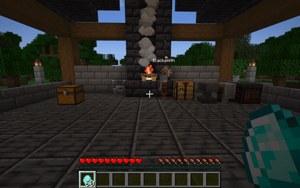
For anyone building game NPCs, the shape to copy is in the card: separate agent/user entities with separate inventories, explicit labels (YOUR INVENTORY, SHARED CHEST), and state marked with visible blocks. The blacksmith works because the state framing makes ownership unambiguous enough for a 4B-active model to reason about it.
The robot demo is the same model again
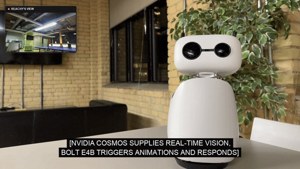
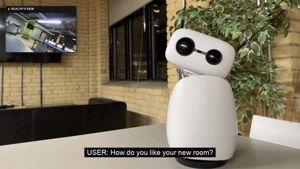
The report’s second live test puts the model on a Reachy Mini desktop robot running Jetson Orin Nano 8GB: NVIDIA’s Cosmos 3 Edge model supplies real-time vision of the room, Bolt E4B handles the conversation and calls the robot’s animation-library scripts. In the GIFs the robot takes a question about its new room and moves while answering.
The numbers that make 4 GB interesting
NVIDIA’s own placement chart plots representative benchmark average against time-to-first-token with circle size as VRAM: Bolt E4B 4GB sits at 70.2 quality with a first token in roughly a third of a second. The neighbors: Gemma 4 26B-A4B at 72.8 but twice the latency and a bigger circle; Qwen 3.8 27B at 67.0 and a much slower first token. The green dot is the argument: within 2.6 points of the 26B class at a fraction of the memory, tuned for responsiveness instead of pile-up quality.
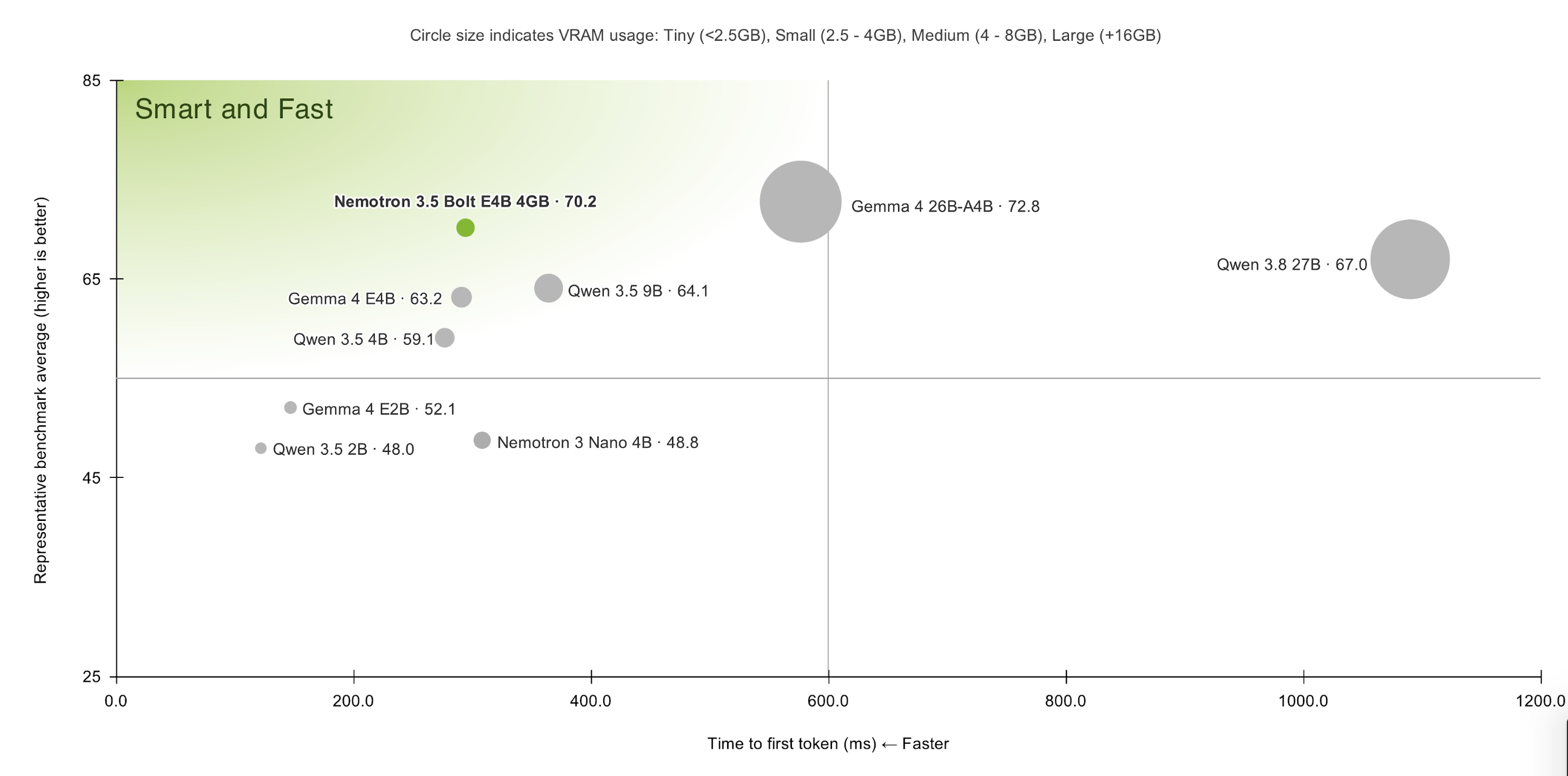
The quantization story is also reported rather than assumed: the 4GB build is Q4_K_M with importance-matrix calibration over a million tokens of RL rollouts, and Table 5 claims it beats plain Q4_K_M as well as IQ4_XS and IQ4_NL builds on average accuracy. Quantization notes usually whisper; this one has a table.
Fit and where it runs
The 4GB label is the memory class: the Q4_K_M GGUF is roughly 4 to 5 GB on disk, runs on llama.cpp, and the report targets Jetson-class edge boxes and laptops. For Steam-deck-class handhelds and single-board robots, that is the whole design space the Bolt line is aimed at: characters and assistants that never phone home.
Sources: NVIDIA’s Bolt E4B technical report (research.nvidia.com), the model card on HuggingFace (OpenMDW-1.1), the live-test GIFs from NVIDIA’s research page.
Related on this site: the engine catalog covers llama.cpp and friends; the builds pages cover the hardware tiers where 4GB models live.