On August 31, 2026, Coinbase CEO Brian Armstrong and Yunjie Dai, listed by omarchy.org as cofounder of TapTap, each committed $1M, taking the Omacom Foundation to $12M from twelve patrons. The foundation launched August 21 with $8M, with eight patrons, and hit $10M on August 24 with Dropbox cofounder Drew Houston and Peter Steinberger, listed by the site as the creator of OpenClaw; ten days in, it had added $4M and four more patrons. Every patron put in personal money. DHH’s framing when the foundation launched: “We’re going to make the prophecy of The Year of Linux on the Desktop come true. All the pieces are now in place.”
The official Omarchy wordmark, in the project’s Tokyo Night green, published at 4096px on the site’s brand page. Omarchy is a pending trademark.
The foundation’s stated job, verbatim from the launch post: “hold the trademarks, fund the infrastructure, promote the work, and support the open-source projects and developers Omarchy depends on.” The foundation takes no equity and pays no return. What it buys is runway for a distro that calls itself, per its homepage, “the malleable OS for the age of agents.”
View this post on X →
Corporate patronage opened the same day. 1Password and 37signals are the first Distinguished Corporate Patrons, each committing $100,000 a year over three years and taking the foundation’s total to $12.6M. In the follow-ups on the announcement, DHH thanked Jason (@jmeller) for leading 1Password’s participation and compared the fit to the Rails Foundation, then put the project’s economics in one line: “Open source doesn’t need to be a commune!”
View this post on X →
Omarchy itself is DHH’s Arch Linux build on the Hyprland Wayland compositor, incubated at 37signals and released June 26, 2025. The GitHub repo (omacom/omarchy, MIT licensed) held 35,911 stars and 3,713 forks as of August 31, 2026.
What Omarchy ships
The 2025 launch post described Omarchy as DHH’s “Platonic ideal of what a developer environment should look like” - a continuation of Omakub, his Ubuntu take from 2024, rebuilt on Arch. Version 4, “Quattro,” shipped August 14, 2026, and 4.0.2 is the current release; the 4.0.1 patch in between was a security fix. Quattro rewrote the desktop shell on Quickshell, replacing eight separate tools - Waybar, Walker, Mako, SwayOSD, hyprlock, hypridle, swaybg, and the GNOME polkit agent - with a shell that stays under 300MB of RAM, and cut the ISO by about 30 percent.
On 37signals’ REWORK podcast, DHH framed the project in his own company’s terms: “Omarchy is now a 37signals Linux distribution in the same way that Rails is a 37signals Ruby web framework.” The company’s tech, ops, and Ruby teams are moving to Omarchy on Framework laptops, a migration the company expects will take about three years as its Macs hit refresh.
The install is ISO-based and defaults to LUKS full-disk encryption. Omarchy’s manual promises “under a minute on the fastest modern machines” and no more than five minutes on an older machine. One BIOS prerequisite matters: Secure Boot and TPM have to be turned off before install, and the full-disk option wipes the selected drive. The Register’s August 27 hands-on measured a ~14GB footprint after the first update and about 1.5GB of idle RAM.
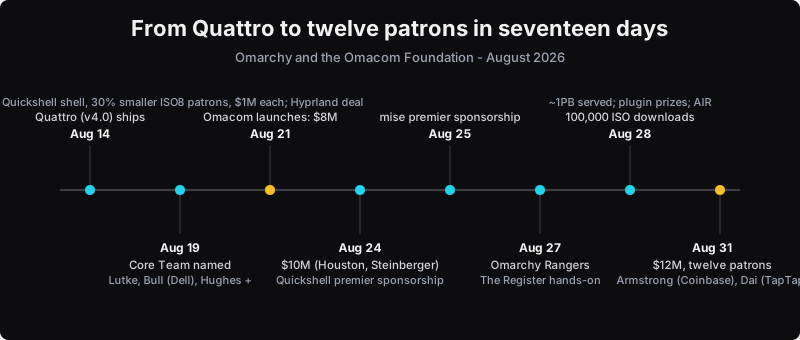
Omarchy’s August 2026: from the Quattro release on the 14th to twelve patrons and $12M on the 31st, with the 100,000-download milestone and three project sponsorships between them.
Where the $12.6M goes
Three sponsorships are signed so far, all disclosed on omarchy.org:
-
Hyprland: an exclusive three-year sponsorship with an option for two more. The paid Hyprperks program ends and its perks go free. Hyprland is the compositor Omarchy runs on.
-
Quickshell: a three-year premier sponsorship of the framework the Quattro shell is built on.
-
mise (jdx): a premier sponsorship of the tool-version manager that also backs Omarchy’s agent launcher stubs.
No dollar figures were disclosed for any of the three. Governance is not published: no board, no bylaws. What exists instead is an Omarchy Core Team, announced August 19, that DHH says “will share the responsibility of driving the direction of our distro”: Ryan Hughes (partner at Oodle), Tobi Lutke, Bjarne Overli (CTO of Unite AS and builder of the Aether theme), HANCORE (mechanical engineer, builder of Solitude), Spencer Bull (Distinguished Engineer at Dell), and DHH. A community program, Omarchy Rangers, followed on August 27.
The first two weeks
Between the Quattro release and the last patron signing, the project announced its adoption milestone: on August 28, omarchy.org reported 100,000 ISO downloads in a week, part of “nearly one petabyte” of traffic across ISOs and package updates served through Cloudflare. The site publishes no methodology or window for the count, so treat it as self-reported. Other August items, from the site’s own news posts: the plugin marketplace passed 500 plugins; the first plugin competition produced winners (Radio Atlas, Omagotchi, AirPods); and an artist residency, Omarchy AIR, launched with HANCORE and OldJobobo as the first artists.
The security criticism
The most pointed critique comes from the “Merchants of Insecurity” blog: “Do NOT use Omarchy if you care about security of your machine even a little bit.” A Framework forum member called it “not a secure distribution” - notable given 37signals standardized the migration on Framework hardware and Dell has an engineer on the Core Team.
The checkable problems, per The Register’s hands-on: installing requires disabling Secure Boot, a hard requirement of the current ISO; updates run through a custom script rather than plain pacman; the custom keyboard setup, in the piece’s words, “ignores almost all existing keyboard shortcuts and UI conventions from other OSes”; and the reviewer needed the third-party hyprmon tool to fix multi-monitor output. Against that, the project shipped security fixes as 4.0.1 within days of Quattro, with another batch of security patches in 4.0.2. The LUKS default and the wipe-warned install options are in the manual, but the Secure Boot requirement is the one that disqualifies hardened setups outright.
View this post on X →
DHH’s answer to the security pile-on came on the 4.0.2 release thread, where Omarchy Core Team member Ryan R. Hughes thanked five researchers for responsible disclosures. DHH: “We’ve gotten such a special focus from security researchers that we will soon be the most hardened Linux distro out there.” The Secure Boot requirement stands regardless of patch velocity.
The agent workstation
The reason a local-AI site covers a Linux distro is the AI manual. Omarchy preinstalls launcher stubs for agent harnesses - lazy mise binaries that download nothing until first run - for claude, codex, opencode, agy, copilot, crush, grok, pi, omp, and ori. Stock Arch and Ubuntu ship nothing comparable in their installers.
The wiring around the stubs is what makes it opinionated:
- A default agent set with
omarchy default agent <name>, launched with Super+Shift+Ctrl+A, or inline via the a, c, cx, and cy aliases.
- Agents are documented to run unattended in their respective “don’t-stop-to-ask” auto-approve modes, from a ~/Work directory because, per the manual, agents do not trust $HOME.
- An Omarchy Skill symlinked into the skills directories of Claude Code, Codex, Pi, Gemini, and the generic ~/.agents location.
- A crash watcher that hands segfault core dumps to your default agent with a diagnose-crash skill.
- A top-bar panel tracking plan usage, the five-hour session limit, weekly limits, and tokens per day per model for Claude Code, Codex, and Fireworks, refreshing every 15 minutes.
- herdr, a terminal multiplexer covered in byteiota’s Quattro write-up, shown surfacing per-pane agent state (idle, working, blocked, done) with git worktree management and sessions that persist over SSH.
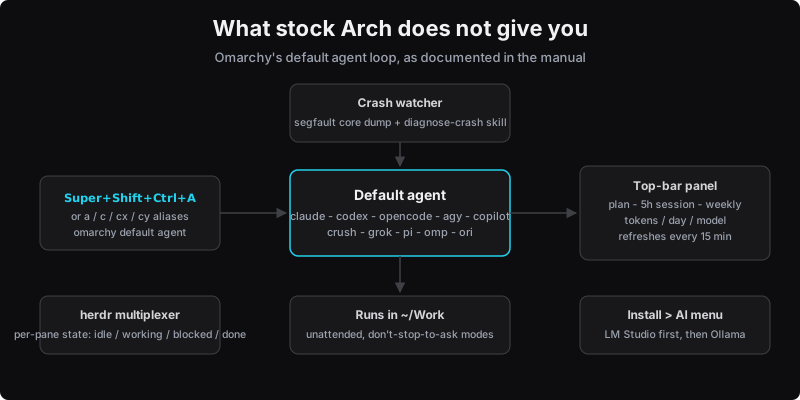
Omarchy’s stock agent loop: one shortcut launches the default agent from ~/Work, the usage panel refreshes on a 15-minute cycle, and crash watcher hands segfault core dumps to the default agent.
Under Install > AI, the manual recommends exactly two local runtime options, in this order: LM Studio first - “if you’re new to local models, I’d start with LM Studio” - then Ollama. No llama.cpp entry exists anywhere in the manual. The ChatGPT and Grok desktop clients sit in the same menu.
DHH’s own usage sits elsewhere. On The Standup with Theprimeagen podcast (August 22, 2026), he said his LLM workloads run in the cloud and that he almost never uses local LLMs anymore - an auto-transcribed quote, so paraphrased here rather than cited verbatim. The distro’s local-model menu is there for the audience, and the sizing question it raises - which hardware runs which model - is what tokenstead’s model pages and rig finder cover.
No ARM yet
Quattro is x86_64 only. A 6,600-line aarch64 pull request was closed in July 2026 because it predated the Quattro rewrite; follow-on work continues in the omarchy-iso repo. Community fills the gap: the Armarchy forks run Asahi-based builds on M1 and M2 Macs, and TensorFleet’s omarchy-cm5 builds Quattro images for Raspberry Pi 5 and CM5, with the AYN Thor handheld reported working.
Pending: the token announcement
On the Primeagen episode, DHH also discussed giving Omarchy “unlimited token budgets,” and the auto-transcript has him follow with a note about an upcoming announcement on “endless tokens for Omarchy.” Nothing had been announced as of August 31, 2026. The $12M close itself came with a letter from Yunjie Dai (“Unlike the App Store or Google Play, we take no revenue share from developers”) and a postscript from DHH that he has “changed my mind” on crypto and wants Omarchy to be “a great place for crypto.”
What it means for local AI developers
Omarchy makes the agent harness a setup decision and local inference a one-menu-item install. Point those harnesses at local models instead of API plans and you are editing the launchers yourself: the usage panel and plan-limit tracking assume Claude Code or Codex accounts, and no UI surface targets an LM Studio or Ollama endpoint. The foundation’s money so far lands on the compositor layer - Hyprland, Quickshell - and mise. Nothing yet funds local model tooling, so the runtime choice, and the hardware behind it, remain yours.