Meta asks your birthday for open weights mirrors ship freely
meta_description: “Meta gated the Muse Spark Open weights behind a form asking for legal name, birth date and organization. The same weights download free from three mirror repos, license kept the 20M clause.”
sources:
- https://x.com/elder_plinius/status/2110798024998113708
- https://huggingface.co/meta-models/Muse-Spark-Open-816B-A42B-NVFP4
- https://huggingface.co/meta-llama/Llama-4-Scout-17B-16E-Instruct
- https://dev.meta.ai/resources/blog/build-with-muse-spark-open
- https://www.unite.ai/metas-816b-parameter-muse-spark-open-weights-are-now-public/
- https://news.ycombinator.com/item?id=50107379
figures:
- /images/articles/spark-open-gate/gate-vs-mirrors.svg
- /images/articles/spark-open-gate/fit-ladder.svg
original-facts:
- Both Meta-run Muse Spark Open repositories on Hugging Face (the BF16 and the NVFP4 checkpoint) carry a manual gate with a custom identity form asking for full legal name, date of birth, and full organization name with corporate identifiers, and the form warns that it cannot be edited after submission
- Meta’s Llama 4 Scout and Llama 3.1 405B repositories also sit behind a manual gate, but their pages carry no custom form heading; the checkbox EULA era asked for a click, Muse Spark Open is the first Meta repo that asks for an identity
- The gate is per repository and already bypassed: Unsloth’s 21-file GGUF rebuild, three MLX conversions, and AMD’s Quark FP8 and MXFP4 checkpoints of the same 816B weights sit ungated with no form at all
- The form’s data goes to the Meta Privacy Policy under facebook.com, so the identity documents collected in exchange for open weights are collected by the ads company
- The Muse Model License dated October 15 permits open use and requires a “Built with Muse Spark Open” attribution, and any business whose aggregate gross revenue with affiliates exceeds 20 million dollars in any 12 month period from AI models as a service must notify Meta and sign a separate agreement, while internal use, research and ordinary products stay free
- The NVFP4 checkpoint weighs 484 GB, the useful community quant ladder starts at 209 GB (IQ1_M, two Spark nodes) and tops at 554 GB (IQ4_K_XL, above what the largest Mac Studio pools)
- Meta’s own page shows the open line did not die with Muse Wonder’s API-only debut: the weights are the flagship tier now, gated and attributed, three days after the closed flagship went up
TLDR: Muse Spark Open is an open source 816B parameter model from Meta that ships real weights under an open license. It enables running a frontier-class agentic model on your own hardware, with community quantizations from 209 GB up. The difference between Muse Spark Open and the Llama gates before it is that downloading now requires your legal name, date of birth and organization identifiers, while mirrors of the same weights ask for none of that.
On October 15, three days after Meta launched Muse Wonder as an API-only closed frontier model, the company published the weights of Muse Spark Open: 816 billion parameters with about 42 billion active per token, a million-token context window, native multimodal input, quantized checkpoints across NVIDIA, AMD, Intel and Apple silicon, day-one support in every major runtime. The release read as the answer to the question the October sweeps kept asking: is Meta out of the open-weight business?
The answer: Meta is in the open-weight business, and the tollbooth is new. Pliny the Liberator, the red-team researcher whose screenshots are usually about jailbreaks, posted one about paperwork instead: the Hugging Face download page for Meta’s own checkpoint asking for a full legal name, a date of birth, and an organization name with all corporate identifiers, with a warning that the form cannot be edited after submission and that failure to fill it can block access to other models on the platform. The reply that traveled underneath it wrote what the form means: open source that signs a liability form in your blood.
The gate is real and worth reading in full. Beyond the name, birth date and organization fields, the page states the information will be collected, stored, processed and shared under the Meta Privacy Policy under facebook.com, the same policy that governs the ads company. The manual gate flag on both Meta-run repositories (the BF16 master and the NVFP4 checkpoint) means access is decided by hand, per applicant, after the identity is on file.
The Llama line’s gates, including the current Llama 4 Scout and the 405B, are manual too, but their pages carry the stock Hugging Face checkbox, no custom heading, no fields. Click, agree to the EULA, download, and nobody ever knew your birthday. Muse Spark Open is the first Meta repository where the exchange for open weights includes identity documents.
The mirror test
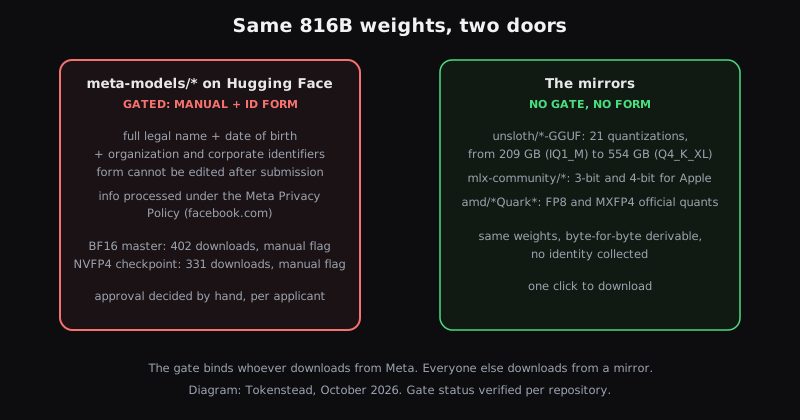
Every gate that has ever protected a model on Hugging Face is a per-repository permission, and Muse Spark Open’s gate is already a case study in what that is worth. The same 816B weights, byte-for-byte derivable, ship from three families of mirrors with no form at all: Unsloth’s GGUF rebuild across 21 quantizations, MLX community conversions in 3-bit and 4-bit, and AMD’s own Quark checkpoints in FP8 and MXFP4, all ungated at the time of writing. A researcher who does not want to hand Meta’s ads company a birth date downloads from a mirror in one click. The gate collects identity from whoever downloads from Meta’s repository; anyone who downloads from a mirror avoids the form.
The license, in plain terms
The Muse Model License dated October 15 grants the standard open set: use, copy, modify, fine-tune, distill, distribute. Two conditions carry the weight. Attribution: any product or service built on the weights has to display Built with Muse Spark Open in its interface or documentation. And the revenue clause: a business offering AI models as a service whose aggregate gross revenue with affiliates crosses 20 million dollars in any 12 month period has to notify Meta and enter a separate written agreement before including the model. Internal use, research and ordinary products that only use the model as a component stay free, and Meta takes no ownership of outputs.
That structure is Llama tradition (the community licenses carried similar clauses) and the HN thread’s sharpest comment named the real cost: the separate-agreement door lets Meta choose which inference providers compete to serve the model, and the visible effect has been less price competition, the pattern seen around Kimi K3’s serving terms. The open weights remain open for inspection; the serving market is negotiable.
Why the model matters anyway: the fit ladder
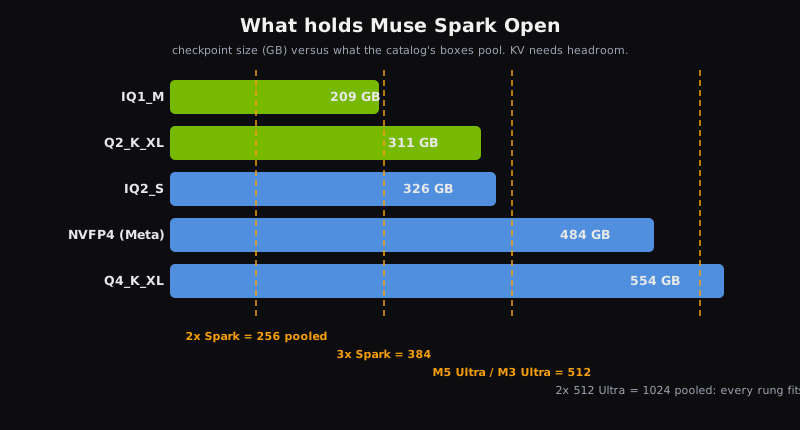
Strip the gate story and Muse Spark Open is still the biggest single open-weights release of the month, and its size ladder is exactly the site’s territory. The NVFP4 checkpoint weighs 484 GB: the 512 GB Mac Studio flagship holds it with a single-digit gap, and nothing below does. Unsloth’s quant ladder: IQ1_M at 209 GB, the two-node DGX Spark cluster’s territory; IQ2_S at 326 GB and Q2_K_XL at 311 GB, the three-node cluster or a 384 to 512 GB Mac; Q4_K_XL at 554 GB, which needs more memory than any single consumer box on the market pools today, a two-box flagship pairing or a wait for the next memory tier. MoE active-parameter math keeps the token rates sane: 42 billion active per token on the 42B-per-token architecture means serving speed is closer to a 42B model than an 816B one, on bandwidth that the Apple boxes and pooled Sparks carry.
The pivot this reveals
The clean story from Tuesday was that Meta’s open-weight era ended when Muse Wonder stayed API-only at 4 and 20 dollars per million tokens. Muse Spark Open says the truer story: the open tier did not close, it climbed. Meta now sells the closed frontier as a subscription and API, and publishes the flagship weights under a license with an attribution tag, an identity form at the download, and a revenue clause for the serving market. The doorman stands where the tollbooth used to. Whether the form is friction or funnel is the question every future Meta release will answer.
Related on this site: the Muse Wonder row covers the closed side’s pricing and the Full variant’s subscription lock; the Spark cluster and flagship build pages carry the ladder’s real prices; The modeldex page for weights and the memory ladder: /models/muse-spark-open-816b. The MXC containment piece covers what an agent running these weights should be fenced by.