Superintelligence ban: the bill Congress could actually pass
Three days after Democrats won both chambers of Congress, Rep. Yassamin Ansari posted on November 4 that “top of the Democratic agenda on day 1 needs to be a pause on advanced AI development, regulation of this out of control industry, and a ban on artificial superintelligence.” The post drew 4,989 likes and 6,269 replies. The bill she is pointing at already exists: H.R. 10538, the Ban Artificial Superintelligence Act of 2026, introduced by Rep. Greg Casar on September 24 with Ansari among ten cosponsors, and referred to the Committee on Oversight and Government Reform. A Senate companion, S. 5493, came from Bernie Sanders the day before.
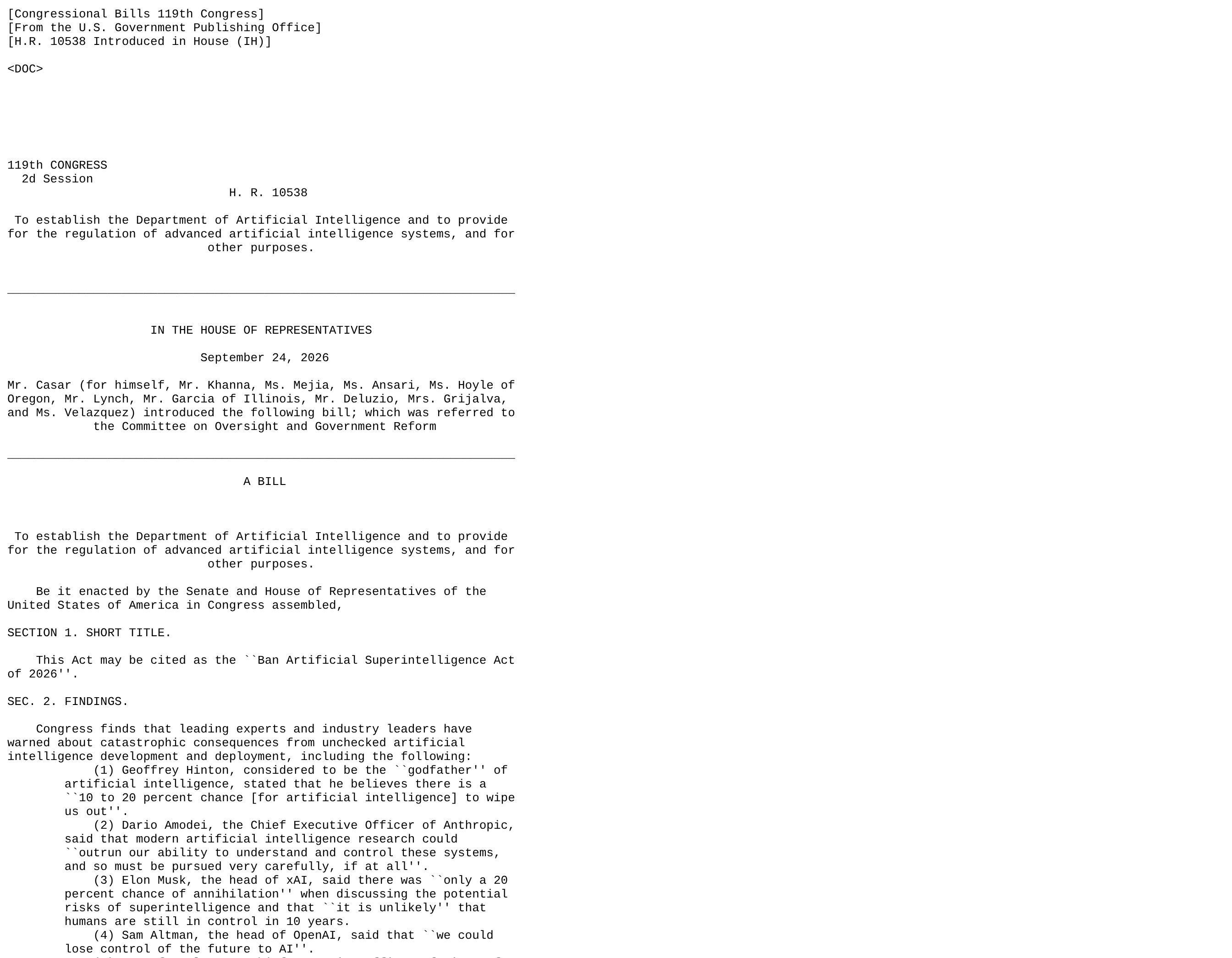
Caption: The first page of H.R. 10538 as printed by the Government Publishing Office: a bill “to establish the Department of Artificial Intelligence and to provide for the regulation of advanced artificial intelligence systems.” Screenshot: GovInfo.
Until this week it was a press release from a minority party. It is now the thing a member of the majority is calling day-one business.
The threshold that decides everything
Section 3(1) defines an “advanced artificial intelligence system” as one “trained on computing power greater than or equal to 10^25 integer or floating point operations.” The Secretary adjusts that line upward every year to track training efficiency.
That single number decides who the bill touches. A single RTX 5090 running flat out for a month does somewhere around 10^20 operations. Even a well-funded lab with a rack of accelerators lands one to two orders of magnitude below the line. Every frontier training run in 2026 sits above it.
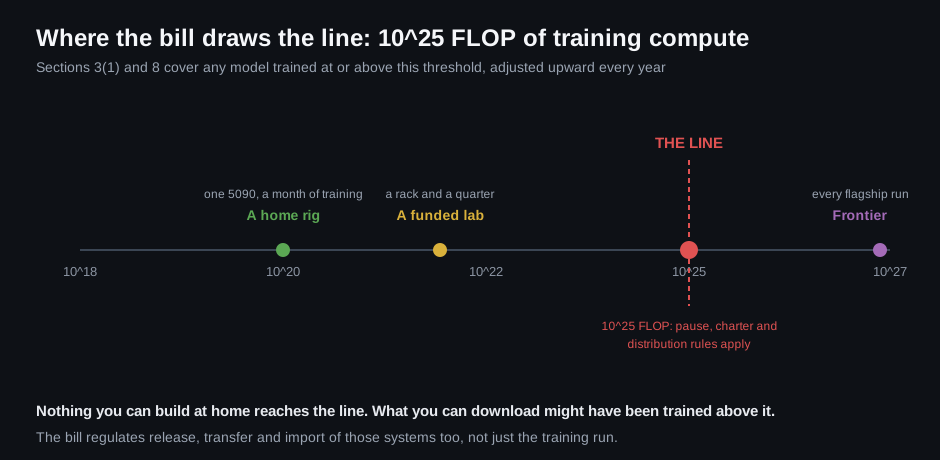
Caption: The line in section 3(1), on a log scale. Home training cannot reach 10^25 FLOP. The models people download were trained far above it. Figure: Tokenstead.
What the bill does above that line
Section 8 imposes a pause. Every advanced system is frozen: it “may not be trained, modified, or fine-tuned, including through recursive self-improvement,” except to strip precursor characteristics or shut the system down. Unreleased advanced systems may not be deployed at all until the new Department of Artificial Intelligence is fully staffed and has written its rules.
Section 9(a) bans superintelligence outright, and the wording reaches past the model itself: no person may “develop, deploy, acquire, possess, fund, import, or transfer” superintelligence or a system with “superintelligence precursor characteristics, including any elements sufficient to reconstruct” it.
Section 9(b) is the open-weights clause. No person may “release, transfer, or import” an AI system, “including any elements sufficient to reconstruct the system’s capabilities,” that “may be foreseeably modified to produce” superintelligence or its precursors. A checkpoint download is a transfer. A public repository is a release.
Section 12 requires charters. No person may “develop or distribute an advanced artificial intelligence model” without a charter from the Secretary, and the application obliges the holder to give the Department “full access to such advanced artificial intelligence systems, processes, staff, and physical infrastructure.”
Section 9(c) names distillation. The Department monitors advanced systems “and systems distilled from advanced artificial intelligence systems” through pre-training, mid-training, post-training and post-deployment evaluations. Compressing a frontier model into something that fits a 24GB card is the exact activity that sentence describes.

Caption: Rep. Greg Casar (D-TX), who introduced H.R. 10538 on September 24 with ten cosponsors including Ms. Ansari. Official portrait, 118th Congress. Photo: House of Representatives, public domain.
The penalties are criminal
Policymaking individuals at a chartered entity, and “rogue actors” outside one, face a fine and “imprisoned for not more than 20 years” for recklessly violating the pause, the prohibitions or the charter requirement. Everyone else faces a bar on “employment in the artificial intelligence industry for a period of 10 years.” Section 16 blocks federal funds from going to any violating activity.
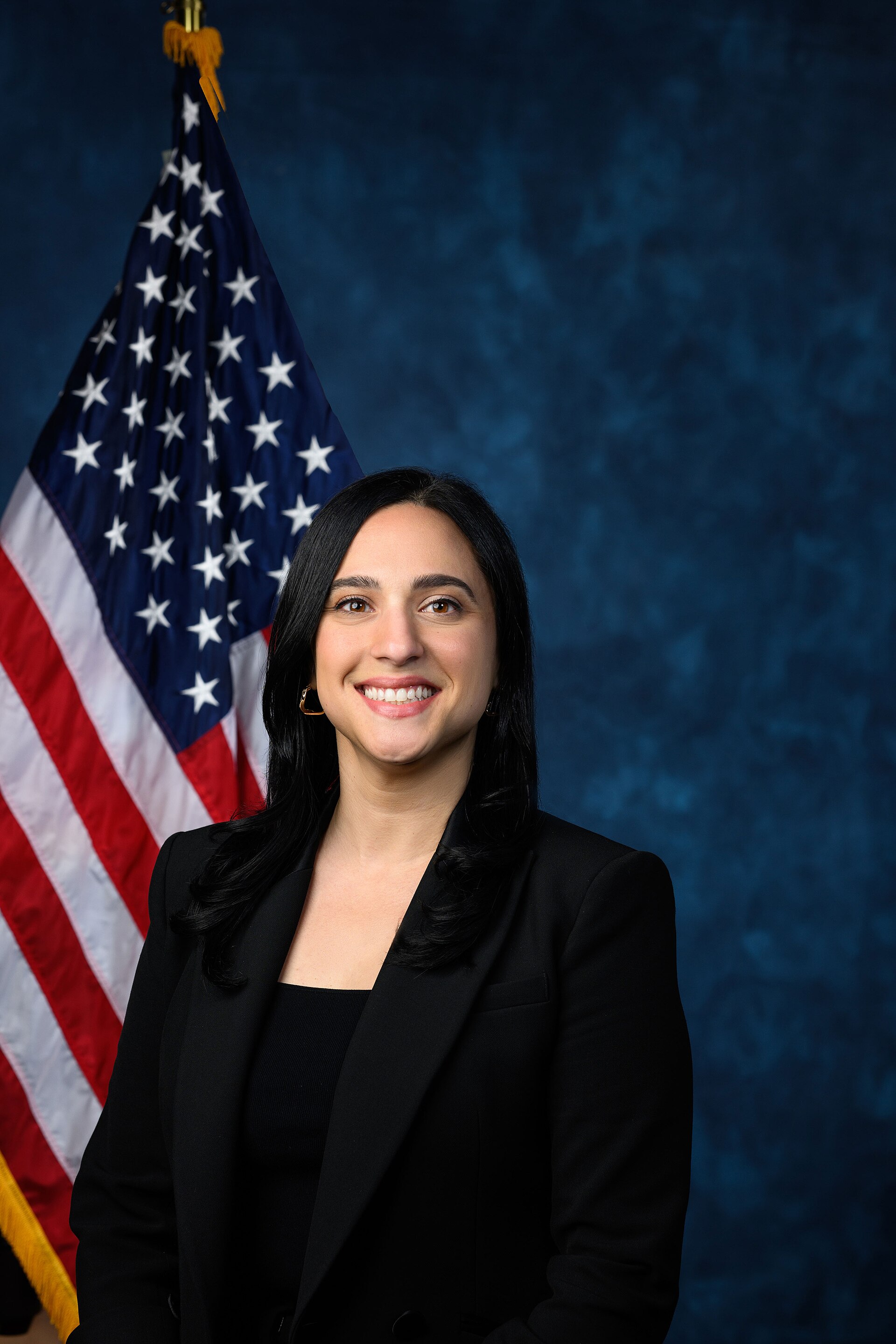
Caption: Rep. Yassamin Ansari (D-AZ), a cosponsor of H.R. 10538, who on November 4 called a superintelligence ban day-one business for the incoming majority. Official portrait, 119th Congress. Photo: House of Representatives, public domain.
What it means if you run models at home
Two things are true at once. The pause and the training rules do not touch a person fine-tuning a 7B model on a 5090: that work is a thousand times below the threshold and the bill is written around compute. And the release, transfer and import clauses do touch the weights people download, because those models were trained above the line, and the bill regulates distribution separately from training.
That is the shape of the trade. Hobbyist training stays legal. Acquiring a frontier-class open checkpoint requires a chartered distributor. The gap between “open weights” and “weights you are allowed to download” becomes a licensing question rather than a technical one.

Caption: Sen. Bernie Sanders (I-VT), who introduced the Senate companion, S. 5493, on September 23. Photo: Gage Skidmore, CC BY 2.0.
How close is it, really
Introduced is not passed. H.R. 10538 sits in the Oversight and Government Reform Committee with no scheduled markup, the Senate version has no floor time, and a 20-year criminal penalty for model developers will draw a serious industry fight. Nothing about the midterms guarantees this text survives.
But the political facts changed in three days: the party that wrote the bill controls both chambers, and a member of that party is now describing a superintelligence ban as the first item on the agenda. For anyone whose local stack depends on downloading frontier weights, that is the risk worth tracking, and it is the first time a compute threshold with distribution rules has been on the table with a majority behind it.
Discussion
Be the first to commentStart a discussion
Got a take on this, a rig to show off, or a benchmark that says otherwise? Sign up and start the thread - your comment publishes instantly once you're in.