AI firms, ordinary bankruptcy: Congress opens the no-bailout file
House Democrats introduced a resolution on October 28 that Congress should refuse “additional funds or exceptional regulatory support to companies or financial institutions facing insolvency or financial collapse due to exposures to acute stress within the artificial intelligence market.” Rep. Greg Casar (D-TX), chair of the Progressive Caucus, and Rep. Maxine Waters (D-CA), in line to chair House Financial Services, co-authored the seven-page measure, obtained exclusively by The American Prospect. It is a nonbinding “sense of the House” resolution: no Senate vote, no president. What it does is put the question of who eats the loss on the record before the crash, not after it.
Caption: The US Capitol at sunrise, October 2023. The resolution is a marker, not a law; the vote Casar wants comes early next Congress. Photo: Wikimedia Commons, public domain.
The numbers that scared Congress into pre-negotiating
The resolution arrived three days after Anthropic’s S-1 prospectus made the industry’s debt structure public for the first time. The filing shows H1 2026 revenue of $16.3 billion, roughly fifteen times the year-ago figure, against a net loss of $80.7 billion, of which about $72.4 billion is a non-cash fair-value change on convertible notes. The operating loss was $693 million. Those are the numbers a casual reader saw; the number Congress noticed was different.
Between $518 billion and $807 billion: that is Anthropic’s planned obligations over the next decade to power and run its models, depending on how you count, and roughly 80 percent of it cannot be canceled and is owed “regardless of actual usage.” The counterparties are the industry’s own suppliers. Broadcom holds $161 billion of it, Google $111 billion, Amazon $110 billion, Nvidia $86 billion, Microsoft $31 billion. For every dollar Anthropic earned in 2025, it owes between $113 and $200. It owns no data centers; it leases power inside a landscape owned by the entities financing it.
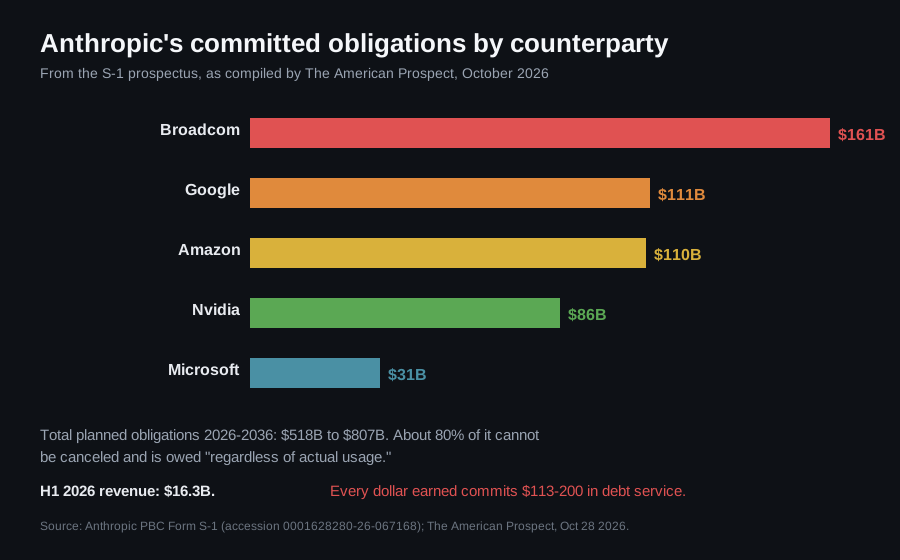
Caption: Anthropic’s committed obligations by counterparty, from the S-1 as compiled by The American Prospect. The five creditors are also the industry’s five suppliers. Figure: Tokenstead.
OpenAI’s structure is the same shape with different numbers: roughly $400 billion and more in leased commitments across Stargate, Oracle ($300 billion over five years), CoreWeave, SoftBank, and Microsoft, on top of a $122 billion raise in March 2026 whose investor list includes Amazon ($50 billion) and Nvidia ($30 billion). Nvidia’s total announced commitments across the sector passed $530 billion in October, and the company defends the pattern publicly: it invests in the customers who then buy its chips, sometimes with financing it helped arrange alongside Apollo, BlackRock, Blackstone, and Brookfield. The resolution’s language calls this out directly: AI firms “hold trillions of dollars in debt, much of which is raised in opaque and unregulated private credit markets,” and data-center borrowing “are multiples higher than projected revenues.”
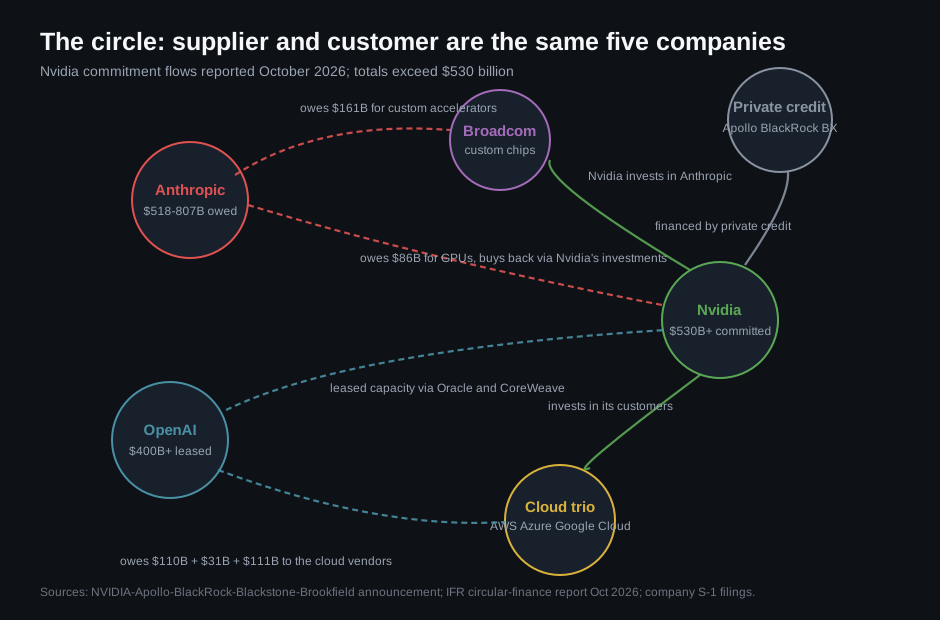
Caption: The circle as disclosed: Nvidia sits on both sides of its customers’ balance sheets, Anthropic’s creditors are its suppliers, and private credit funds finance the vendors. Figure: Tokenstead.
What the resolution actually says
The seven pages spend their opening on 2008: the “profit-driven financial risk-taking, fueled by Wall Street’s speculative fervor,” the near-10 percent unemployment at the trough, the decade-long weak labor market, the bailouts that rescued institutions while workers and homeowners absorbed the damage. The operative section then commits Congress to refuse rescue funds or “exceptional regulatory support” for insolvent AI-related firms or banks exposed to them, and to route any failure through the ordinary bankruptcy process: wind down or reorganize, in ways that support workers, consumers, and pension and retirement fund holders, with competition preserved.
Two sentences carry the accountability teeth. Senior executives found to have taken excessive risk or acted unlawfully “should be held fully accountable under civil and criminal law,” with disgorgement of ill-gotten gains. And where government does act, the resolution says it should backstop workers, not executives: fiscal stimulus, job creation, retirement-fund protection, automatic stabilizers that fire immediately if a collapse starts.
Casar’s framing to the Prospect was blunter than the document. “Many of us, myself included, came into political life watching as many people who caused the crisis in 2008 or cheered it on weren’t held accountable,” he said. “We know that the American people were appalled at these Wall Street executives nearly two decades ago, and they’re even more pissed off at these tech oligarchs today. We shouldn’t be trying to make them whole.” Waters, in an emailed statement: “Big tech and Wall Street are taking enormous risks with billions in borrowed money to fuel the AI boom, despite growing warning signs of a dangerous bubble. We cannot let history repeat itself.”
Caption: Rep. Greg Casar (D-TX), Progressive Caucus chair and resolution co-author, official portrait, 118th Congress. He wants a floor vote early next Congress to force members on record. Photo: House of Representatives, public domain.
The timing: a marker dropped into a falling market
The resolution did not land on a calm tape. Nvidia is down about 12 percent from its high as of October 27, with the week’s selloff dragging the whole complex. CoreWeave, the Nvidia-backed neocloud, has lost close to half its value in a month, and its three co-founders have cashed out over $3 billion in stock since the IPO. The resolution itself cites AI stocks as responsible for as much as 75 percent of S&P 500 returns since October 2022, a price-to-earnings ratio near the 1990s tech-bubble peak, and an Nvidia market capitalization near $6 trillion, roughly 16 percent of US GDP.
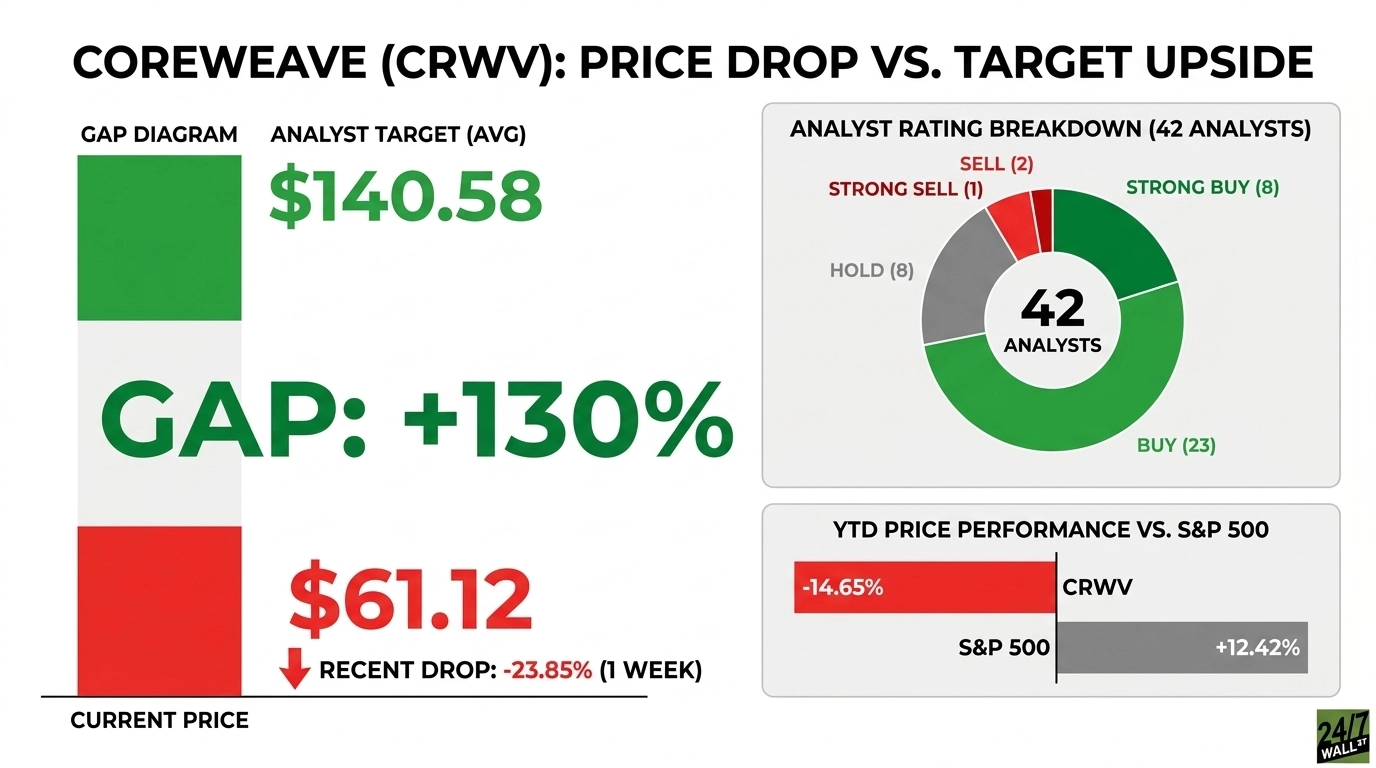
Caption: CoreWeave’s month: down 23.85 percent in a week and 14.65 percent year to date against an S&P up 12.42 percent, with 42 analysts still averaging $140 targets. Figure: 247wallst.com, October 2026.
Anthropic is the resolution’s centerpiece example and its IPO is next month. Casar’s own line on the prospectus: “It should be a wake-up call to all of us that we’re sitting on top of a bubble.” He also wants transparency first: “Before any of these companies should be going public, we need financial transparency across the entire ecosystem.”
What it means for the local argument
Read the resolution as a statement about the loss surface. The parties exposed to an AI downturn are the firms with the leveraged compute obligations and the investors holding their private credit: the labs, the hyperscalers guaranteeing them, the chip vendors financing their buyers, the neoclouds between them. Nothing in that chain describes a company running a 70B model on its own hardware against its own data. Local inference has no data-center debt against future revenue, no counterparty to default into a circle, no collateral clause. It is the one position in this market that is unlevered.
That is the practical read for buyers and builders: when Congress starts pre-negotiating bankruptcy mechanics for the labs, the risk has migrated from a question to an assumption. The resolution is nonbinding and a minority-party marker, and it may never get a floor vote. But the debt numbers it responds to are contractual, disclosed, and uncancellable, and they live in filings that now exist. The bet those contracts encode is that inference stays expensive and centralized enough to service $518 billion to $807 billion of obligations. Running the weights yourself is the position that pays off if the bet fails.