Tencent’s Hunyuan team just released the thing that used to cost a call-center: Hy-SimulMT, a 30B MoE (3B active) that interprets speech the way a human simultaneous interpreter works - listening while you talk, streaming the translation as text and speech in your own voice - and it went out under Apache 2.0 last night with weights, quantized builds, an inference server, and training tools all public on the same day.
The timing matters because simultaneous interpretation has been the one translation job that stayed expensive. Turn-taking translation (wait for the sentence, translate it) is solved; the interpreter’s skill is the stream: starting to speak the Chinese while the English sentence is still arriving, without the meaning collapsing. Hy-SimulMT’s card puts a number on that trick: about 3 seconds of latency (StreamLAAL) on long-form audio, the lowest of every system compared - open-source or commercial - while its GEMBA quality score beats open-source peers and four of five commercial APIs.
What “simultaneous” changes for the caller
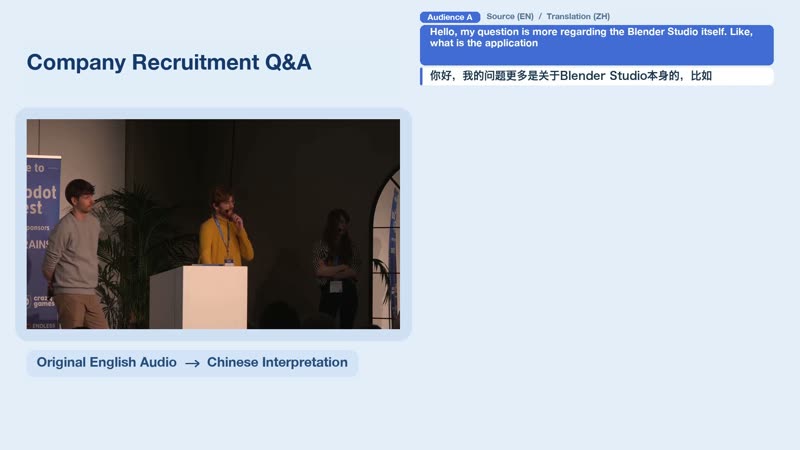
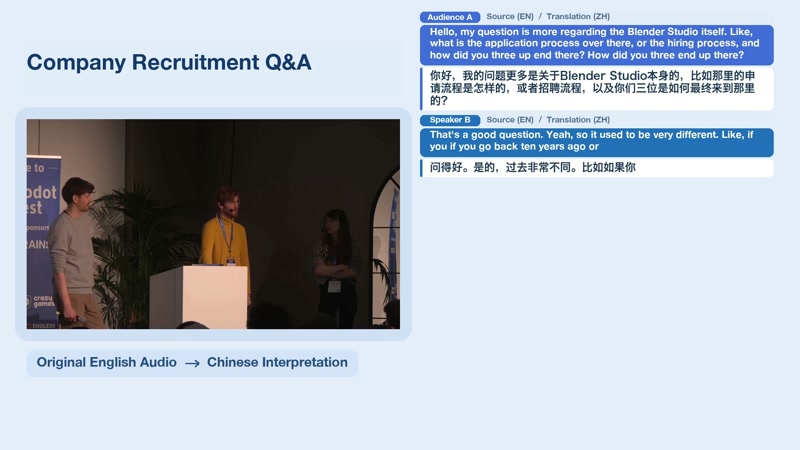
A live Q&A makes the difference vivid. The demo video runs a two-speaker exchange - audience questions in English, answers back - and both directions get captioned in the other language mid-sentence: the question about an app’s hiring process is half-translated before the asker finishes it, and the panelist’s reply streams back into Chinese in the same box. That is an interpreted meeting on one GPU.
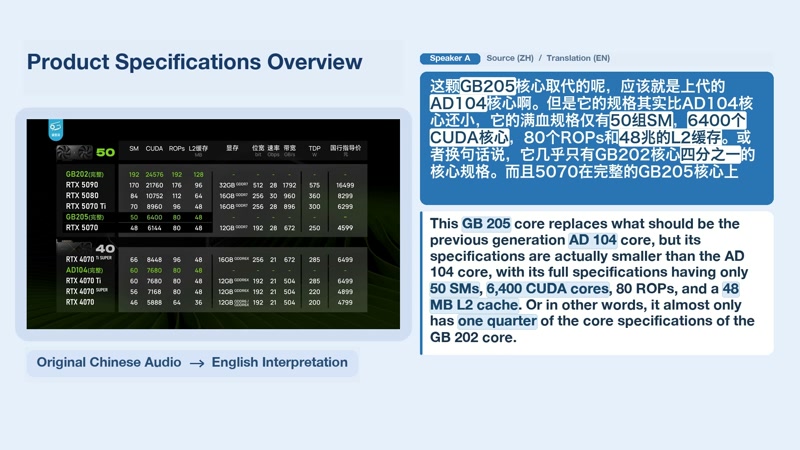
The party trick that is actually load-bearing: real-time voice cloning. The translated speech comes out sounding like the original speaker, which is what makes broadcast interpreting usable - a speaker’s voice carries authority that a generic TTS voice throws away. A hardware briefing demo shows the second half of the appeal: a Chinese-language slide deck about GB205 silicon streams into English as the presenter talks - chip specs, CUDA-core counts and all - which happens to be exactly the kind of meeting where the terminology usually breaks human interpreters too.
The engineering shape
Three components ship at once: the model (six repos in one day - base and Interleave variants in BF16, FP8, and GGUF), SimulInfer (the inference service, running on vLLM 0.31+ with the HYV3ForCausalLM arch), and SimulTrain (the training tools - the part that says Tencent expects others to fork this for their language pairs). Speech output and the voice-clone channel require a separate TTS service; text-only streaming runs on the model alone.
The size is the deployment story. A 30B MoE with 3B active per token is a strange, clever spot on the curve: the resident weights are a 24GB-GPU-class model (4-bit fits one card), but the per-token compute is 3B-class, which is what lets it keep pace with a speaker in real time without an H100. There is no streaming ASR stage to bolt on; the audio goes in as audio.
Why this particular release matters to us
The site has covered the local-voice wave (Dessa’s full-duplex S2S, Voxtral’s transcription family, realtime voice APIs both open and closed), and the interpreter tier was the missing bracket: everything shipped so far either transcribes or takes turns. Hy-SimulMT is the first open model whose job description is the conference booth, and Apache 2.0 means the interpreted-meeting product built on it costs weights plus a GPU - for teams that today pay per-minute interpreter rates or subscription API floors. The caveat list from the card is honest: the speech demos have their playback timing caveats (offline replays, not live latency measurements), the simultaneous mode is Chinese-English bidirectional while the other 35 languages ride the text path, and TTS quality is yours to configure.
Sources: the Hy-SimulMT model card (benchmarks, RealSI evaluation, language list), Tencent Hunyuan’s release announcement (Oct 26), the demo videos from the official repo (frames quoted above, Apache 2.0), HF repo stats for the six-repo day-one picture.
Related on this site: Dessa covers the full-duplex S2S research tier; Voxtral 3 is the transcription family (weights pending); the modeldex carries the rest of the Hunyuan family.===