Anthropic just filed the paperwork to become a public company, and the internet did the thing the internet does: screamed “$80 BILLION LOSS” (TheInsiderPaper’s version: 4,630 likes in hours). I pulled the actual S-1 from SEC EDGAR tonight. The scream is true. It is also an accounting mirror, and the filing itself contains the number the screaming crowd never mentions: an operating loss of $693 million.

The headline pair, from the filing itself
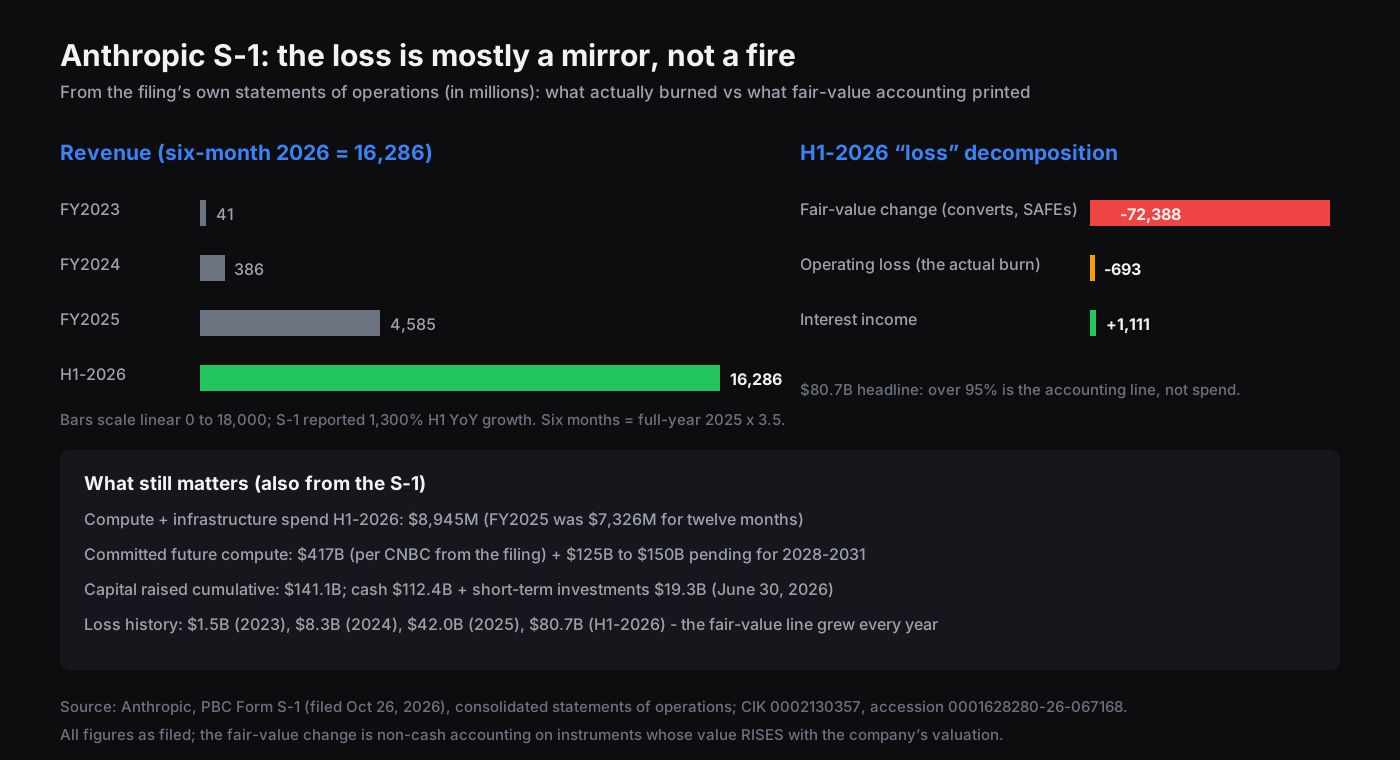
The document (Anthropic, PBC, a Delaware public benefit corporation, CIK 0002130357, applying to list Class A shares as ANT on Nasdaq) reports revenue of $16.3 billion for the six months ended June 30, 2026, against a net loss of $80.7 billion. Five years of revenue history, straight from the statements of operations: $41 million in 2023, $386 million in 2024, $4.6 billion in 2025 - and 16.3 billion in the first HALF of 2026. The filing says the phrase the press release would never survive: “We do not expect our revenue will continue to grow at comparable rates.”
Why the loss is (mostly) a mirror
The decomposition table in the filing is the whole story: the -$72,388M line is “change in fair value of convertible notes, derivative liabilities, and SAFEs.” A convertible bond is a loan where the investor may take a discount on shares instead; accounting rules park it on the balance sheet as a liability, and when Anthropic looks like it will be worth MORE, the liability gets marked UP - and that markup flows through the income statement as a loss. No money moved. No server was rented. The filing’s own paradox: the better Anthropic’s prospects, the bigger this number prints. The -$693M operating loss (the part that involved actually spending more than selling) comes with +$1.1B of interest income earned off the war chest - a net OPERATING picture roughly break-even-ish by IPO-standards absurdity.
None of this means Anthropic is healthy. It means the headline number is measuring valuation change, not burn. The burn is in the next line: $8.9 billion of compute and infrastructure spend in six months - more than the $7.3 billion all of last year - and commitments CNBC totals from the filing at $417 billion of delivery obligations starting 2026-2027, plus $125-150B still being negotiated for 2028-2031. THAT is the number the business has to survive.
The filing’s quieter confessions
Three details in the risk section matter more than the loss line. First: model versions released in the six months to September accounted for over 80% of Q3 revenue - the business cannibalizes itself with every release cycle, and each new model has to out-earn the one it replaces. Second: the filing flags two high-profile disputes with the US government, with CNBC’s summary warning of “material revenue losses” from administration actions. Third: the raise size, share count, and price range are BLANK in this filing - the $2-trillion valuation everyone quotes is press-reported, not filed, and the listing-by-Thanksgiving timeline is a rumor wearing a suit.
The local-AI angle, honestly stated
Anthropic’s own revenue disclosure is a demand signal: $16.3B in six months, mostly (per the filing’s revenue table and CNBC) from businesses putting Claude and Claude Code into production. Two responses coexist. The public one: enterprises are voting with budgets that rival labs need public-scale capital to match - Axios’s Dan Primack reads the whole filing as “using public markets to finance compute spending.” The countertrend this same week: NVIDIA’s $2,000-per-GPU agent-software fee story (our piece), open RAG stacks landing as weights, and an exploit-driven hardware patch wave - each subtracting one reason to keep the per-token habit. Both can be true at once: the cloud labs are winning revenue at a scale nothing else in software has matched, and the margin-elastic edge (the workloads that CAN leave, are leaving) is where our catalog lives. What the S-1 settles for good is that “nobody’s actually paying for AI” is no longer a defensible take. The open question it can’t settle is whether $417B of committed compute can be amortized by a customer base concentrated by design - Anthropic’s revenue concentration is in the enterprise, and ours is a catalog for the edge of the market that wants out.
The honest scoreboard today: the biggest AI IPO in history by reported size, filed the same week its competition got public scrutiny for refusing to debloat a TV, its rival’s software fees being priced per-GPU, and the open-weight week that gave away an entire retrieval stack. Anthropic priced its future in all of it. The market will answer by the lock-up calendar CNBC’s headline already tracks.
Sources: Anthropic, PBC Form S-1 (SEC EDGAR, filed Oct 26 2026, accession 0001628280-26-067168 - all financial figures quoted from the filing’s consolidated statements of operations and notes), CNBC’s live filing coverage (Oct 26), The Register and TweakTown for market context, TheInsiderPaper’s Oct 26 post for the viral framing (4,630 likes).
Related on this site: NVIDIA’s $2,000/GPU software fee is the cost-side mirror of this filing; the Claude Code refusal net documents the product side under scrutiny; the model catalog is where the fee-free option lives.