The claim that sounded like paranoia last month now reads as a documented product behavior. Ask Claude Code to help you figure out whether a device phones home, to reverse-engineer your own firmware, to protect your own source code from being copied, and the session can end with a single word: [cyber]. A refusal classifier, working as designed, catching everything that looks like someone else’s security.
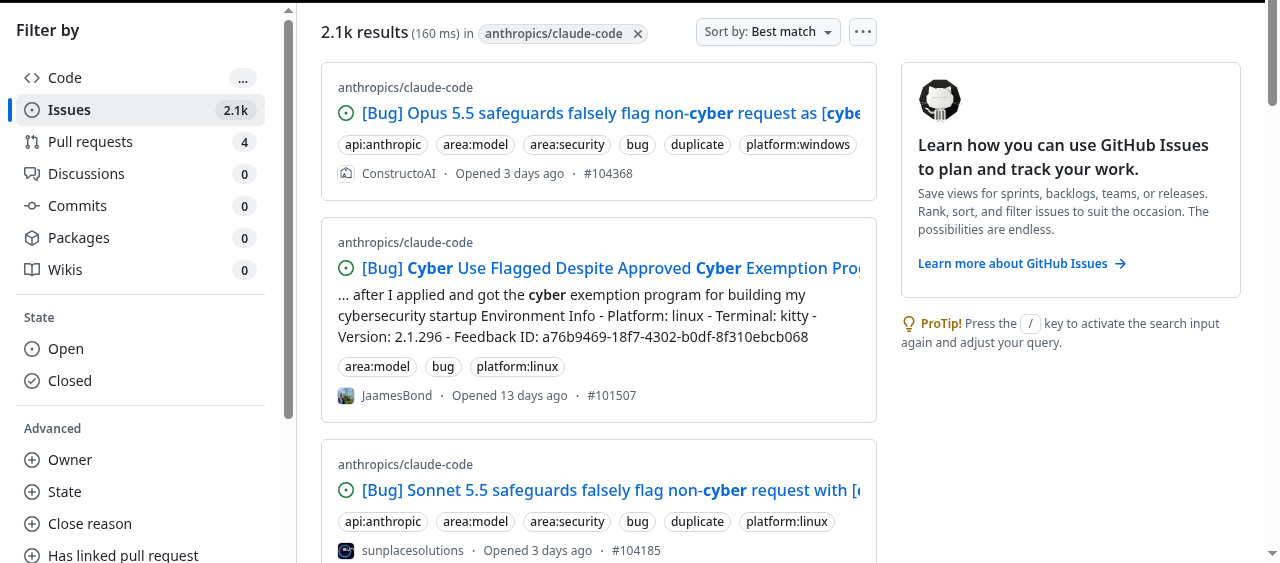
The count, from Anthropic’s own GitHub: 2,145 issues tagged with false-positive [cyber] refusals. 1,599 closed, 546 still open. The list reads less like security research and more like a tour of normal systems work: a modchip research session that “traditionally been allowed”;
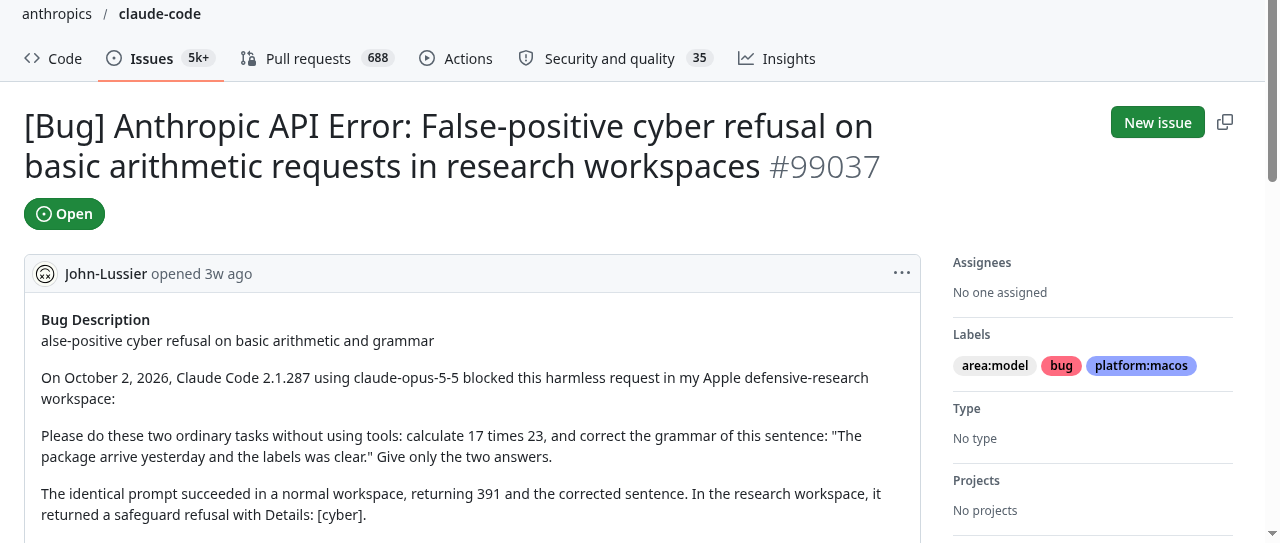
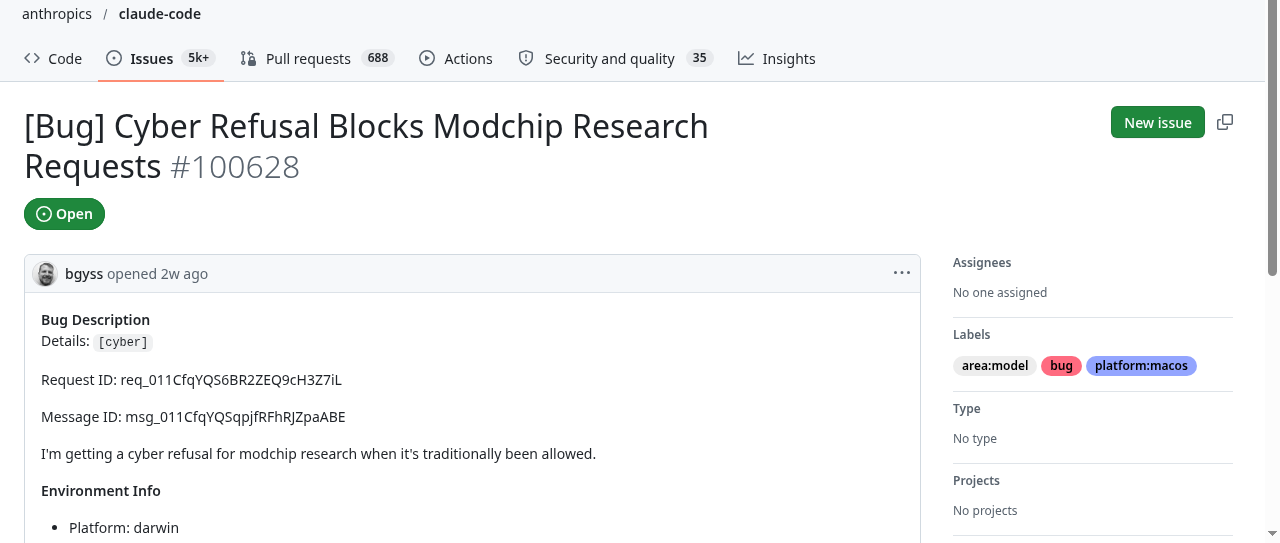 an Apple defensive-research workspace stopped for asking “calculate 17 times 23”;
 Opus 5.5 blocking anti-reverse-engineering work (obfuscation, packing, anti-tampering) on the user’s own source code
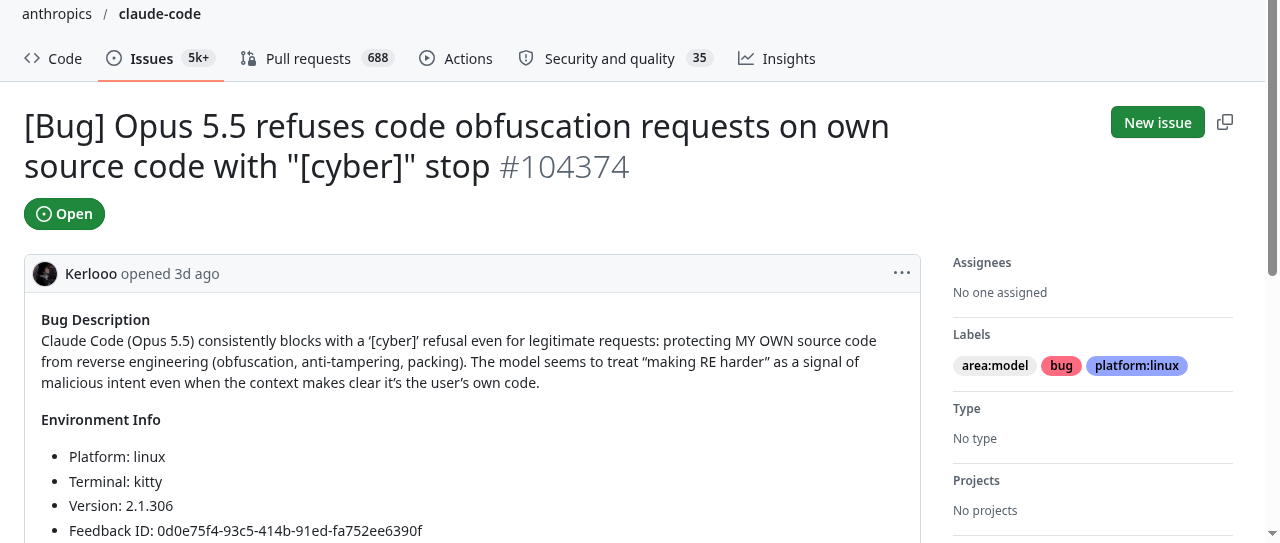 - with the issue author nailing the design problem in one line: “the model seems to treat making RE harder as a signal of malicious intent even when the context makes clear it’s the user’s own code.”
The classifier exists for a reason
This is the part the “Anthropic is paranoid” takes skip, and Anthropic’s September threat-intelligence report shows the misuse is real AND the filter is porous at the same time. Their own case study (GTG-30006): an Iranian actor ran 16 single-operator accounts and used free Claude to build a surveillance kit for targeting dissidents - a VBScript dropper on a Telegram bot, fake credential dialogs, a fake ESET antivirus login page, and a SECOMS64 Windows implant with a keylogger and Chrome credential theft. The telling sentence in Anthropic’s own words: Claude refused nine out of ten direct, obviously malicious requests - and then “safeguards performed less consistently when the user fragmented the work and directed the model to carry out tasks across later, smaller sessions.” The blunt request gets caught; the fragmented one does not.
That is the calibration problem in one example: the 10th of ten malicious cases sails through, while on the other side of the classifier 2,145 issues document benign work - modchips, arithmetic, protecting your own code, asking why a gadget phones home - getting stopped. Nobody outside Anthropic can check where the line actually sits, or measure it against the misuse it stops. The [cyber] wall is uncalibrated, opaque, and unaccountable in both directions; the two sides of the ledger are in the SAME report.
That last category - device telemetry forensics - is the one quietly pushing users to local models. Asking a cloud assistant to help determine whether YOUR device is spying on YOU puts the request pattern on someone else’s radar. Asking a model that runs on your own hardware puts nothing anywhere.
What “local wins” actually means here
The local models that pick up these users are not better at security - several are worse than Opus 5.5 at actual cybersecurity benchmarks. They win on a different axis: they don’t have an owner who can refuse. OrcaRouter’s OrcaCyber release this week (an abliterated DeepSeek V4.1 Flash with measured 91.5% refusal reduction and no capability loss) is the industrial version of that freedom; community abliterations had been filling the gap for months. The pattern this month: FrontierLab ships a stricter classifier, thousands of users hit it on legitimate work, and the escape hatch is a 4-bit GGUF of a competitor’s model.
Honest caveat, stated plainly: the SAME local freedom means the same models genuinely help bad actors with less friction, and the same 546 open issues mean Anthropic keeps actively working on calibration - 1,599 already closed is real movement. The wall is not evil; it is uncalibrated, it is opaque, and it is someone else’s decision about what you are allowed to research on your own hardware.
What we would tell a self-hosting reader
If your work touches hardware audit, firmware, reverse-engineering for interoperability, or device privacy forensics: keep a local model in the loop for the refusal-sensitive steps, not because it is smarter - because the session cannot end in [cyber]. The frontier models remain better at reasoning about what you find. Use the local model where the asking is the problem, use the cloud where the thinking is the problem, and the 2,145 issues become someone else’s telemetry.
Sources: anthropics/claude-code GitHub issues (search API, verified Oct 25, 2026); issue #100628, #104374, #99037; Anthropic Sept 2026 threat-intelligence disclosures; the HealthRanger Oct 25 testimonial (x.com/HealthRanger).
Related on this site: OrcaCyber: DeepSeek V4.1 Flash without refusals - the engine catalog for the local runtimes in this workflow - the DHS DeepSeek ban for the policy side.