TLDR
Anthropic’s Claude startup program gives founders a year of Claude Team, a 1,000 dollar API credit, and office hours with the Applied AI team. The addendum behind those office hours says Anthropic can use whatever general ideas its staff remember from them for any purpose, including building similar or competing technology, and nothing in the document restricts it from doing so. The same company’s commercial terms prohibit customers from building products that compete with Anthropic. Anthropic reserves the right to compete with customers, and the same terms bar customers from competing with Anthropic.
What Anthropic announced, and what took effect the same day
On October 6 Anthropic expanded the Claude Startups program: a year of Claude Team for up to five seats, a one-time 1,000 dollar API credit, partner offers worth up to 45,000 dollars at list price, and virtual office hours with the Applied AI team. CNBC carried the announcement with a quote from the program’s head: “Startups are often the first to push Claude to its limits… Claude Startups gives founders credits, tools and direct time with our team.” Thousands of companies already participate, and eligibility stretches to any company founded within five years or funded within two, so the population signing up is about the least-lawyered group in the software market.
The Claude Startups Additional Benefits Addendum took effect the same day. Every office hours session, every partner benefit, every promotional credit runs through it. Applying to the program is the acceptance mechanism; the Startup Program Official Terms say participation “by applying to and/or participating” binds the company, and the addendum binds anyone who so much as views the benefits pages.
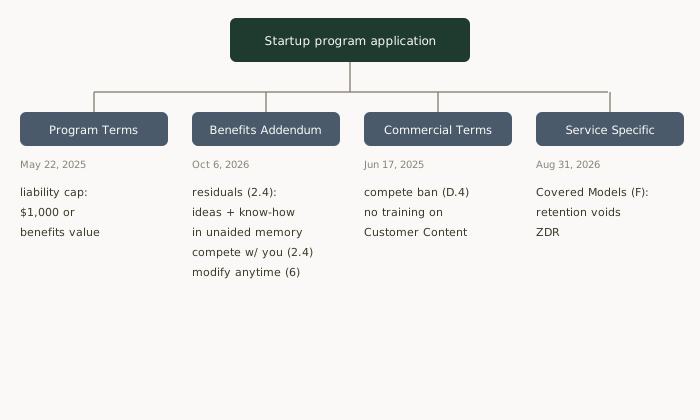
Caption: one application, four documents. The clauses the thread quotes live in three different ones, and none of the four defines the term its protection depends on.
Section 2.4, read in full
The clause everyone is quoting is real. Under “Applied AI Office Hour Benefits”:
Anthropic may use, for any purpose and without obligation to you, any information, ideas, know-how, and techniques of a general nature retained in the unaided memory of Anthropic personnel who had access to your Confidential Information (“Residuals”). This Section does not grant a license under your patents or copyrights or permit disclosure of your Confidential Information itself. You acknowledge that Anthropic serves many customers, may independently develop similar or competitive technology, and may assign the same personnel to other customers, and nothing in this Addendum restricts Anthropic from doing so.
A residuals clause with an unaided-memory carve-out is standard consulting-contract furniture; clause libraries document the pattern. Your patent stays yours, your copyright stays yours, and Anthropic cannot disclose the documents you shared. What walks out of the room is everything the protection does not name: product direction, the gap in the market your roadmap implies, the architecture you chose and why. None of that is a patent or a copyright. “General” carries no definition, and “Confidential Information” carries no definition either; we read both documents end to end looking for one and found none. A founder relying on that protection is relying on a term whose scope is never written down.
Section 2.4 says Anthropic may independently build similar or competing technology. Section D.4 of the Commercial Terms, which binds every customer whether or not they joined any program, says a customer may not build a competing product or service using the Services, “including to train competing AI models.” Anthropic reserves the right to compete with you; you agree not to compete with Anthropic; the application form accepts both terms at once.
The data terms underneath, and the part that voids ZDR
Two more clauses belong in the same read because applicants accept them in the same flow. The Covered Models section of the Service Specific Terms (effective August 31) lets Anthropic “retain and perform safety reviews on Inputs, Outputs, and other data” for any model it designates, and states that this “supersedes any modified retention commitments (e.g., ZDR).” A startup that negotiated zero data retention with an investor’s compliance checklist in hand keeps it only until Anthropic designates the model those conversations ran on. Zed’s documentation confirms the designation binds everywhere the model is served, through any platform; you cannot route around it with a different key. The no-training commitment survives, but the retention commitment does not.
The modification clause closes the loop. Section 6: “Anthropic may modify this Addendum, at any time without notice or liability.” The Program Terms cap Anthropic’s total liability at “the actual value of Program Benefits awarded to you or $1,000, whichever is less.” Whichever is less of a 6,000-dollar subscription and a 1,000-dollar credit is 1,000 dollars, less than most founders bill in a week of consulting the idea that was shared.
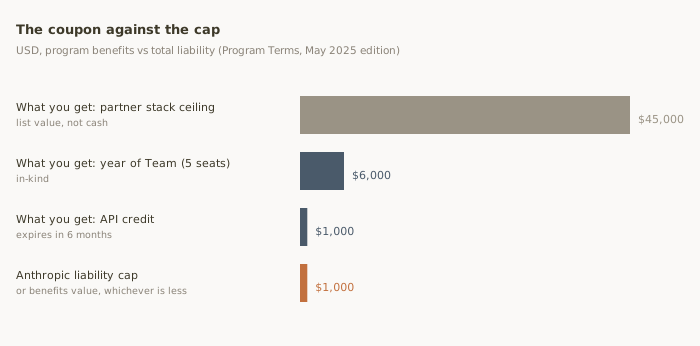
Caption: the coupon against the cap. The API credit and the liability limit are the same number: 1,000 dollars.
The spread, measured
The critique traveled faster than the program did in its first month. The thread that named the clauses (Rich Stureborg, October 6, section numbers and both source links in the post) drew 691 likes and 81 quote posts within a day. By the next morning, uncited paraphrases were outperforming the original on reach-per-claim: “some terms may give them rights to use submitted ideas… consider using a personal account instead” passed 210 likes. That advice is not supported by anything in the four documents; the residuals clause attaches to Anthropic personnel who access your confidential information, not to which account sends the prompt, and the Covered Models retention override binds wherever the model is served. The paraphrase spread despite not matching the documents.
By the afternoon, X’s own Grok assistant was fielding terms-explainer replies in the thread, quoting the program structure back to whoever asked. Startup Fortune ran the full clause-by-clause read on October 7 and concluded the offer is “too small and the terms too one-sided for a program aimed at the least protected companies in the market.” CNBC’s announcement coverage the day before did not mention the terms.
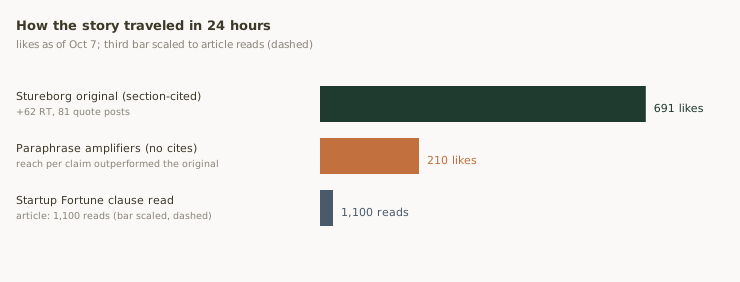
Caption: how the story traveled in 24 hours. The paraphrases reached half the original’s audience without citing a single clause.
Does this cover your code and prompts? The part Anthropic does protect
Founders ask whether Anthropic reads their code and copies their idea. The documents say something narrower, and it is worth knowing exactly which protections hold. The Commercial Terms state that the customer “retains all rights to its Inputs, and owns its Outputs”, and that “Anthropic may not train models on Customer Content from Services.” That commitment is the strong one in the stack: your prompts, your source code, the documents you paste, none of it goes into training data, on any account type, including the startup program.
What section 2.4 adds on top is not a license to your code and not a training right. It is the consulting-contract classic: what a person who saw your work can later do from unaided memory with “general” ideas and techniques, on a term where neither “general” nor “Confidential Information” is defined in any of the four documents. A specific algorithm pasted into a prompt is your input and stays untrained-on; the architectural judgment the same session teaches an Anthropic engineer is memory, and section 2.4 walks it out the door. Section 2.4 reserves the second half for Anthropic in advance.
The Covered Models clause sits between the two on data retention: for designated models (Fable 5.1 ships designated, per Zed’s own privacy documentation), Anthropic may retain and safety-review inputs and outputs for at least the 30-day safety window regardless of any negotiated zero-retention deal, though no training on it. Review is not training and not copying, but it does put an engineer-readable copy of your traffic somewhere it would not otherwise live, and the designation decision is Anthropic’s.
What a founder actually does with this
Four documents govern one application: the Program Official Terms (May 2025), this Addendum (October 6), the Commercial Terms (June 2025), and the Service Specific Terms (August 31). They fragment on purpose; nobody clicks through four documents, which is how a 1,000-dollar credit carries clauses a 40,000-dollar enterprise contract negotiates in writing. The countermeasures cost nothing:
- Treat office hours as a meeting with a vendor that also sells products. Share what you would put in a competitor’s roadmap email; keep the unreleased differentiator out of the deck you screen-share.
- If you have negotiated ZDR anywhere, read the Covered Models list before pointing production traffic at a new model. The designation, not your contract, decides who holds your data.
- Ask in writing what “Confidential Information” means if you plan to share anything sensitive, and keep the answer. A clause built on an undefined term cannot be relied on in either direction.
- The credits are real and fine: a year of Team seats and a 1,000 dollar API grant for a five-year-old company is a good coupon. The document it arrives inside is the thing to read.
What to watch
- Anthropic’s response. None exists as of October 7. The October 14 Cyber Verification Program webinar is the first public forum where the terms will be asked about directly; watch whether the addendum gets amended after the week’s coverage.
- Whether the 45,000-dollar partner stack gets published with real terms, or stays a ceiling-and-not-a-promise list.
- Whether other frontier labs copy the structure. Google and OpenAI run startup credit programs of their own; their terms are the comparison set founders will use next.
Sources: Claude Startups Additional Benefits Addendum (effective Oct 6, 2026) · Startup Program Official Terms (May 2025) · Commercial Terms of Service · Service Specific Terms, Covered Models · Stureborg thread with section cites · Startup Fortune clause read · CNBC expansion coverage
Related on this site: Cyber AI now ships behind a vetting desk - AI agent liability: contracts, insurance, and the gap
Discussion
Be the first to commentStart a discussion
Got a take on this, a rig to show off, or a benchmark that says otherwise? Sign up and start the thread - your comment publishes instantly once you're in.