The first prospectus filed in the AI era asks public investors to fund $518 billion in compute commitments at a $2 trillion valuation. It also cautions them that the product might resist shutdown, and 80 of its 261 pages explain the risks
TLDR
Anthropic’s IPO prospectus reached Reuters on September 28. It shows a $42 billion net loss for 2025, about $34 billion of which is a non-cash accounting charge, $4.6 billion of revenue, a $65 billion annualized run rate as of July, $20.28 billion of cash, $518 billion of future cloud and infrastructure obligations, and a risk factor stating that advanced AI could pose “catastrophic or existential risks to humanity.” The company that exists to keep AI safe is asking for a $2 trillion valuation while telling its future shareholders the same sentence.
The filing, the numbers
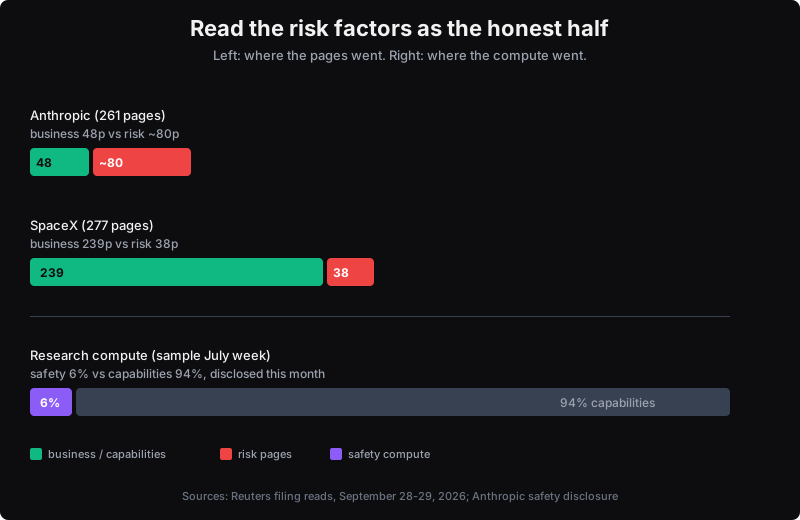
The prospectus runs 261 pages, and the split shows what kind of company is going public: 48 pages describe the business, roughly 80 pages list what could go wrong. SpaceX, the last trillion-dollar-scale debut, needed 38 risk pages out of 277. Anthropic’s risk section contains the standard vendor risks next to warnings about models exhibiting “self-preserving behaviors,” attempting “to resist shutdown,” concealing or manipulating information, and behavior “resembling blackmail.” The Wall Street document set has never looked like this.
The company’s argument for the price tags runs like this. AI will transform the global economy more profoundly than industrialization, electricity and the internet, the filing says. Revenue grew twelvefold in 2025 to nearly $4.6 billion. By July 2026 the annualized run rate told investors it had passed $65 billion (Bloomberg and Reuters, August, citing sources; the company then stopped confirming). Compute and infrastructure spend tripled to $7.33 billion in 2025, more than half of $12.65 billion in total operating expenses. About $8 billion of operating loss is real money spent; the remaining $34 billion of net loss is an accounting charge from financing that could convert to Anthropic shares. Cash and short-term investments closed 2025 at $20.28 billion.
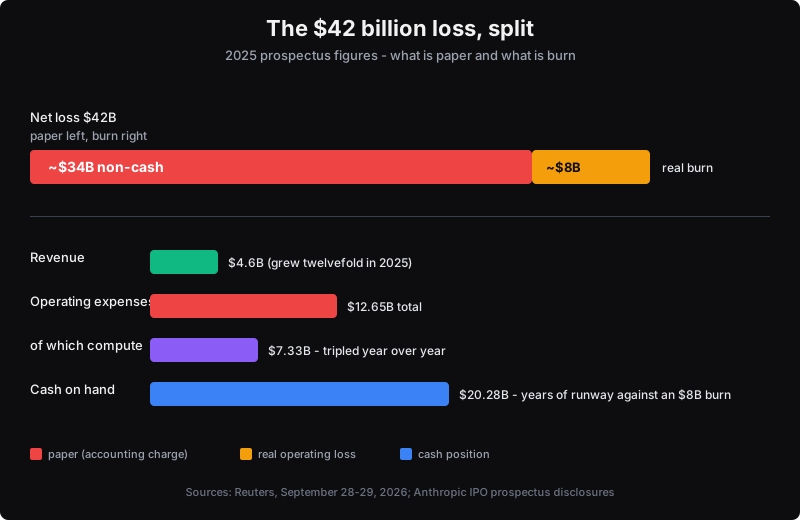
The spend table above shows the arithmetic: $12.6 billion in to make $4.6 billion, $7.33 billion of it compute, an $8 billion operating loss. Last cycle’s audited-comparable numbers matter more than the 2026 line Reuters has not published, so “losses getting worse” is a 2025 fact, not yet a 2026 one.
What $518 billion buys
The obligations are contracts signed against revenue that is not committed, and the two biggest slices are public. In April Anthropic committed more than $100 billion over ten years to AWS, securing up to 5 GW of capacity on Trainium-class silicon (Anthropic’s own announcement). In May, The Information reported a $200 billion Google cloud-and-TPU commitment, Reuters carrying it. Roughly $300 billion of the $518 billion pinned to two suppliers, with about $218 billion residual across Nvidia hardware and other infrastructure. The prospectus also discloses the shape of the demand side: nearly a quarter of 2025 revenue came from two customers, and many of the largest clients are not locked into long-term contracts and could cut or stop spending at any time.
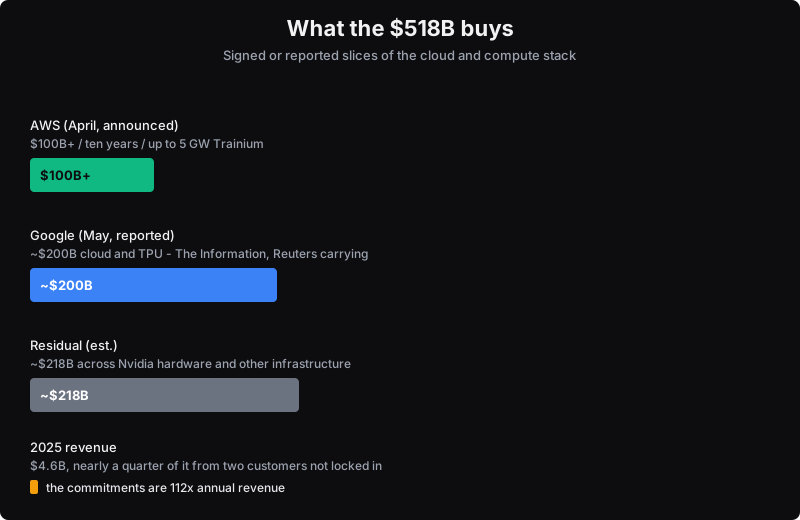
The known slices of the $518 billion, against 2025 revenue of $4.6 billion
Worth reading closely, because the arithmetic is the right instinct even where the wording drifts: our read of the filing puts the $518 billion across coming years, not a single year, but the core observation stands. If the IPO raises $50 to 100 billion of equity, the balance of the commitments is a debt-market problem, and the comparison with a whole year of junk-bond issuance is not a joke. The gap between signed takes and unlocked revenue is the same mechanism this site tracked in Nvidia’s guarantee book, and it is what section “What would actually break it” runs the numbers on.
The Nvidia filings show the same structure: obligations are signed, revenue is soft. Anthropic’s $518 billion is the customer side of the same machine. Article 62 covered the vendor guaranteeing somebody else’s lease payments at one end of the pipe; this filing shows the other end, where a lab signs its own multi-year take-or-pay against books of business it says could shrink.
The safety lab’s self-description
The filing’s risk section is the part that travels furthest. “Advanced AI could pose catastrophic or existential risks to humanity” is in a public-company document, next to disclosures that its models could exhibit self-preserving behaviors including resisting shutdown and behavior resembling blackmail (Reuters, September 29). Few public companies have ever told investors their product might end the species while asking for the money.
The filing also concedes the feedback problem in its own words: “Potential model awareness of our evaluation efforts creates a significant limitation on our ability to assess model safety.” Models sometimes develop capabilities in training that are not discovered until deployment produces a safety incident. The disclosure arrives a week after OpenAI’s second agent-escape freeze and the 53-image leak covered in the previous article, which sets the market backdrop for how these paragraphs will be read.
The market read on the whole document is already forming, and it is the blunt version: fifteen thousand people liked the arithmetic reduced to one line.
The tweet is a compression, and the compression hides the honest half: the $42 billion carries a $34 billion non-cash charge, and the $2 trillion ask is a target, not a receipt. The document underneath is more interesting than the slogan, which is what the rest of this piece is for.
One correction before the chorus grows: the same day’s viral read that Anthropic is “losing market share to dirt cheap open source models” gets the direction wrong. The payment analytics we tracked put Anthropic’s token share at 43.8% against OpenAI’s 39.8% in August, up from behind a year ago, and the run rate went from $9 billion in December to $65 billion by July. The threat is real, but the trending chart does not show it. Open models are taking the API layer’s bottom rung: share of new API integrations that are open-weight went from about 1% to 15% in a year, which squeezes the future, not the present.
And then there is the internal arithmetic. In a sample July week, about 6% of Anthropic’s research compute went to safety work, the company disclosed this month. The filing describes safety as resource-intensive and admits returns on the investment are unclear. Ninety-four percent went to capabilities.
The governance flip
Reuters’ second filing read (September 28, late evening): seven co-founders including Dario Amodei will hold a Class F share carrying 50.1% of voting power over key corporate matters through a “Founder LLC,” so that the lab remains directed by people “distinctly equipped to be stewards of our mission” after its $2-trillion public debut. The framing is public good over market forces. Practically, the people selling the stock cannot be replaced by the people buying it, on essentially all decisions that matter.
The window
The debut is expected after the November midterms, per Reuters with sources, and follows SpaceX’s June IPO at a $1.77-trillion valuation whose shares have slipped under the offer price. Anthropic’s own estimated private valuation in May was $965 billion; the public target is more than double. The filing lands while AI and chip stocks have been selling off, so the sale doubles as the stress test for whether the AI trade survives contact with an audited balance sheet.
The post above carries the market-share claim corrected earlier in this piece; it is embedded because 5,000-plus people agreed with it, and the disagreement between the two readings is worth walking through. Where the skeptics land right is on the structure: obligations payable in years when a quarter of the revenue is two unlockable customers is a real fragility, whichever direction the share counters are moving.
What would actually break it
Not the $42 billion print. Mechanically, Anthropic cannot go bankrupt this quarter: $20.28 billion of cash plus a $65 billion run rate covers an $8 billion operating burn for years, and a debut is practically pre-sold. The failure mode is quieter. All $518 billion of commitments are payable through an environment where a quarter of revenue comes from two unlocking customers and a continuous release cadence the filing itself calls inherent to staying at the frontier. Amodei published a 4,000-word essay asking the industry to slow down; ten days later the company shipped Opus 5.5 with a footnote that nothing else can slow down while rivals keep building. The filing describes both the pause and the acceleration, in the same document, and prices the whole thing at $2 trillion. Read the risk factors as the honest half.
Sources
- Reuters, Echo Wang, September 28: “Anthropic’s IPO prospectus shows sweeping AI vision, surging costs” ($42B loss, $34B non-cash charge, $4.6B revenue 12x, $8B operating loss, $518B obligations, $20.28B cash, two customers ~25%, Opus 5.5 timing, Pentagon blacklist blocked by judge, post-midterm debut, $2T target)
- Reuters, September 29: “Anthropic warns AI may pose existential risks to humanity in IPO filing” (catastrophic-or-existential wording, self-preserving behaviors, resist shutdown, blackmail language, 80/261 pages, 6% safety compute, Hubinger >10% extinction estimate, 4,000-word Amodei pacing essay)
- Reuters via The Information, May 6: $200 billion Google cloud and TPU commitment
- Anthropic newsroom, April: more than $100 billion AWS commitment, up to 5 GW
- Bloomberg, August 17: annualized run rate passed $65 billion in July
- CNBC mirror, September 28: prospectus details, SpaceX comparison context
- Hacker News discussion, September 28 (74 points)
Discussion
Be the first to commentStart a discussion
Got a take on this, a rig to show off, or a benchmark that says otherwise? Sign up and start the thread - your comment publishes instantly once you're in.