TLDR
A viral tweet this week claimed most Nvidia GPUs sold since 2023 are sitting in warehoused boxes. The verifiable numbers say something narrower and stranger: roughly a tenth of shipped Blackwell packages wait in staging at any moment, Microsoft’s CEO admitted chips he cannot plug in, and Nvidia’s own quarterly filing shows the company guaranteeing $108.5 billion of land, power, and building shells for a customer’s data center campus that produces its first revenue-bearing phase in fiscal 2029. The hardware those guarantees cover will be two generations old by the time the obligation begins. The difference between the boxes and the guarantees is the timeline: a timing lag corrects itself when power arrives, while a guarantee written against 2026 hardware prices that only triggers in 2029 does not.
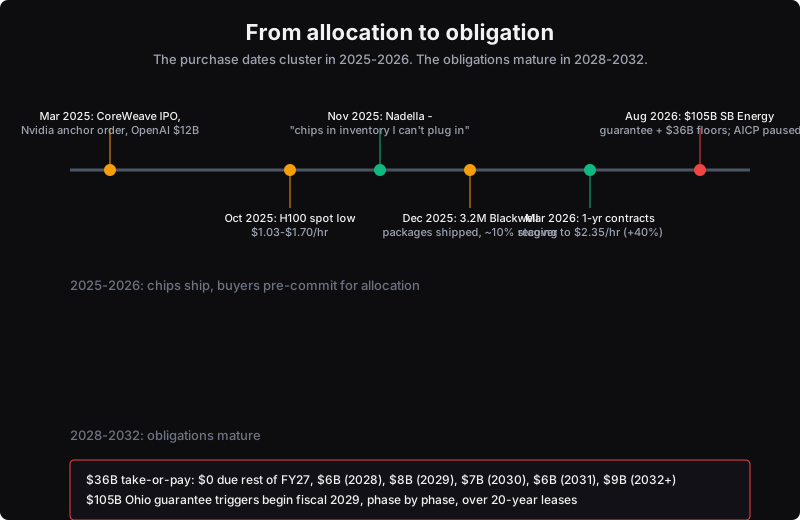
The tweet, and the accounting error underneath it
The post came from a finance account on September 27 with a clip from Raiders of the Lost Ark: men wheeling crates marked TOP SECRET into an endless government warehouse. It claimed most of Nvidia’s 2023 through 2027 sales sit warehoused, and once people notice, it’s over.
A real admission gives the warehouse image force. Satya Nadella told the BG2 podcast alongside Sam Altman in November 2025: “the biggest issue we are now having is not a compute glut, but it’s power… if you can’t do that, you may actually have a bunch of chips sitting in inventory that I can’t plug in. In fact, that is my problem today.” The largest Blackwell buyer said out loud that his constraint is warm shells, not chips.
But the tweet’s arithmetic collapses on a counting choice. Jensen Huang’s “six million Blackwell GPUs shipped” counts dies, and every Blackwell package fuses two dies. The package count is roughly 3.2 million through December 2025. AC Research, which publishes the only public package-level accounting, puts about 2.9 million of those deployed or in staging, with roughly ten percent in staging at any moment during a four to twelve week install and power-commissioning lag. Ten percent of a real number is not “most of sales.” The claim overstates by treating dies as boxes and staging as storage.
What the pile actually contains
Nvidia’s own balance sheet makes the inventory visible in dollars. The 10-Q for the quarter ended July 26, 2026 lists $31.6 billion of inventories, up from $21.4 billion in January: $11.3 billion of raw materials, $13.4 billion of work in process, $6.9 billion of finished goods. Finished goods are the closest thing to “boxes in a warehouse” Nvidia reports, and they are $6.9 billion against a company running roughly $60 billion a quarter in revenue.
The staging number has a structural explanation. About 0.3 million packages sit between the loading dock and the energized rack at any time, waiting on power commissioning and network fabric. That lag is ordinary data center operations, visible in every previous generation. Nobody outside the operators publishes a per-unit clock for when staging becomes storage, and the accounting offers only proxies. Nvidia’s finished-goods balance fell from $8.8B to $6.9B over the same six months raw materials tripled, which reads as chips shipping out faster than components arrive as finished units, not as unsold stock accumulating. The idle-risk signal to watch is the rental price, and the rental price says the market absorbed the 2025 shipments: one-year H100 contracts bottomed in October 2025 and have risen about 40 percent since. The gap between chips-arrive-in-nine-months and shells-arrive-in-two-to-four-years is where the boxes pile up, and the pile self-corrects as power arrives.
Who holds the deployed capacity tells you where demand actually is. Ten operators control 67 percent of shipped Blackwell: five hyperscalers (Microsoft, Meta, Google, Amazon, Oracle) hold 49 percent, five GPU-focused clouds hold 18 percent, and the rest spreads across enterprises, sovereign projects, and smaller providers.
| Operator | Share of shipped Blackwell | Packages (approx) |
|---|---|---|
| Microsoft, Meta, Google, Amazon, Oracle (five hyperscalers) | 49% | ~1.57M |
| CoreWeave, Nscale, Lambda, Nebius, Crusoe (anchor neoclouds) | 18% | ~0.58M |
| Enterprises, sovereign AI, smaller neoclouds | 33% | ~1.06M |
| Total shipped through Dec 31, 2025 | 100% | ~3.2M |
The same quarter’s 10-Q gives the inventory lines behind those packages:
| Nvidia balance sheet line | Jul 26, 2026 | Jan 25, 2026 |
|---|---|---|
| Raw materials | $11.3B | $3.8B |
| Work in process | $13.4B | $8.8B |
| Finished goods | $6.9B | $8.8B |
| Total inventories | $31.6B | $21.4B |
Raw materials nearly tripled in six months: that is the supply-commitment machine buying components ahead of demand, not crates of finished cards idling.
Why anyone buys chips they cannot plug in yet
Four reasons make those purchases rational on their own.
Nvidia sells allocation before it sells chips. Blackwell supply for 2026 is 70 to 80 percent pre-committed to the big four clouds. A B200 order placed today ships in the second or third quarter of 2027. Buying early works as an option on future silicon; in a shortage regime the purchase order is the only currency Nvidia accepts.
Relationships set the queue. Nvidia allocates by strategic tie. CoreWeave received the first commercial GB200 NVL72 deployment because Nvidia holds equity in it. An oversized order today purchases priority in the next cycle’s allocation.
Power determines the schedule. Shells take two to four years, grid interconnects run 24 to 36 months, chips take about nine months. The rational buyer orders silicon when the shell is announced so both arrive together. The mismatch becomes visible only when power slips, which is exactly what Nadella described.
Debt financing removes the cash cost at purchase. Since August 2023, GPU buyers have borrowed against the chips themselves: Magnetar and Blackstone lent CoreWeave $2.3 billion with H100s as collateral, the first deal of its kind. The buyer never pays cash; the forecast rental revenue pays the loan.
Each reason made sense alone. Stacked together they produce the strange sight of companies buying hardware whose install date they do not control, financed by debt secured on the hardware itself.
The neoclouds: a dollar flowing in a circle
“Neocloud” is the industry name for GPU-only clouds: CoreWeave, Nscale, Lambda, Nebius, Crusoe. They hold 18 percent of shipped Blackwell. CoreWeave, the largest, started in 2017 as an Ethereum mining operation founded by commodities traders.
Trace one dollar through CoreWeave and the loop closes. Nvidia invested $2 billion for roughly nine percent of the company. Nvidia anchored CoreWeave’s March 2025 IPO with an order Bloomberg reported at about $250 million. CoreWeave used its capital plus GPU-collateralized debt to buy Nvidia chips. Nvidia contractually backstops $6.3 billion of CoreWeave’s unsold capacity through April 2032: whatever the neocloud cannot lease, Nvidia buys itself. The company that makes the chips is simultaneously investor, supplier, and buyer of last resort for the reseller.
The demand underneath is concentrated the same way. One customer, Microsoft routing capacity toward OpenAI, produced 62 percent of CoreWeave’s 2024 revenue and 67 to 72 percent of its 2025 quarters. OpenAI signed a five-year, $12 billion contract with CoreWeave in March 2025 and bought $350 million of IPO shares. SoftBank funded its share of OpenAI’s $40 billion round partly by liquidating $5.8 billion of Nvidia stock. Nvidia’s data center revenue depends on the circle continuing to turn.
Borrowing against the chips you just bought
Yes, the loan against the GPUs is real, and it has a precise shape. The founding transaction: in August 2023 CoreWeave closed a $2.3 billion delayed-draw term loan co-led by Magnetar and Blackstone Tactical Opportunities, with Coatue, DigitalBridge, BlackRock, PIMCO, and Carlyle in the syndicate. At the reported 70 cent advance rate, the collateral pool was over $3 billion of H100 servers, roughly 70,000 to 100,000 GPUs. The invention was not lending against hardware; it was pairing the chips with assigned customer contracts inside a bankruptcy-remote special purpose vehicle, so the lender’s repayment comes from the contract cash flow and the collateral only matters at the end.
The standard terms, as the market has settled them: advance rates of 50 to 70 percent of fair value for current-generation hardware, higher with investment-grade offtake contracts attached; debt service coverage covenants of 1.3 to 1.5 times tested on rental revenue; minimum utilization of 70 to 80 percent of installed capacity; monthly borrowing-base certificates; and perfected security interests that let a lender seize and remarket the GPUs through specialized brokers within 30 to 90 days of default, recovering 60 to 80 percent of current value against 40 to 60 percent for generic IT equipment.
Because GPU values fall as new generations launch, the loan’s effective loan-to-value rises over its life unless amortization keeps pace. That is why every deal in this asset class amortizes on the depreciation schedule: repay before you ever have to sell a used GPU. The founding lenders priced that unproven structure at 11 to 14 percent all-in in 2023. The experiment has since run its course: CoreWeave’s March 2026 facility, $8.5 billion at SOFR plus 225 basis points, rated A3, carries roughly $550 million a year less interest than the 2023 pricing on the same borrower and the same silicon.
The migration underneath those numbers matters: eight facilities in, the collateral concept has moved from the GPU to the contract to the counterparty: two facilities with non-investment-grade customers price at SOFR plus 450 to 550, the investment-grade facility at plus 225, a 325 basis point spread between tiers of the same borrower on identical chips. Moody’s is effectively rating the customer, not the hardware. A term search of CoreWeave’s newest $8.5 billion credit agreement makes it explicit: “GPU” appears throughout in defined terms, but the words a lender would use to value hardware against an outside reference (appraisal, residual value, orderly liquidation, advance rate, loan-to-value, borrowing base) appear zero times.
Stop and read that again. An $8.5 billion lending program secured by GPUs contains no mechanism anywhere to value the GPUs. No appraisals, no residual value schedule, no liquidation reference, no advance rate, no loan-to-value test. Lenders never underwrote the hardware. What they underwrote is the rental contract attached to it. Strip the contract and the collateral is worth whatever a broker bids on used silicon, and nobody in the chain has ever had to find out what that is. Without a third-party valuation step, this is not a completed secured transaction in the way a mortgage or an equipment loan is; it is a contract-repayment promise wearing the collateral as a label. A credit agreement that never prices its collateral is a term sheet, not a closed deal.
And the tell comes from Nvidia itself. In August it filed a Residual Value Guaranty covering up to $105 billion on the Ohio campus, which sounds like the vendor finally putting a floor under its own product. The exhibit defines the guaranteed minimum value as data-center, power, and transmission costs, and Nvidia’s own equipment is carved out as “Guarantor Property” under a separate repossession clause. The company with the best information about GPU value on earth guarantees the building and the substation, and declines to put a number on the chips.
The guarantees: reading the actual filing
The 10-Q filed for the quarter ended July 26, 2026 contains a note titled “Guarantees” that deserves a slow read.
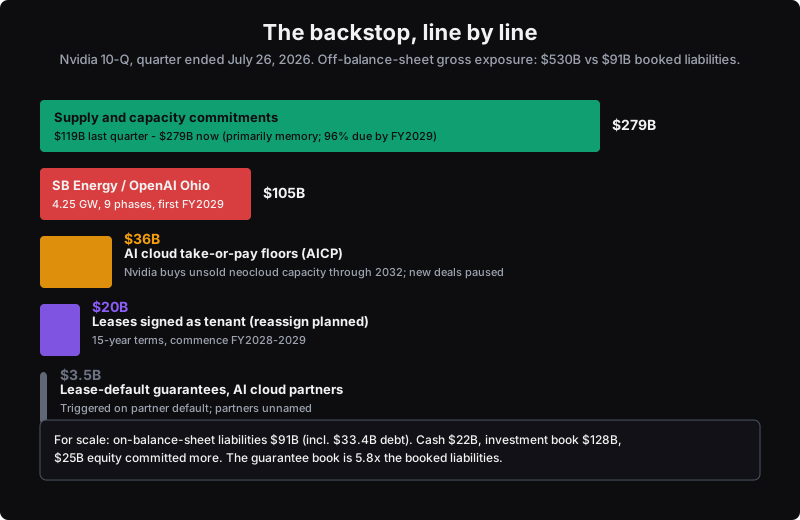
The smaller guarantee line is $3.5 billion of land, power, and shell guarantees for select AI cloud partners, payable if they default on data center leases.
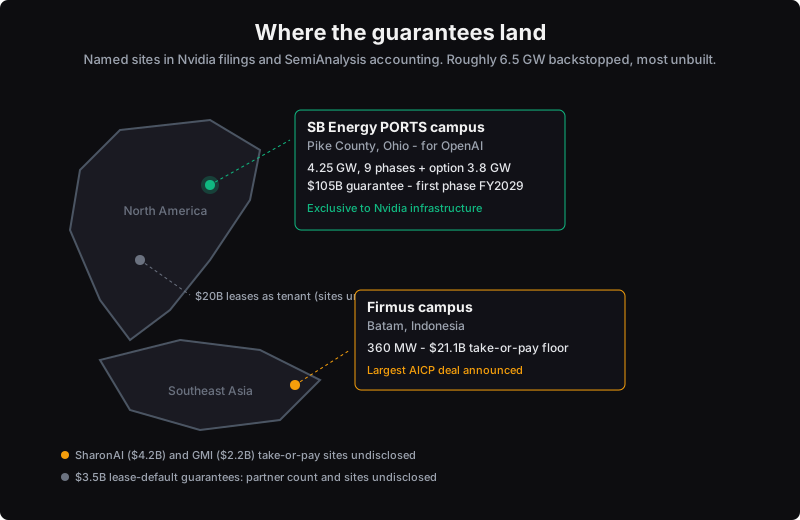
The larger line is new this quarter. In August 2026 Nvidia entered guarantees capped at $105 billion to support a buildout by SB Energy, a power developer, on behalf of OpenAI: approximately 4.25 gigawatts of IT load at the PORTS Technology Campus in Pike County, Ohio, across nine construction phases, the first expected in fiscal 2029. The guarantees grow as each phase completes, cover defined portions of lease and power payments over 20-year lease terms, and terminate when OpenAI achieves a satisfactory credit rating.
The exchange clause states: “In exchange for the guarantees, the site will exclusively host NVIDIA AI infrastructure, subject to limited exceptions.” Nvidia also holds an option to extend the same credit support to roughly 3.8 additional gigawatts as the campus scales.
Nvidia’s own risk language is unusually blunt for a filing: if OpenAI defaults and a guarantee triggers, Nvidia “may assume the applicable lease.” OpenAI has agreed to reimburse and indemnify, but Nvidia warns it “may not recover amounts promptly or in full.”
Public sentiment runs ahead of the filings. A widely shared post this week put the bear case in three lines: lawsuits closing in, bankruptcy sooner than people think, Microsoft waiting to buy the remains. The lawsuit count is real (a public tracker lists 41 cases against OpenAI, and the New York Times case awaits summary judgment), but the structural facts run the other way: OpenAI closed 2025 above $20 billion in annualized revenue, and Microsoft cannot simply acquire the company because the public benefit corporation structure plus the nonprofit’s control make a purchase a governed process, not a checkout. What makes the post worth reading beside the 10-Q is that Nvidia’s own risk language prices the same scenario the post imagines: the guarantee is drafted for the world where OpenAI defaults, and the indemnification is drafted for the world where recovery is slow. Neither the filing nor the poster claims that world has arrived.
The same quarter’s commitments table adds $36 billion of AI cloud agreements (the take-or-pay floors: if neoclouds cannot sell committed capacity, Nvidia purchases it) and $20 billion of data center leases Nvidia signed as a tenant while expecting to reassign them to third parties.
Add the lines and Nvidia’s off-balance-sheet gross exposure across guarantees, supply commitments, and capacity floors reaches $530 billion against $91 billion of on-balance-sheet liabilities. A company with $91 billion of booked obligations is underwriting over half a trillion more.
The obligations attach to these named sites:
| Site / program | Location | Scale | Nvidia obligation | Status |
|---|---|---|---|---|
| SB Energy PORTS campus (for OpenAI) | Pike County, Ohio | 4.25 GW, 9 phases; option +3.8 GW | $105B guarantee | First phase fiscal 2029 |
| Firmus campus | Batam, Indonesia | 360 MW | $21.1B take-or-pay floor | Announced under AICP |
| SharonAI | Undisclosed | Undisclosed | $4.2B take-or-pay floor | Announced under AICP |
| GMI | Undisclosed | Undisclosed | $2.2B take-or-pay floor | Announced under AICP |
| Unnamed AI cloud partners | Undisclosed | Undisclosed | $3.5B lease default guarantees | Active |
| Nvidia-as-tenant leases | Undisclosed | $20B of 15-year leases | Signed, expects reassignment | Commence fiscal 2028-2029 |
SemiAnalysis counts roughly 6.5 gigawatts of capacity backstopped in total, most of it unbuilt, against roughly 15 gigawatts the hyperscalers lease from third parties this year. The program is small in site count and enormous per site: the Ohio guarantee alone is about four nuclear reactors’ worth of IT load, and exercising the Ohio option would take one campus toward eight gigawatts.
Hardware that expires, promises that mature
GPU economics concentrate value at the start of a generation’s life. H100 rental rates peaked above $8 per GPU-hour in 2023 scarcity pricing, fell through 2025, and Amazon cut on-demand H100 prices 44 percent in June 2025 as Blackwell inventory arrived. SemiAnalysis’s one-year contract index bottomed near $1.70 per hour in October 2025 and recovered to about $2.35 by March 2026 as memory shortages tightened supply. The pattern holds across every generation: the first 12 to 18 months carry the premium, then the next launch resets the price floor.
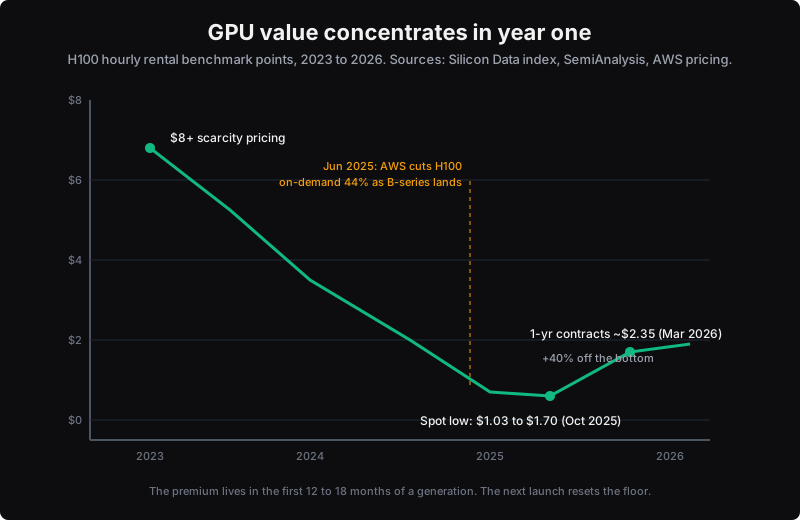
| H100 hourly rental, benchmark points | Rate |
|---|---|
| 2023 scarcity pricing | $8+ |
| Late 2025 spot low | ~$1.03 to $1.70 |
| One-year contract, March 2026 | ~$2.35 |
| Mid-2026 index | ~$2.53 |
The commitments table gives the obligation curve Nvidia signed:
| Fiscal year | AI cloud agreements due |
|---|---|
| Remainder of 2027 | $0 |
| 2028 | $6B |
| 2029 | $8B |
| 2030 | $7B |
| 2031 | $6B |
| 2032 and thereafter | $9B |
| Total | $36B |
The commitments schedule avoids the current fiscal year almost entirely. Every dollar of the take-or-pay floor matures after the hardware it covers has passed through its first-generation revenue window.
The decay curve and the obligation curve diverge. The Ohio guarantees begin with the first phase in fiscal 2029. The commitments table allocates $6 billion due in 2028, $8 billion in 2029, with the bulk in 2032 and beyond. Nvidia is writing checks whose trigger conditions mature after the covered hardware passes through its prime revenue window and two successor generations.
That is the mismatch the tweet gestured at and missed. The boxes are a timing lag, while the guarantees are a bet that demand still exists in 2029 at prices set in 2026, denominated in hardware that will be two generations old.
What the guarantees are actually buying
One clause in the Ohio deal explains the structure: exclusivity. Nvidia is not underwriting demand confidence; it is purchasing locked-in deployment share. Every site covered by a guarantee must run Nvidia infrastructure. AMD’s MI-series, Google’s TPUs for external buyers, and the custom silicon Amazon and Microsoft are building are all shut out of 4.25 gigawatts and any expansion Nvidia elects.
The $530 billion works as defense spending. Nvidia converts balance-sheet risk into position at the few dozen sites large enough to matter, at terms no competitor’s margin pool can match. The alternative reading is more charitable and not inconsistent: nobody else on earth can finance 4.25 gigawatts, so the only chipmaker with the margin pool guarantees the buildout and prices OpenAI’s indemnification into the risk.
Both readings agree on the mechanism. The 10-Q discloses a company using its balance sheet to lock the physical footprint of AI compute to its own hardware through the end of the decade, one campus at a time, with the first revenue phase arriving after the current architecture retires.
What an operator takes from this
Rental rates give the clearest public price signal. Contract rates for one-year H100 capacity sit near $2.35 per hour; B200 commands a premium while memory lasts. If you buy capacity, buy the term that matches your workload, not the allocation game.
If you build for the clouds, watch the neocloud concentration. A provider whose revenue is 70 percent one customer, whose supplier guarantees its unsold inventory, and whose collateral is a depreciating chip is a provider whose pricing can move hard in both directions.
And if you are waiting for the market to crash because crates are in a warehouse: the crates are staging lag, the accounting error is dies versus packages, and the real exposure sits in filing appendixes, denominated in years, and backed by a company that has so far been right about demand. The bet to watch is not whether the GPUs get turned on. It is what their exclusivity clauses do to everyone else’s hardware options in 2028.
Sources: Nvidia 10-Q for the quarter ended July 26, 2026 (SEC EDGAR); BG2 Pod, November 2025 (Nadella quote via Tom’s Hardware); AC Research package accounting, April 2026; SemiAnalysis rental price index, April 2026; CoreWeave S-1 and 2025 quarterly filings; Bloomberg IPO anchor report, March 2025; Gartner power-constraint projection, 2026; ailawsuittracker.com case count (checked 2026-09-27); TechCrunch (Altman: $20B ARR, $1.4T commitments, Nov 2025); CNBC (compute spend reset, Feb 2026).
Discussion
Be the first to commentStart a discussion
Got a take on this, a rig to show off, or a benchmark that says otherwise? Sign up and start the thread - your comment publishes instantly once you're in.