TLDR
Xing4.0-29B-A4B is an open source agentic model that plans multi-step tasks, calls tools, and works through long documents on hardware you can put on a desk. It enables local agent workflows (code development, data analysis, document processing) on a single consumer GPU, with no data leaving the machine. The difference between Xing4.0-29B-A4B and regular small LLMs is that it was trained entirely on Huawei Ascend NPUs rather than Nvidia hardware, and a state telecom ships it as a supported product with its own customer service platform running on it.
The first model of its scale with no Nvidia in the training loop
China Telecom AI released Xing4.0-29B-A4B officially on September 22, 2026, and the fact worth more attention than the benchmark table is in one line of the model card: it is “the first model of this scale trained entirely on the Ascend NPU platform with the MindSpore framework.” The training was not assisted by Nvidia with a domestic fallback, and it did not run on rented H100s with an Ascend inference story. The run happened entirely on Ascend 910C clusters, with fused operators written in Ascend C for the architecture’s mHC component, and a claimed 96% training-throughput improvement over out-of-the-box performance from that co-optimization work.
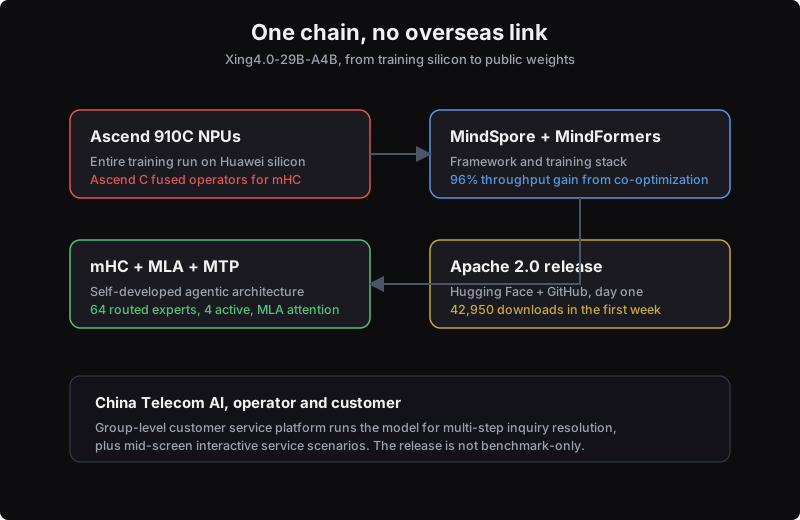
The full domestic chain behind Xing4.0: Ascend silicon for training, MindSpore and MindFormers for the framework, self-developed mHC plus MLA plus MTP architecture, and open-source release under Apache 2.0. No point in the chain touches an overseas supplier.
The Xing series is the renamed TeleChat lineage, China Telecom’s in-house model family going back years, with two arXiv training reports behind it (TeleChat3-MoE and TeleChat2). The 29B model is the current small flagship: 29B total parameters with 4B active per token, 64 routed experts with 4 active plus 1 shared, MLA attention, 40 layers, and a 256K-token native context the card says extends to 512K.
What the numbers actually say
The headline benchmark is SWE-bench Verified at 75.0, which the card footnotes properly: SWE-agent harness, temperature 1.0, a 210K-token context window. In the same table, Xing4.0 posts 75.0 against 53.0 for Gemma4-26B-A4B, while Qwen3.6-35B-A3B edges it at 76.0.
The more interesting row is Terminal-Bench 2.1, where the card reports 57.5 against 30.0 for Gemma4-26B-A4B and 51.5 for Qwen3.6-35B-A3B, averaged over three runs with a 24-hour timeout per task. Agent work that takes hours instead of turns is exactly where a 4B-active MoE earns its keep, because the cheap-per-token property compounds over long trajectories.
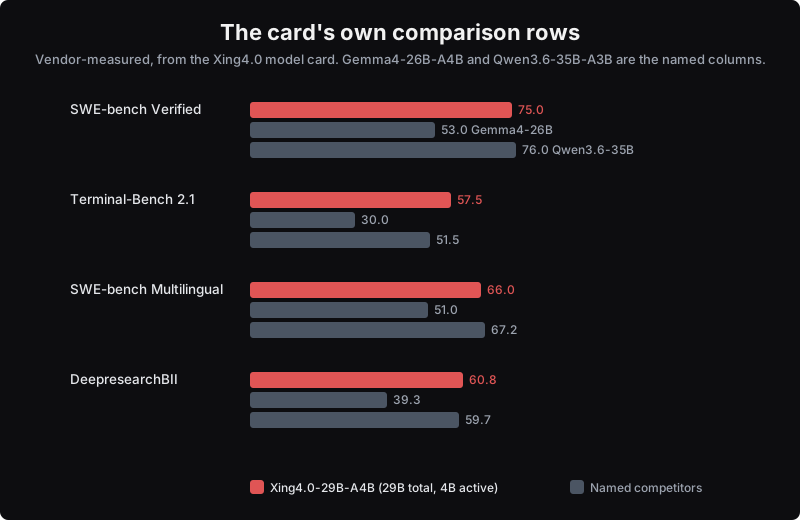
Selected benchmark rows from the model card, Xing4.0-29B-A4B against its two named 26B and 35B MoE competitors. All three columns are vendor-measured; the SWE-bench gap between Xing4.0 and Gemma4 is the widest row.
On SuperCLUE’s agent capability evaluation, the score is 93.52, third place and within one point of the top two Qwen models. The China Telecom AI spokesperson quote attached to the release makes the positioning explicit: “the future of AI lies not in ever-larger models, but in making powerful intelligence accessible to everyone, affordable, and deployable anywhere.”
The fit math on one GPU
The release qualifies the deployment claim with a specific number: a quantized build requires 15GB of GPU memory and runs locally on a single consumer graphics card. The arithmetic from the released weights backs it. The bf16 checkpoint totals 62.4GB, so 29B parameters at 4 bits come to 14.5GB, and the official 15GB claim leaves about half a gigabyte of headroom for the quantization layout.
A 24GB RTX 3090 or RTX 4090 carries the 4-bit build with roughly 9GB remaining for KV cache and activations, enough for real context at moderate lengths with MLA attention keeping the cache narrow. The community GGUF is already up: one IQ4_NL file, 20.1GB, 10,880 downloads at check. The file is larger than the vendor’s 15GB figure because the IQ4_NL mix differs from the vendor’s own 4-bit build; if you need the vendor number exactly, use the official quantization rather than the community one.
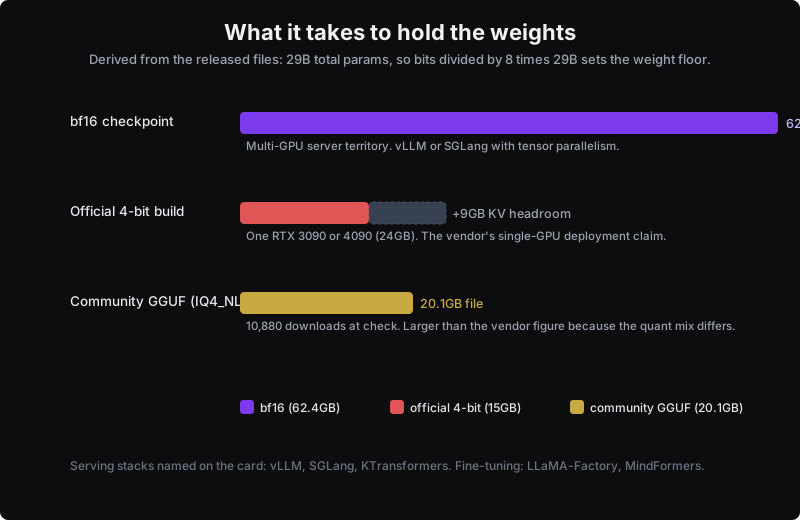
Memory ladder from the released weights: 62.4GB bf16 needs a server, 15GB at 4 bits fits a 24GB card with about 9GB of KV headroom, and the community IQ4_NL GGUF file weighs 20.1GB. Serving stacks named on the card: vLLM, SGLang, KTransformers.
Serving is documented for vLLM, SGLang, and KTransformers; fine-tuning for LLaMA-Factory and MindFormers. The card also calls out format alignment for agent frameworks, naming OpenCode, Claude Code, OpenClaw, and Hermes. That list is the tell for who this is aimed at: people who already run agent harnesses and want a private model behind them.
The operator is also the customer
China Telecom runs this model in production twice over: its group-level customer service platform uses it for multi-step inquiry resolution with tool calling, and “mid-screen” interactive service scenarios use it as a real-time assistant. A model vendor that is also a large deployed customer can keep shipping at a loss in ways a startup cannot, and the release says larger Xing models are coming within months.
The production deployment is the part of this release that goes beyond the benchmark table. SWE-bench 75.0 sits below the frontier class, and every benchmark in the card is vendor-measured. The chain behind it (Ascend silicon, MindSpore, self-developed architecture, Apache 2.0 weights, a telecom-sized customer with a real deployment) shows a full stack arriving without any overseas component. A competitive agent model that fits one GPU and one national supply chain gives buyers a local option that does not depend on Nvidia.
Sources: Xing4.0-29B-A4B model card (config.json and footnotes) · Official release, GlobeNewswire (2026-09-22) · XingChen-AGI GitHub · GGUF repo · AIbase SuperCLUE writeup
Related on this site: Xing4.0-29B-A4B model card · What each local-AI budget buys in 2026
Discussion
Be the first to commentStart a discussion
Got a take on this, a rig to show off, or a benchmark that says otherwise? Sign up and start the thread - your comment publishes instantly once you're in.