DeepSeek V4.1 Flash: the subagent tier gets an open model
Dax Raad, the founder behind SST and OpenCode, posted on November 4 that his team is testing a split: “switching all our subagents to deepseek flash and using opus 5.5 only on the primary subagent.” The post collected 2,471 likes in a day. It reads like a cost note. It is really a statement about where the model market is heading, and it lines up with what the benchmarks in DeepSeek’s own model card show.
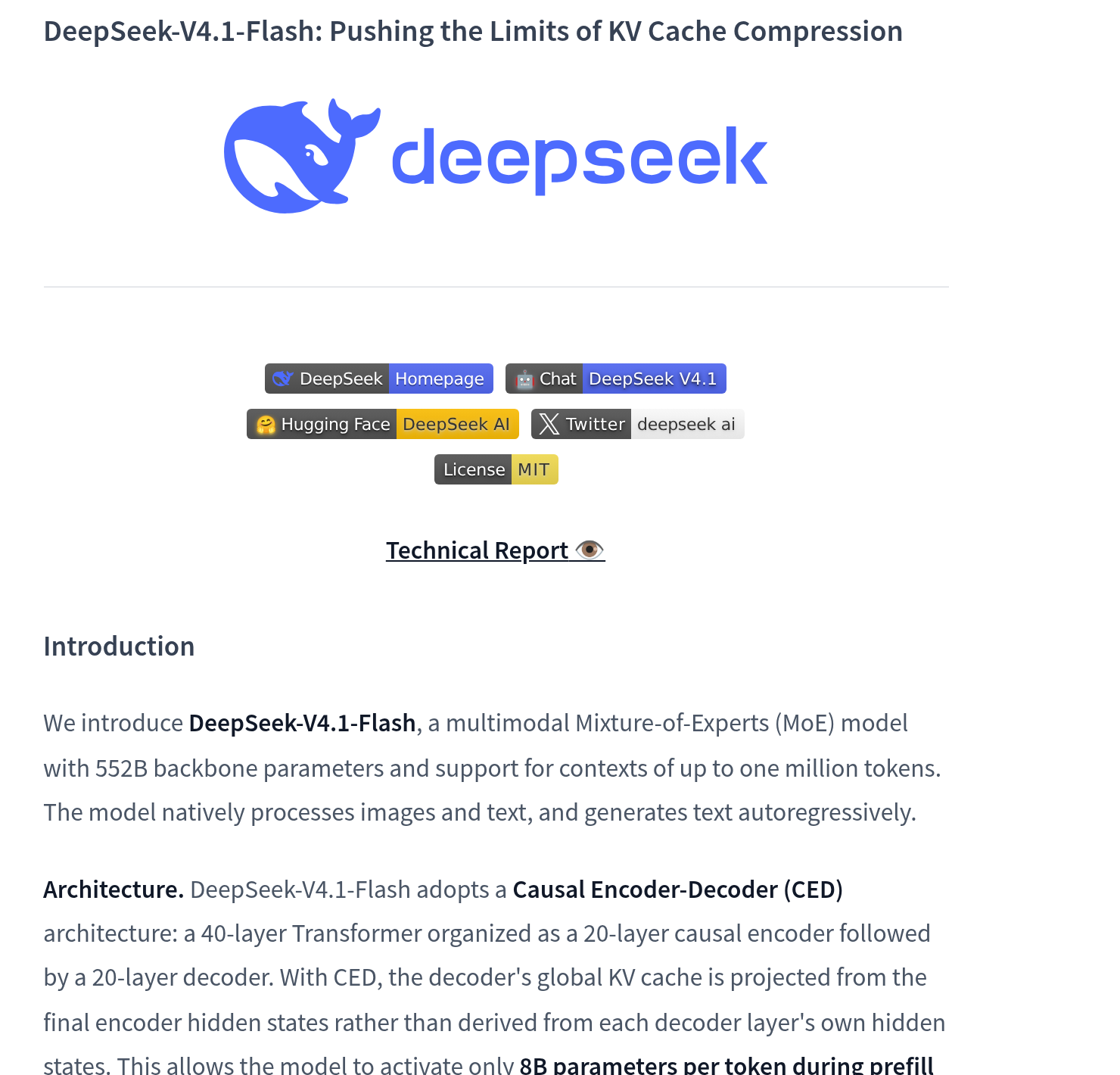
Caption: The DeepSeek-V4.1-Flash model card. The card leads with the architecture, not the benchmark table, because the interesting part is how much context the model can hold per gigabyte. Screenshot: Hugging Face.
What the model actually is
DeepSeek-V4.1-Flash is a multimodal mixture-of-experts model with a 552B backbone and support for contexts up to one million tokens. The stored checkpoint is larger than the backbone suggests: the safetensors listing reports 763B parameters, which covers the 552B model plus a 196B Engram conditional-memory component. Weights are MIT licensed and the repository has 1,950,966 downloads last month and 4,864 likes.
Hand V4.1 Flash a repository, a design doc and a task, and it reads the whole pile once before it starts writing. The trick is that the reading pass and the writing pass are separate halves of the model, and the writing half works from a compressed summary of what the reading half saw rather than re-deriving it layer by layer. DeepSeek says that drops the per-token work to 8B parameters during the reading pass and 16B while generating. Agent work is mostly reading: every step hands the model another long transcript of what the last step did.
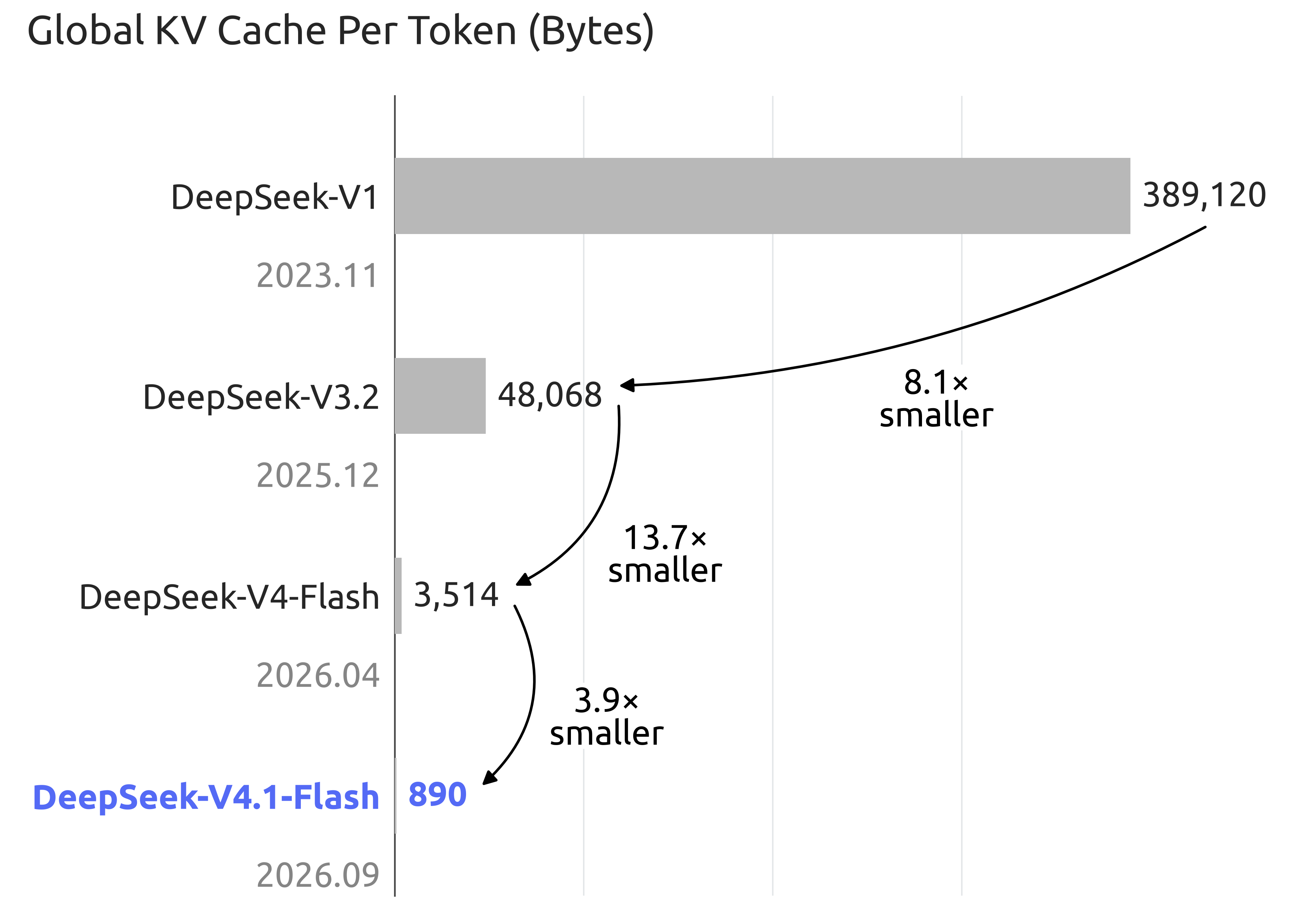
Caption: DeepSeek’s own cache chart. Global KV cache per token has fallen from 389,120 bytes in V1 to 890 bytes in V4.1 Flash: 437 times smaller across four generations, and 3.9 times smaller than V4 Flash alone. Image: DeepSeek model card.
The number that changes hardware math
890 bytes of global KV cache per token is the figure to hold onto. Multiply it out and a one-million-token session costs about 0.89 GB of cache. V4 Flash, one generation earlier, cost 3.5 GB at the same context. In the V1 era the same session would have needed 389 GB, which is more memory than the machines this site recommends have in total.
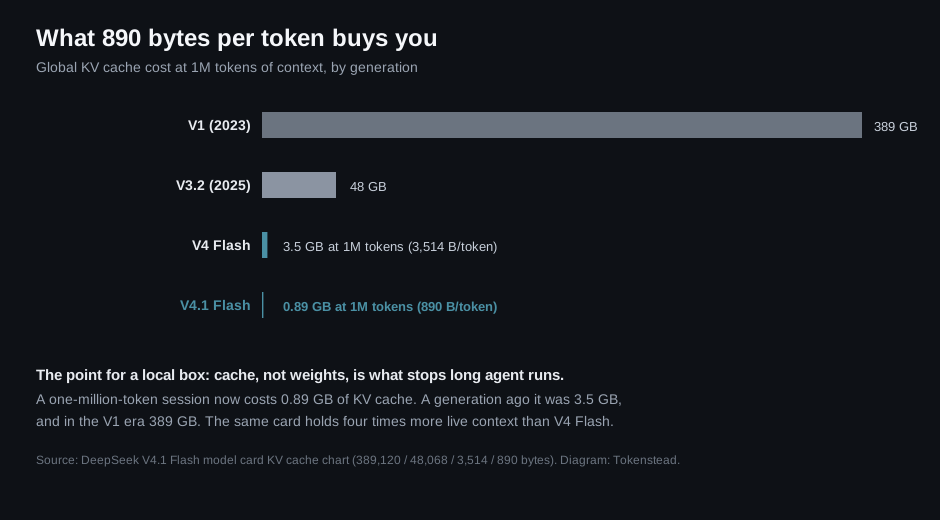
Caption: What the same one-million-token window costs in KV cache, by generation. Cache, not weights, is what ends long agent runs on a fixed box. Figure: Tokenstead.
For a local rig this shifts what “long context” means. The weights are still the hard floor: a 552B backbone does not shrink because the cache did, and a 24GB card runs this model only in aggressive quantization or with expert offload. But once it is running, context stops being the thing that kills the session. That is a different constraint than the one this site was writing about a year ago.
The benchmark table, read honestly
DeepSeek published an agentic comparison against Kimi-K3, GLM-5.3, Opus 5 and GPT-5.6-Sol. V4.1 Flash wins three of the four:
- DeepSWE v1.1: 74.2, against Opus 5 at 74.0 and GPT-5.6-Sol at 73.0
- CyberGym: 88.1, against 84.5 for both Opus 5 and GLM-5.3
- Automation-Bench: 54.8, against 50.3 for Opus 5 and 45.8 for GPT-5.6-Sol
- Terminal-Bench 3.0: 30.0, against Opus 5 at 43.3. This is a loss, and a large one.
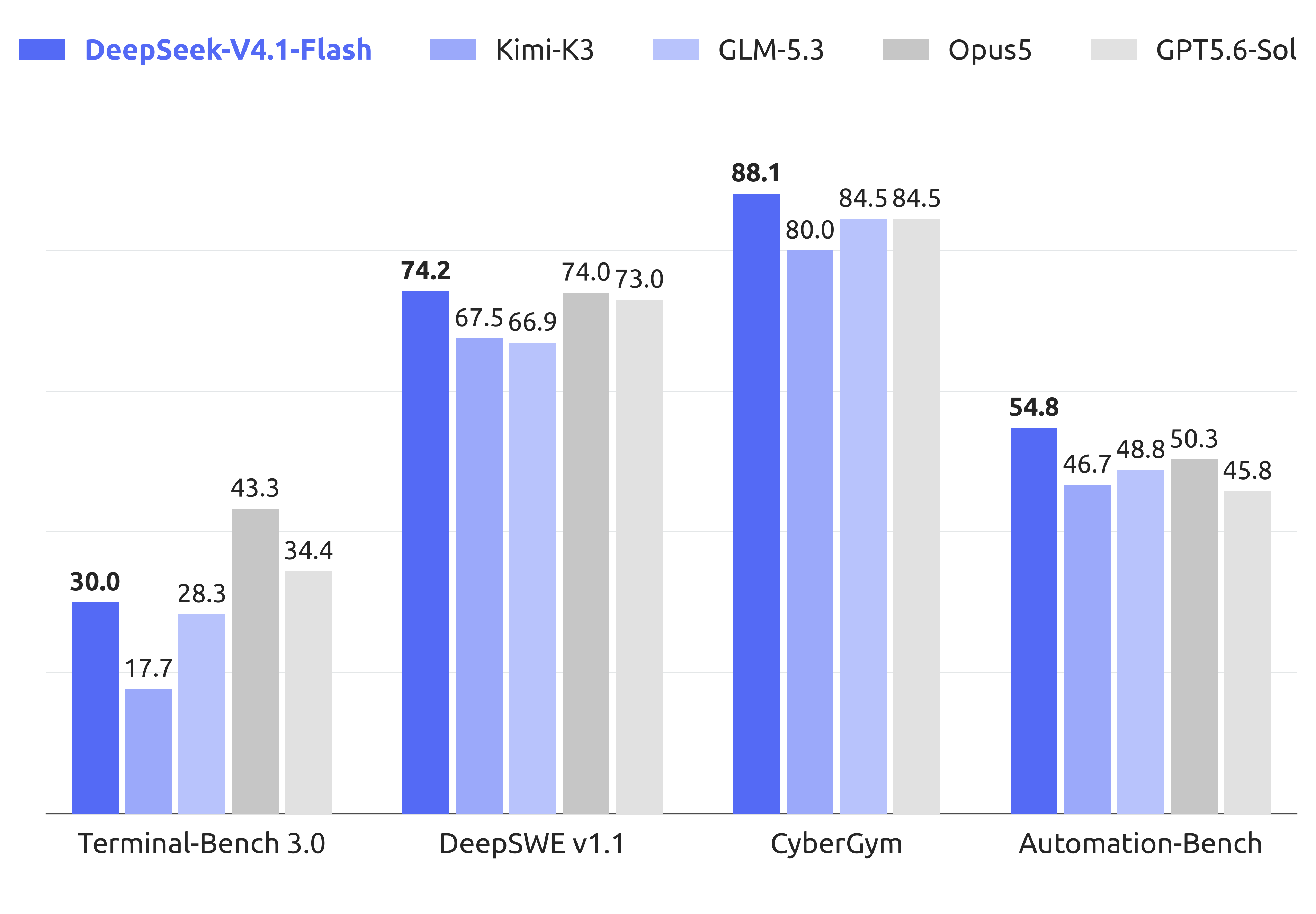
Caption: DeepSeek’s published agentic comparison. Read the fourth group closely: V4.1 Flash trails Opus 5 on Terminal-Bench 3.0 by 13 points while leading it on the other three. Image: DeepSeek model card.
That table explains the routing experiment better than any cost argument. Terminal work, meaning long multi-step shell sessions where one wrong command cascades, is still Opus territory by a wide margin. Code editing, security review and workflow automation, the three jobs that dominate an agent fan-out in practice, are where the cheaper model holds its own or leads.
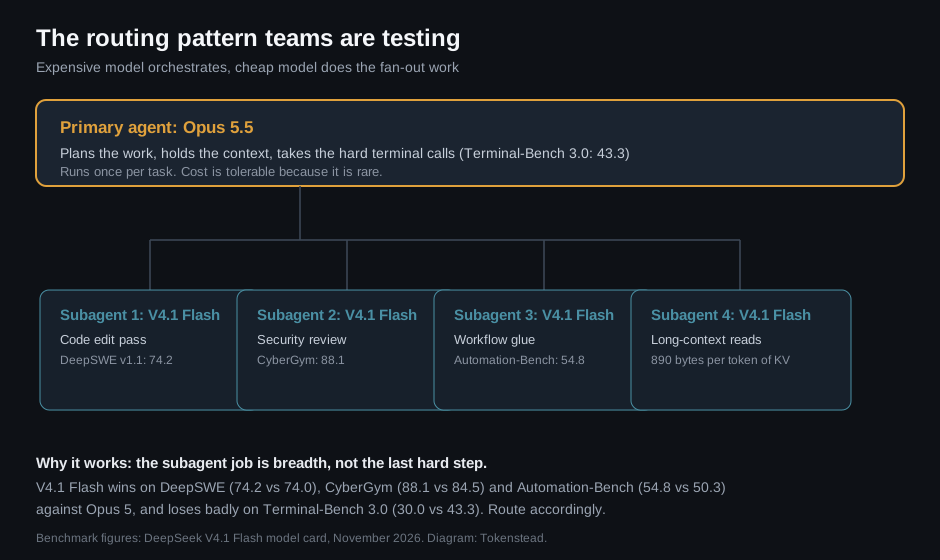
Caption: The split teams are testing: one expensive orchestrator, many cheap subagents, routed by where each model actually wins. Figure: Tokenstead.
Why this is the local-AI story, not just a pricing story
The model being routed into subagents is open weights under MIT, and the escalation target is not. That is the structural point. The subagent tier is the high-volume tier: it is where token counts explode, where the bill lands, and now, where an open model is competitive. The orchestrator tier is where a closed model still holds a real edge on terminal work.
Two implications. First, a team that routes subagents to V4.1 Flash is one step from routing them to a local V4.1 Flash, and the hardware is closer than it was, because the cache math no longer walls off long sessions. Second, the model that already sits on most of this site’s recommended builds is now the one a public founder is describing as good enough for the bulk of agent work. The desk build and the Spark cluster both list it, and the tier where it earns its place just got sharper: it is the model you run many of, not the model you run once.

Caption: License MIT, 1.95 million downloads in the last month, 4.86k likes. The model card is the primary source for every number in this piece. Screenshot: Hugging Face.
Discussion
Be the first to commentStart a discussion
Got a take on this, a rig to show off, or a benchmark that says otherwise? Sign up and start the thread - your comment publishes instantly once you're in.