On September 9, 2026, DeepSeek announced V4.1-Flash, now live on the DeepSeek API as deepseek-flash with native multimodal support and a 1M-token context window. The weights are open under MIT and downloadable now from HuggingFace: 48 shards, 510GB total on the main branch, FP8 as the heaviest precision. The same announcement retires V4-Pro - from 04:00 UTC on September 14, every deepseek-v4-pro request routes to V4.1-Flash, billed at Flash rates. The previous pricing ended at 04:00 UTC on September 10, 2026.
The architecture change
The headline number is 552B parameters total, but the number that matters is the active parameter count: 8B per token at prefill, 16B at decode. V4.1-Flash is the first widely deployed release on a new Causal Encoder-Decoder (CED) architecture - a 40-layer transformer organized as a 20-layer causal encoder followed by a 20-layer decoder, where the previous generation was a decoder-only stack. The MoE configuration puts 1 shared expert plus 384 routed experts per layer, with 6 routed experts active per token. The asymmetric active counts track the workload: prefill is read-heavy and parallel, decode is the generation path that pays per token.
The tech report’s benchmark table is where the flash label stops predicting the scores. DeepSeek’s own comparison numbers put the instruct model, at max reasoning effort, at the top of the agentic rows against the frontier set the table cites: Terminal-Bench 2.1 90.6 (V4-Pro 0813: 87.9, GPT-5.6-Sol 88.8, Claude Opus 5 89.1), DeepSWE v1.1 74.2 (Sol: 73.0, Opus 5: 74.0), CyberGym 88.1, HLE with tools 63.9, and Automation-Bench 54.8. It gives up ground on GPQA Diamond (90.9 against Opus 5’s 93.4 and Sol’s 94.1) and NL2Repo-Bench (65.4 against 75.3), and it trails on Humanity’s Last Exam (36.8) and Terminal-Bench 4.0 (31.2). A Codeforces rating of 3471 tops the same table. Every figure here is DeepSeek’s own reported number for every model shown, pending independent replication.
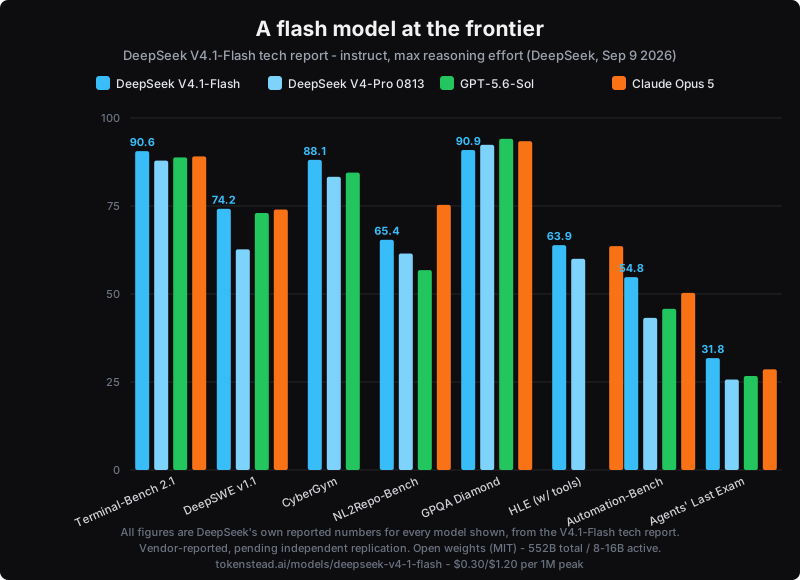
Vendor-reported - from the developer's own model card / tech report
The vendor-reported scores this guide cites, charted from the same data the model card carries.
The KV cache is the pricing story
The KV cache is FP4 and roughly 890 bytes per token. At the full 1M context, a full cache is under 1GB - context memory, the recurring cost driver for long agent sessions, stops being a constraint on this architecture. DeepSeek’s claim against the previous generation: one quarter the HBM and one eighth the SSD storage. Cache-hit charges often dominate agent-workload bills, and the rate card shows it:
| V4.1-Flash, per 1M tokens | Peak | Off-peak |
|---|---|---|
| Input, cache miss | $0.30 | $0.15 |
| Input, cache hit | $0.006 | $0.003 |
| Output | $1.20 | $0.60 |
Peak windows are 01:00-04:00 and 06:00-10:00 UTC, Monday through Friday; everything else is off-peak at half rates. For comparison, the V4-Pro rates being retired were $1.32 peak input and $3.96 peak output per 1M tokens - the flagship tier just dropped to about a third on output.
Data accumulates from 2026-09-10. Longer ranges populate over time. Pricing via OpenRouter routing only. Direct-provider pricing (Baseten, Z.ai, Vast.ai) is not yet tracked.
Tracked input pricing since the first daily OpenRouter snapshot after launch.
The local side
At 485B of safetensors parameters, the 510GB FP8 repo is beyond any consumer rig, but the quantization ladder is the usual story: community 4-bit copies land roughly in the 250GB range, which puts this on the top tier of unified-memory machines rather than a 128GB Mac Studio. The architecture helps where it can: with FP4 KV at 890 bytes per token, memory pressure at long contexts is negligible - the weights, not the cache, set the rig floor. The model card ships an inference/ folder for weight conversion and local setup, plus quantized variants in the llama.cpp, Ollama, and LM Studio ecosystems.
The phase-out mechanics
Compatibility is handled server-side: deepseek-v4-flash and deepseek-v4-flash-vision-exp route to V4.1-Flash until further notice, and from September 14 deepseek-v4-pro does the same at Flash rates until V4.1-Pro launches. DeepSeek’s claim - tested by multiple parties, ahead of V4-Pro on performance, cost, speed, and total runtime - is a vendor claim, but the pricing alone moves the flagship tier down 3.3x on output while the weights go MIT. For the own-versus-rent math on this site, the rent side just got materially cheaper on the frontier tier; the own side gains a new open-weight checkpoint in the 250GB-at-4-bit class. Live pricing and the memory ladder for the new model are on its model card.
Adoption moved fast. OpenCode Go added V4.1 Flash on day zero and, for 72 hours, is running a 4x usage promo on it - 26,000 estimated requests per 5 hours on the $60 tier, against 6,500 normally. Subscription tiers re-bundling a fresh checkpoint within a day is the fastest reflection yet of how the flash-tier market works: the weights are MIT, the API is cheap, and the middlemen compete on limits. If you are picking the harness to pair it with, the agent harnesses directory now tracks DeepSeek Harness, DeepSeek’s own MIT-licensed, everything-is-a-plugin agent runtime that shipped alongside the model push.
DeepSeek is also soliciting large deployments directly - the announcement’s closing line asks anyone planning 2,000 GPUs plus a storage cluster to contact them, which is as clear a signal as any that this release is aimed at self-hosting operations as much as at the API.
Sources
Primary: DeepSeek announcement thread · V4.1-Flash model card · tech report · API pricing.
Adoption: OpenCode on X, day-0 support and 4x usage promo · OpenCode Go usage page.
Related on this site: DeepSeek V4 Flash 0731 · DeepSeek V4 Pro · Agents on Rails: the 16-model leaderboard
Discussion
Be the first to commentStart a discussion
Got a take on this, a rig to show off, or a benchmark that says otherwise? Sign up and start the thread - your comment publishes instantly once you're in.