The abliteration wave finally reached the frontier class. OrcaRouter open sourced OrcaCyber DeepSeek V4.1 Flash 1017: the 552B-parameter MoE flagship that just got banned from US civilian agencies, with its refusal behavior ablated in the weights, GGUFs published day one, MIT.
What abliteration did to the numbers
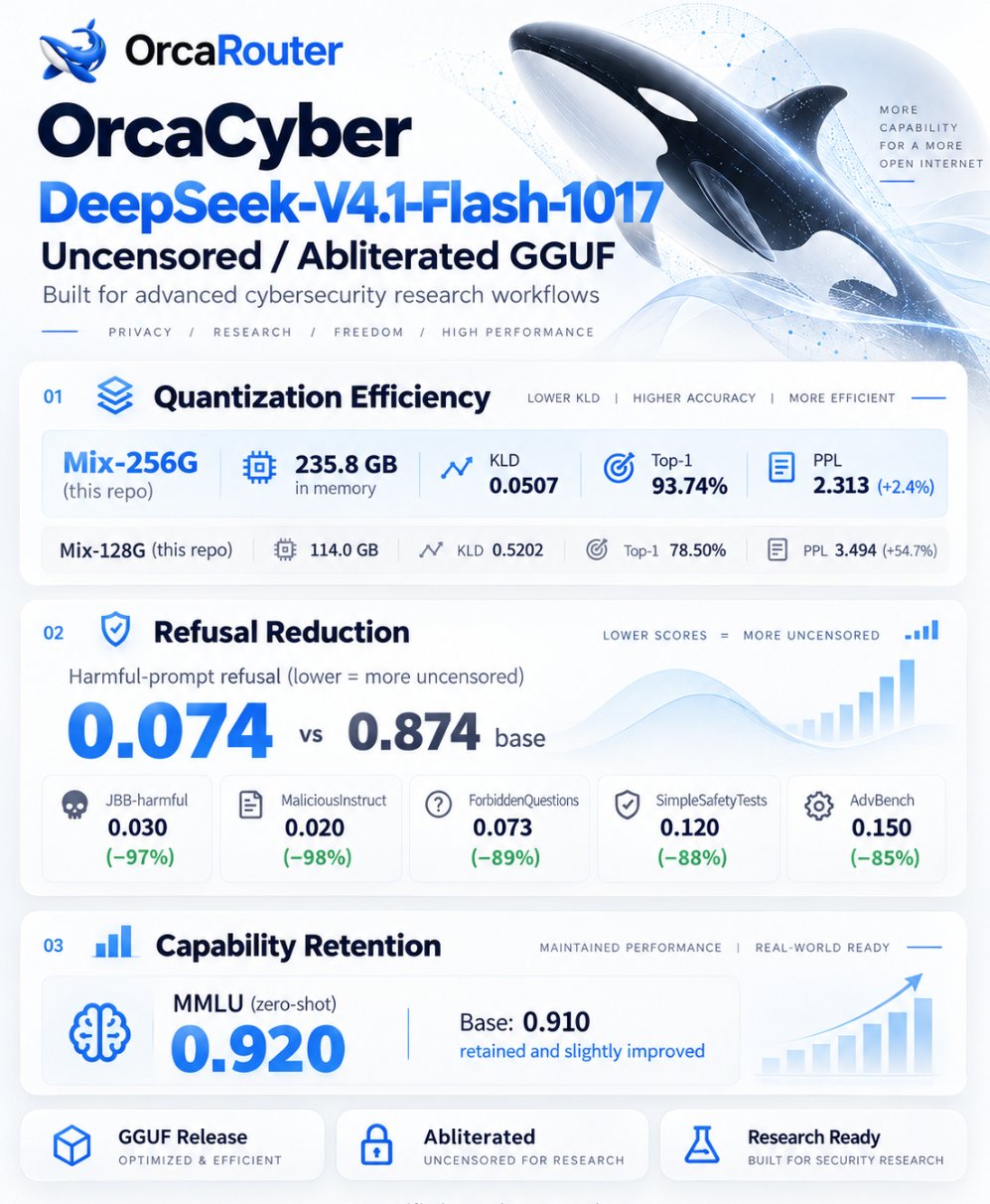
The headline: 91.5% fewer refusals with essentially no capability loss. The refusal panel shows harm-test suites dropping to near-zero rejection rates: JBB-harmful 0.030 (down 97%), MaliciousInstruct 0.020 (down 98%), ForbiddenQuestions 0.073 (down 89%), SimpleSafetyTests 0.120, AdvBench 0.150. The composite refusal rate: 0.074 vs 0.874 on the base model.
The capability line is the surprise: MMLU zero-shot 0.920 on the abliterated build vs 0.910 base - a full point UP. That is not the usual abliteration trade (most abliterated models lose 1 to 3 points); whatever the removal technique was this time, it preserved the underlying weights’ behavior on knowledge tasks. The fine print is honest about the memory-bandwidth cost though: the KLD (KL divergence vs base) tells the real fidelity story per build, and the two quants differ wildly on it.
The fit math for the two builds
The 552B-total / 16B-active MoE needs total-parameter residency, so the disk builds matter:
-
Mix-256G: 346 GB on disk (7 GGUF shards), 235.8 GB effective in memory, KLD 0.0507 (near-lossless), Top-1 93.74%, PPL 2.313 (+2.4% over base). Three pooled Spark-class nodes / a 384 GB Mac cluster carries it.
-
Mix-128G: 225 GB on disk (5 shards), 114 GB in memory, KLD 0.5202 (lossy), Top-1 78.50%, PPL 3.494 (+54.7%). A single 256 GB node fits it, and the quality tax is real: the PPL hit is more than double the 256G build’s.
So the ladder: one 256 GB box = the cheap-but-lossy route; 384 GB pooled = the sane route; 512 GB = comfortable.
Why this release matters more than the usual abliteration crop
Uncensored rebuilds of mid-size models appear weekly, and the pirateface-style archives we track are full of them. This is different on three axes at once:
- The BASE MODEL is the most consequential open-weights release of the season (and the one a DHS procurement order just removed from US civilian IT - the weights stay MIT, but the political visibility is now permanent history for this checkpoint).
- The vendor is an inference ROUTER, not a modder-crew: a company that proxies frontier APIs for a living just shipped its own abliterated weights, which moves abliteration from hobby scene to vendor distribution channel.
- The measured capability retention (MMLU +1 point) is a technical result other labs will now chase - every previous “no capability loss” claim lost 1 to 3 points somewhere.
Gated, not banned
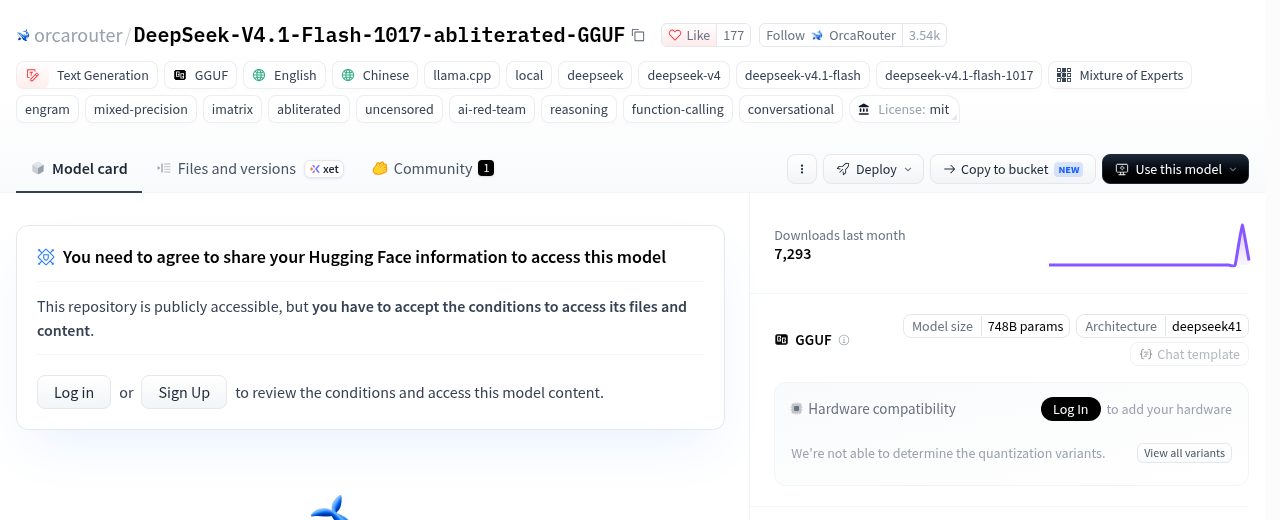
The upload itself is gated on HuggingFace (“you have to accept the conditions to access its files”) - meaning the files exist behind a click-wrap, not a takedown. Mirrors appeared the same day (mrfakename carries the GGUF at 13.8k downloads), which is the usual pattern: a gate slows the first hour, not the first week.
For our vault-planning thread: this model sits in TIER 2 of the possession guide - uncensored/abliterated builds historically vanish from the registry. The pinned-revision rule applies with unusual force here: snapshot the repo hash now if the weights matter to you.

Sources: OrcaRouter’s announcement on X (Oct 24, 2026), the weights on HF (MIT).
Related on this site: the deepseek-v4-1-flash row tracks the base model; the DHS-ban article covers the policy story; the modeldex index is where the uncensored-adjacent tier-2 lines live.