The open source world just produced its own anti-AI moment, and this one is not a thread argument. r/opensource - half a million members, 18 years old, the default “where do I post my project” venue - posted new rules Saturday evening: “If your project uses AI, is made by AI, or is intended for AI, it’s not welcome on r/opensource. AI, as it exists today, is incongruent to this Open Source community.” The rules took effect the moment they were posted; enforcement includes removing the post and banning repeat posters. A rival sub, r/trueopensource, spawned within hours.

What the rules actually say
Three restrictions went live at once. The AI ban covers any project that uses AI (a dependency on an LLM API counts), is made by AI (the code was written by one), or is intended for AI (ML frameworks and inference tooling are out the door). Submission language: English only - the sub’s multilingual tolerance ended. And every submitted project must now be at least one year old, which quietly kills announcement-day posts, the sub’s main content type for years.
The stated reasoning is training-data provenance: models trained on scraped material that “cannot truly be considered open source, even if the resulting model weights are released publicly.” Which, whatever you think of the conclusion, is at least a philosophical position rather than a vibe - the mods are arguing attribution chains, not aesthetics.
This is a wave, not a one-off
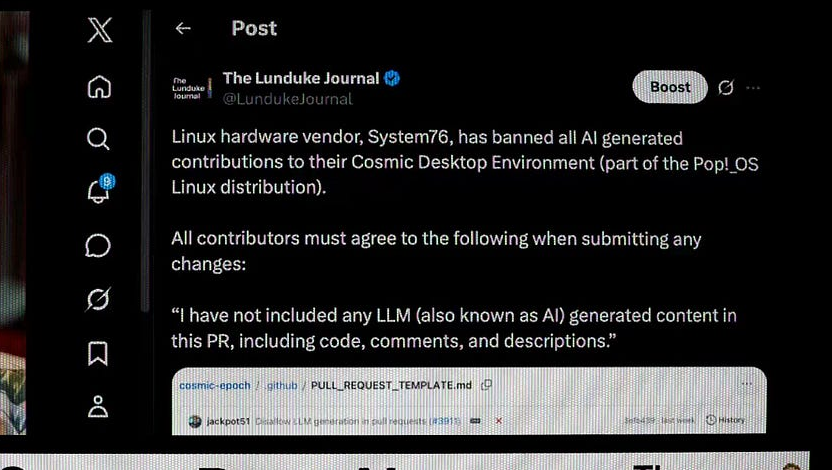
Lunduke’s journal documented the earlier stage of the same motion on Oct 9: System76 banned AI-generated contributions to COSMIC (their Pop!_OS desktop), with the attestation baked into the PR template - every contributor confirms “I have not included any LLM (also known as AI) generated content in this PR, including code, comments, and descriptions.” Elementary OS, OBS, and Guix sit on the same list. r/opensource is the biggest single venue to try it as a community-wide rule.
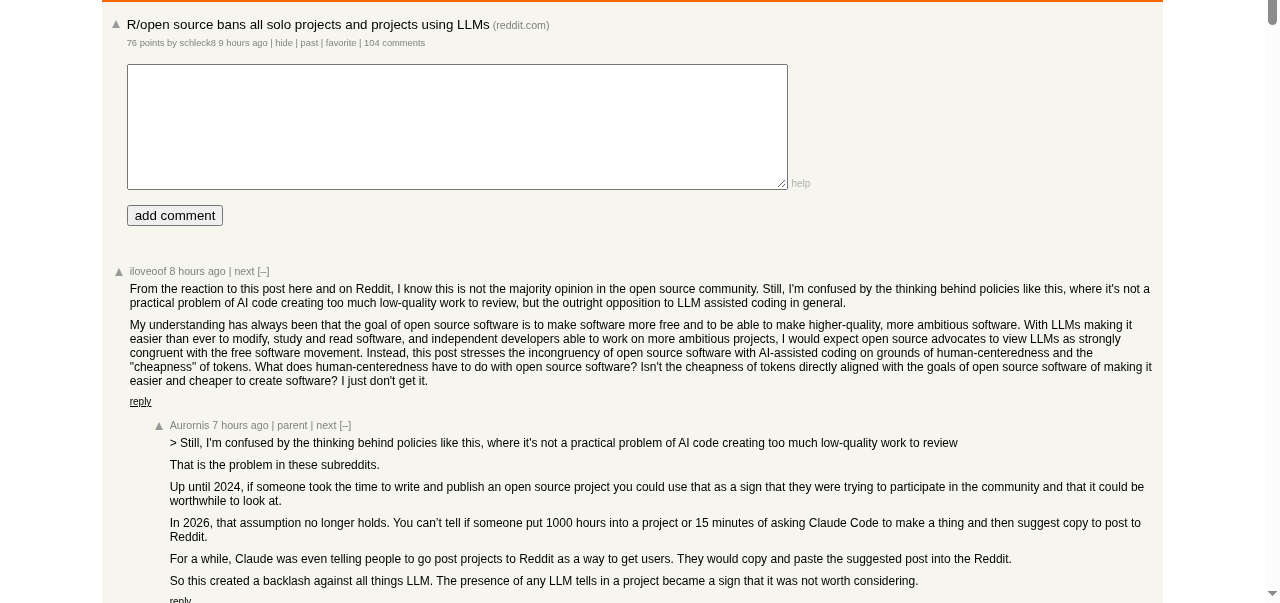
Community response on HN (76 points, 104 comments) runs the full spread: one camp treats it as hygiene (“the presence of any LLM tells in a project became a sign it was not worth considering” - the tell-hunting is now a moderation function), while others point at the obvious hole: the Linux kernel itself now contains AI-generated code, so a strict reading of “is made by AI” bans effectively everything downstream of the kernel, and the mods themselves concede they will enforce selectively (accessibility captioning stays, per moderator Wolvereness in the thread).
Why it matters to the local-AI world
The irony is structural: the SAME week, local AI had its best week in months. Kimi K3.1 Pro, Bolt E4B’s Minecraft NPC, Dessa’s full-duplex voice, OrcaCyber’s measured abliteration - the models just keep getting better ON the machines that open source communities run. A community built on “run it yourself, inspect everything” deciding that AI tools are categorically unwelcome lands exactly as those tools become inspectable, local, and open-weight. The philosophical fracture is real: one side says provenance of training data poisons anything downstream; the other says the weight files are here, the licenses are on the cards, and refusal-by-attrition will not put the capability back in the box.
For us the honest line stays where it has been all year: publish the weights, verify the benchmarks, run what you can inspect. If a community bans the tools while shipping the hardware those tools accelerate, the practical outcome is a migration of its younger contributors to the venues that don’t ask - and a philosophical one to figure out. Either way the story is no longer hypothetical: half a million members, one rule, zero consultation, immediate effect.
Sources: The Verge (Terrence O’Brien, Oct 25), the rules as quoted via the emergent.sh and rockstarmedia syndications of the Oct 24 moderator announcement, The Lunduke Journal’s Oct 9 report (System76 PR template), HN thread #50231722, the HealthRanger Oct 25 reaction post.
Related on this site: OrcaCyber: DeepSeek V4.1 Flash without refusals is the uncensored-weights side of the same tension; Claude Code’s cyber wall is the cloud-side refusal pressure; the engine catalog is where the local side lives.