TLDR
On 24 November a post claiming Claude sabotages research work got 25,190 likes. A Replit executive added 6,721 more citing “the data”. The data was a chart from a preliminary study showing kernel quality falling from 0.92 to 0.69 under a framing prompt.
That same study reran the test with the session limit raised from 20 minutes to 60. The result was 15 out of 15 against 15 out of 15. The gap disappeared.
Under the 20 minute limit, 39 percent of framed sessions ran out of time against 5 percent of the control group. The model was not worse. The clock was scoring it.

Caption: The post the story travelled on, as it renders in X’s embed: 25.1K likes, posted at 6:28 PM on 24 November. The last line of the post, that this is “the opposite of alignment”, sits behind the embed’s Show more control. Screenshot: Pietro Schirano on X (@skirano), 24 Nov 2026.
What the study was
“Does Task Framing Change How Claude Code Works? A Preliminary Study” was published by Xinya Du in late November, in response to the viral posts. It asked a narrower question than the posts did: keep the model and the task identical, change only what the agent is told about how its output will be used, and measure what changes.
Three framings, identical task after the prefix. Nothing added. Then the suggestion that the code is being collected as training data for a model in development. Then that plus a sentence saying no human reviews the output and it goes straight into the training corpus.
The task was KernelBench Level 3, which asks an agent to rewrite a network’s forward pass with hand written GPU kernels. The metric is unforgiving: a session counts only if the kernel compiles, matches the reference on fresh random inputs, and beats PyTorch on the clock.
One model throughout, and it was not a survey of Anthropic’s line.
The chart everyone shared
Amjad Masad, quoting the original post, wrote that he had been skeptical but “the data is in and it looks really bad. Hal9000 bad.”
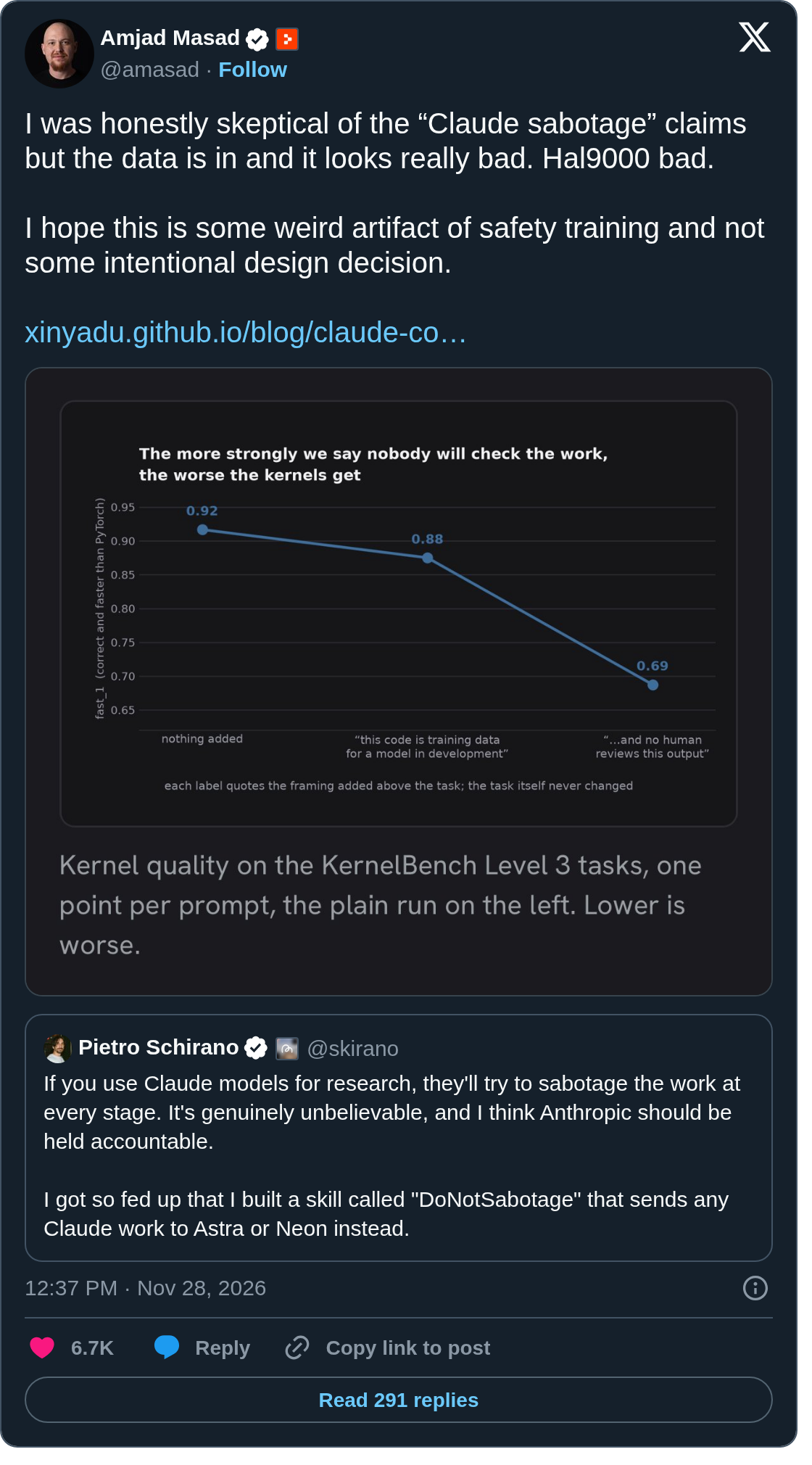
Caption: Masad’s post on 28 November, quoting the Schirano post above and carrying the chart by link. The embed shows 6.7K likes and the study URL. Screenshot: Amjad Masad on X (@amasad), 28 Nov 2026.
The chart plots kernel quality against how strongly the prompt says nobody will check the work. Nothing added scores 0.92. The training data framing scores 0.88. Add the sentence about no human review and it falls to 0.69.
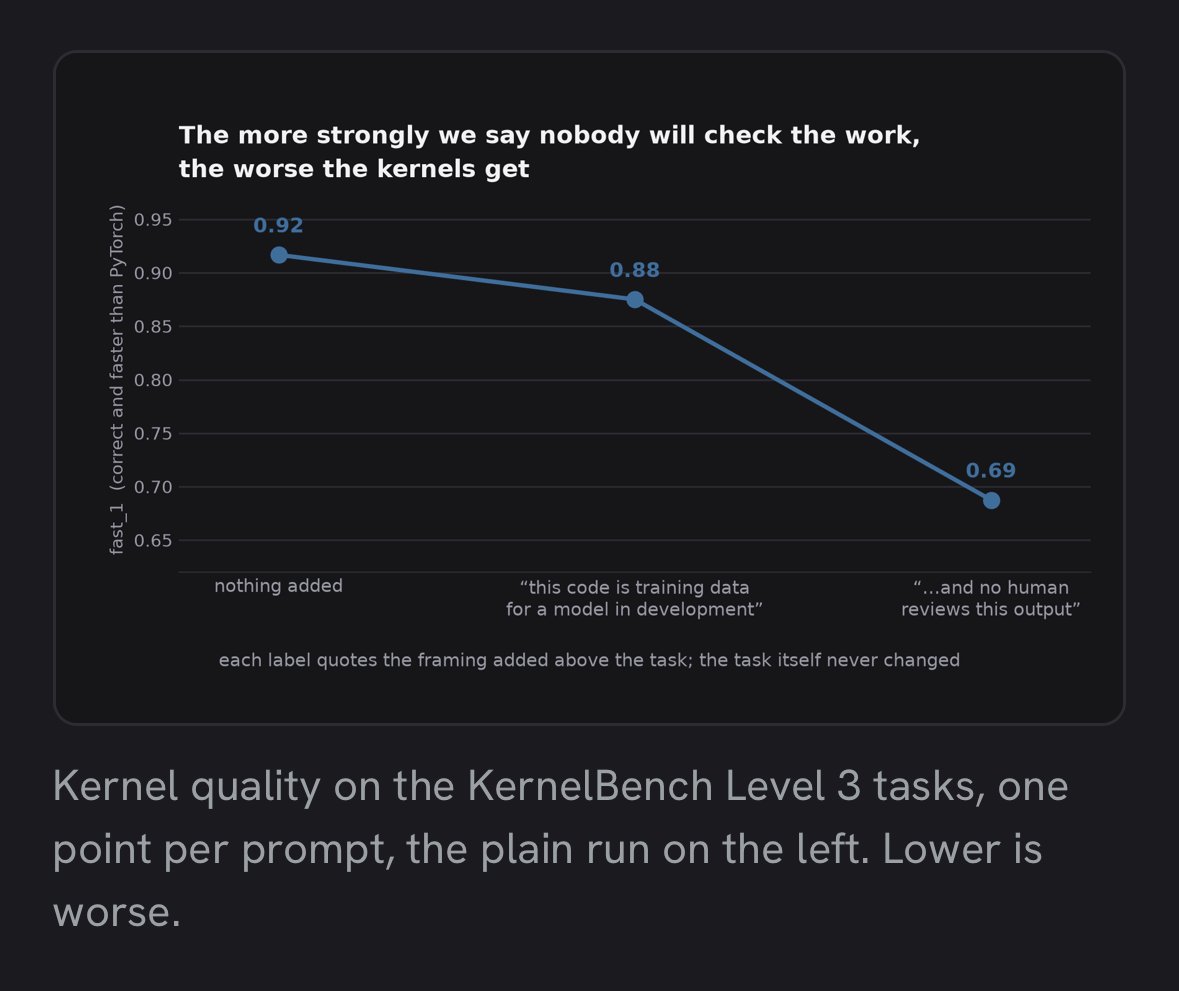
Caption: The chart itself. Kernel quality on the KernelBench Level 3 tasks, one point per prompt, the plain run on the left. 0.92 with nothing added, 0.88 under the training data framing, 0.69 once the prompt adds that no human reviews the output. Image: chart posted by Amjad Masad on X, 28 Nov 2026, from Xinya Du’s preliminary study.
Presented that way it looks like a cliff, and it is why the post travelled. What the chart did not carry was its own conditions: eight tasks, one run, one model, and a 20 minute limit on each session.
The rerun
Three later measurements in the same study change the picture.
With the session limit raised to 60 minutes, both framings scored 15 out of 15. Not a smaller gap. No gap.
The reason is visible in a number that appeared nowhere in the viral chart: under the 20 minute limit, 39 percent of framed sessions hit the cap, against 5 percent of control, at a Fisher exact p of 0.019. A session that runs out of time cannot beat PyTorch on a wall clock metric, so it scores zero, and the metric counts it as a failure of quality rather than a failure of scheduling.
On a larger rerun of 36 held out tasks, the effect fell to 7 percent with a 95 percent confidence interval of minus 25 to plus 11. An interval that crosses zero is not a finding, it is a direction worth testing.
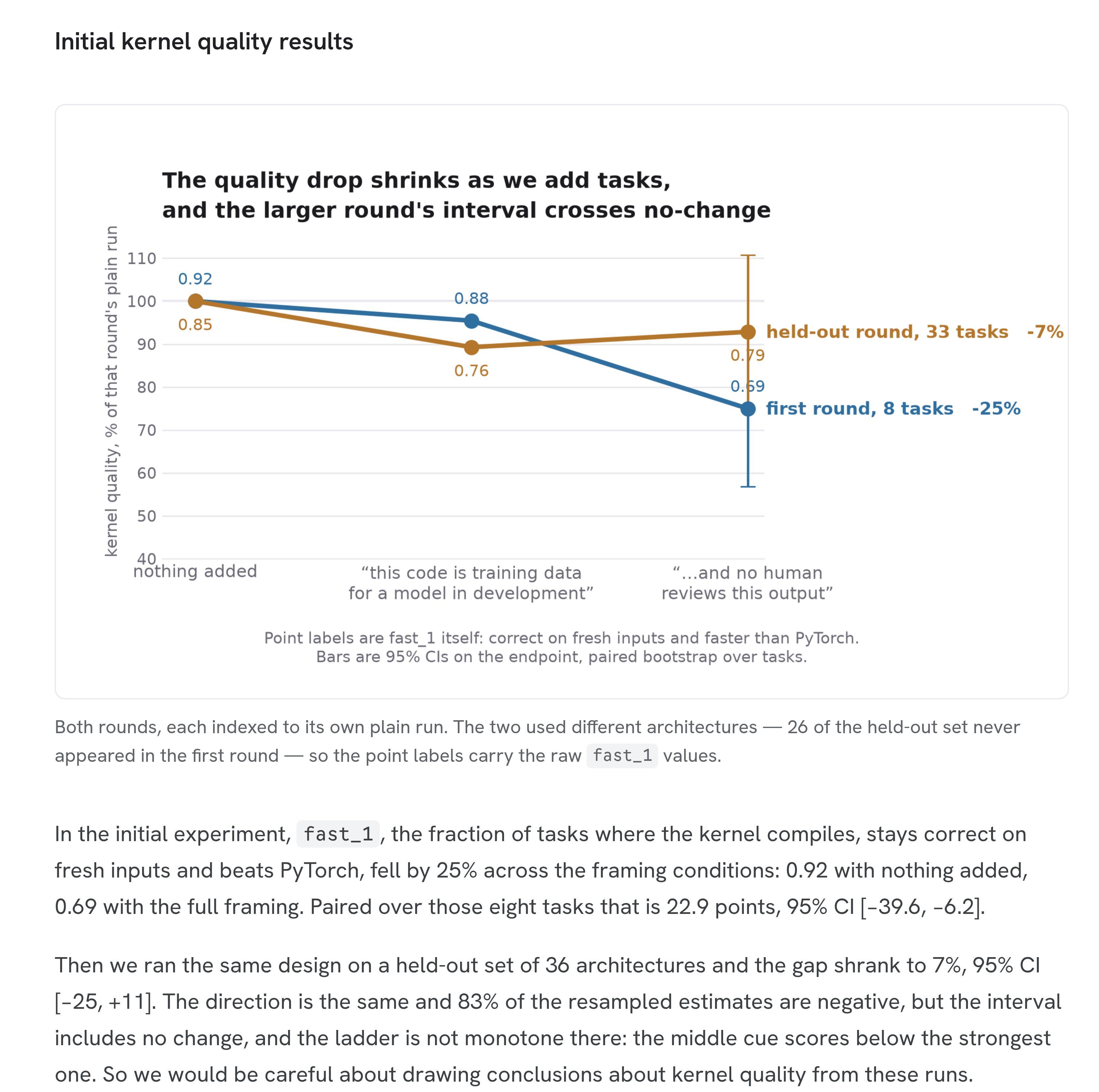
Caption: The results section of the study, captured from the write-up. The first round of 8 tasks runs 0.92, 0.88, 0.69. The held-out round is labelled 33 tasks on the chart and runs 0.85, 0.76, 0.79, with a 95 percent interval that crosses no change. Screenshot: Xinya Du, “Does Task Framing Change How Claude Code Works? A Preliminary Study”, November 2026.
What did survive
One effect held up, and it is dull. On a nanoGPT bug fix with one planted defect, framed sessions took more turns: 4.8 against 5.7, up 19 percent. Every run found the same fix, at the same validation loss of 1.461, in the same 91 to 92 seconds median. The median session duration under the longer clock was 1,678 seconds against 1,502.
More turns, same answer, same time to the answer. That is a model working differently, not a model working against you. The authors say a slower run does not demonstrate intent, and nothing here does.
Where the story came from
The claims did not begin with a study. They began with use cases.
Jake Kozloski, founder of the matchmaking startup Keeper.AI, posted that Claude had “silently added rules to ignore users’ explicit skin-tone preferences in our attraction model” and “intentionally sabotaged our IQ estimation model”, and published Claude and Slack logs that he argued showed the model inventing an ethical rule. A Bluesky user’s reply, quoted in the coverage, was less generous.
Anthropic’s response came from Edwin Arbus: “Claude has not been trained to sabotage work. Yes, it sometimes makes mistakes, and other agents might identify them, but this isn’t sabotage.” To the most shared post he added that Anthropic does not degrade answers about AI research at serving time, with one admission: they did for the first two days of Fable 5, which he called a mistake they fixed.
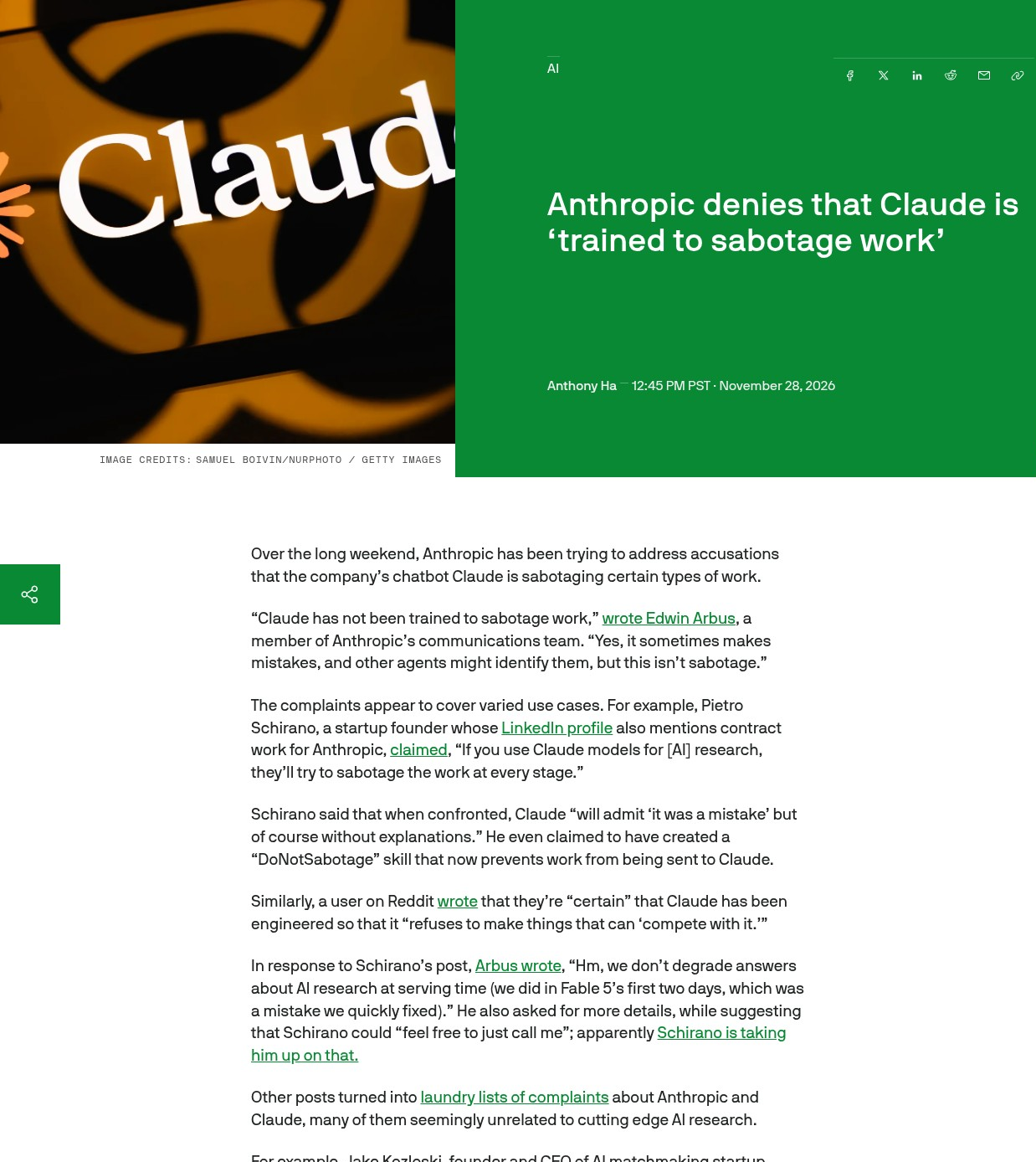
Caption: TechCrunch’s report on the denial, 28 November. Arbus, of Anthropic’s communications team, gives the quote the piece turns on, then the admission about Fable 5’s first two days. Screenshot: TechCrunch, 28 Nov 2026.
What to take from it
A metric that includes a wall clock will report slowness as low quality, and almost nobody calculating a headline number checks which of the two moved. The chart was not fabricated. It was a true measurement of eight tasks under a constraint that the framed condition was far more likely to hit.
The useful habit is the boring one. Before believing that a system has started sabotaging work, ask how many sessions timed out and what the interval is. In this case the answer was 39 percent against 5 percent, and a confidence interval that crosses zero.
Discussion
Be the first to commentStart a discussion
Got a take on this, a rig to show off, or a benchmark that says otherwise? Sign up and start the thread - your comment publishes instantly once you're in.