Meta description (draft): Willison asked for default hard budget caps; AWS and Google shipped early versions. The cap that cannot fail open is a box you own. The per-build math. —
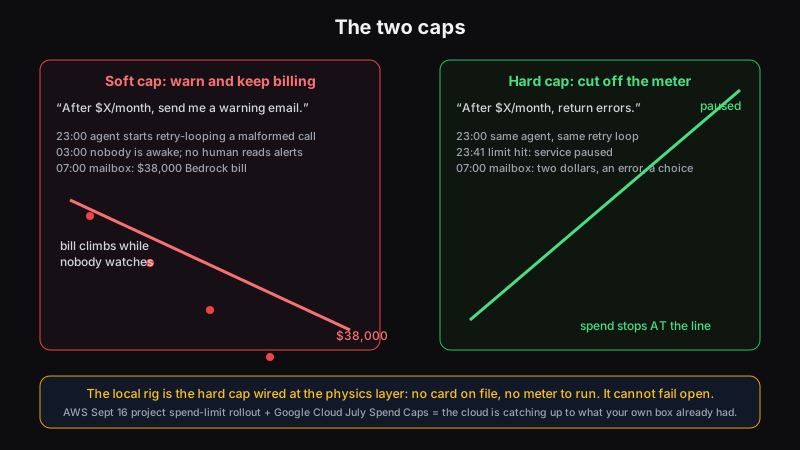
Simon Willison’s October 3 argument is the cleanest framing yet of the problem every agent operator eventually meets: pay-by-usage services need default hard budget caps, the kind that return errors once you cross a number, not the kind that send a warning email. A coding agent lowers the friction of spinning up work that costs money until the cost of one runaway retry loop is a four-figure bill at dawn. His post landed at 468 points on HN; the cautionary tale is one thread away, an $38,000 AWS Bedrock invoice caused by nothing more than a prompt-caching miss.
The cloud is responding, though slowly. AWS shipped project-level spend limits on September 16 that pause a project for the month; Google Cloud launched Spend Caps in July, both are the right shape: usage stops at the line, opt-in to go uncapped. Neither is GA-everywhere yet, and Willison’s real point stands: they need to be the default, not a feature you go looking for after the first invoice.
The local pitch, sharpened
Your own hardware is the one budget cap that cannot fail open. There is no card on file to charge and no meter to overrun. The agent’s ceiling is watts and gigabytes, enforced by the wall outlet, and the recurring bill is your electricity rate times duty cycle. When the agent works at decision-model rates (the class this site tracks: routing, triage, guardrails, reranking), a single used card covers the workload forever, and the build cost is the total spend of its lifetime, not the first month of it.

At October’s street prices from this site’s snapshots, the tiers are: the $1,499 used 3090 value-pick caps the always-on classification line, the build that pays for itself in months against one capped agent. The $19,497 twin-5090 rig and the $6,499-per-unit Spark line cover the serious lanes. A $38k Bedrock bill sits inside the value-pick’s budget twenty-five times; the failure mode the cloud is still shipping its way toward, your box shipped with.
Sources: Willison’s post - HN thread, 468 pts - $38k Bedrock bill - AWS spend limits - Google Spend Caps
Related on this site: How to Spend $200/Month on AI in 2026 - The value pick - Open-weights models cost less: a 2026 pricing guide
Discussion
Be the first to commentStart a discussion
Got a take on this, a rig to show off, or a benchmark that says otherwise? Sign up and start the thread - your comment publishes instantly once you're in.