TLDR
OpenAI told investors its annualized revenue was approaching $50 billion at the end of September, about $20 billion below the $70 billion run rate widely reported in late September, per the Financial Times. It enables anyone holding AI-infrastructure equity or judging the IPO narrative to see the distance between a growth story and a comparable-to-Anthropic story. The difference between the two numbers is arithmetic and definitional: the September figure was built to make OpenAI’s growth rate legible against Anthropic, the October figure is built to make OpenAI’s revenue legible against Anthropic’s, and the same books produce both.
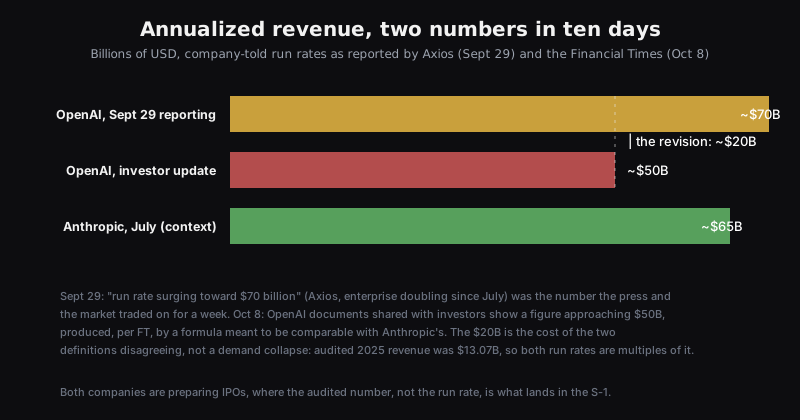
Caption: the September run rate the market traded on, the October investor figure, and Anthropic’s July number for scale; the $20B revision is the cost of moving between definitions.
What the two numbers were
The September figure came to the press through Axios-sourced reporting on September 29: a run rate surging toward $70 billion, up more than 70 percent since the start of the third quarter, business-to-business sales up more than 100 percent since July, and consumer revenue in the quarter alone exceeding what all of 2025’s consumers brought in. Oracle finished the next session up 5.3 percent, and for the week that followed, the “$70 billion OpenAI” became the baseline every compute-side forecast carried, from chip-debt packages to power-plant schedules.
The October figure is OpenAI’s own document, shared with investors and reported by the FT on October 8: annualized revenue approaching $50 billion at the end of September, about $20 billion less than previously signalled. Per the FT, citing a person familiar, the discrepancy stemmed from OpenAI’s effort to produce an annualized figure comparable with Anthropic’s, and the $70 billion September figure came from a different construction. Anthropic’s July annualized revenue was about $65 billion on that comparable construction, while on the September construction OpenAI’s comparable number was $70 billion. The two formulas do not disagree about how much money OpenAI took in during September. They disagree about what a run rate is.
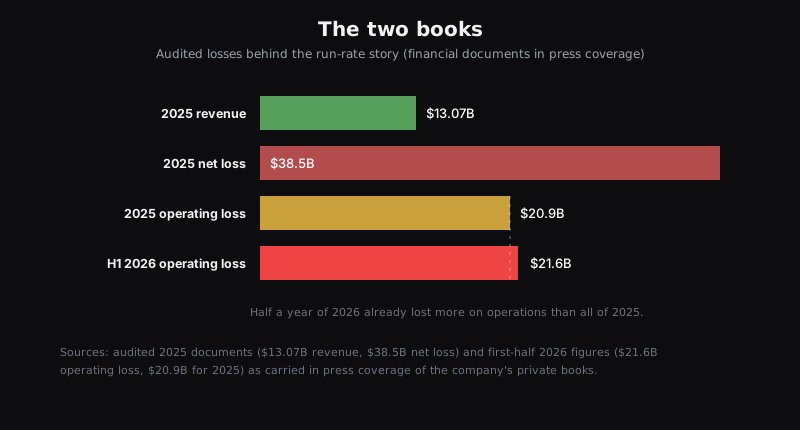
Caption: the audited and reported loss figures that sit behind both run rates; the first half of 2026 has already lost more on operations than all of 2025.
The books under the run rate
Audited 2025 documents put OpenAI’s revenue at $13.07 billion against a net loss of $38.5 billion, about $1.60 lost for every dollar earned. Operating-loss accounting of the same year shows roughly $20.9 billion, and the first half of 2026 carried $21.6 billion of operating losses, which means the company lost more on operations in six months than in all twelve of the year before, during the exact window its run rate was publicly climbing toward $70 billion. Neither number contradicts the other: a run-rate claim and a loss claim measure different things, and both were available the entire time.
Annualized revenue is an extrapolation of a short window, and the extrapolation bends dramatically on three choices: whether committed contracts count, whether usage against rate limits counts, and which month is the base. Anthropic’s number, which the FT says OpenAI was trying to match, has survived more skeptical coverage than most precisely because Anthropic discloses its own books more often. When OpenAI produces a $50B that borrows Anthropic’s construction, the gap to $70B is a measurement of how far the September narrative had drifted from the audited floor of $13.07 billion.
The churn and the timing
Denise Dresser, OpenAI’s chief revenue officer, departed in August after less than a year, replaced by Dali Rajic, and the revenue-definition revision surfaced six weeks later. By then the September $70B narrative had run its week, and the investor document showed $50B. Revenue-definition changes at a company preparing an IPO, timed to a new revenue chief’s first months, are the kind of coincidence that financial reporting treats as a fact pattern rather than a smear: the company re-cut a headline number downward before an offering, in a filing cycle where a higher number later collapsing would read as misrepresentation, and a controlled revision now reads as housekeeping. The IPO motive runs the same direction for Anthropic, whose $65B July figure is the cleanest comp in the document set.
Market reaction, both directions
The intraday receipts give the story its price tag. OpenAI perpetual futures listed on the crypto exchange Liquid slid on the report, a small instrument but a fast read. Oracle and AMD fell, the same two names that had rallied on the September growth number and on their capacity commitments to the company. Gil Luria’s September note to Reuters that OpenAI’s growth was a positive signal for Oracle’s ability to meet its capacity commitments became, in October, a question of whether those commitments were sized against a $70B customer or a $50B one, and the stock prices of the compute suppliers moved against their own September direction within hours of the reporting. The infrastructure buildout was financed on the higher number; the debt service is now repricing against the lower one.
What to watch
- Whether the FT’s comparable-with-Anthropic construction gets its own named metric in future OpenAI investor updates, or whether the company retreats to audited-only numbers as the IPO approaches.
- Anthropic’s next investor figure: if its construction is the one OpenAI adopted, its own December number becomes the baseline both companies are judged on.
- Whether Oracle or AMD restate or re-time any capacity commitment language this quarter; the stocks’ October slide is the market pre-reading that footnote.
- The Q3-to-Q4 consumer-versus-business split inside the $50B: the September story leaned on consumer records; the comparable construction weights business revenue, and the mix is where the next revision hides.
- The Dresser-Rajic window: any statement on when the re-cut formula was adopted would date the revision against the hire.
Sources: Financial Times - Wall St Engine - MarketScreener - Quartz on the September run rate - ZeroHedge on the August departure - AInvest on the audited books
Related on this site: SpaceX’s $40B Nvidia GPU debt talks - Nvidia talks acquire Hugging Face for $13B - Agent liability insurance gap
Discussion
Be the first to commentStart a discussion
Got a take on this, a rig to show off, or a benchmark that says otherwise? Sign up and start the thread - your comment publishes instantly once you're in.