TLDR
SpaceX is in talks to borrow about $40 billion to buy Nvidia chips, the Financial Times reported on October 6, with Bloomberg confirming the talks a day later. It enables Elon Musk to fund the Colossus AI datacenter buildout on debt instead of SpaceX’s own cash. The difference between this and a normal corporate bond sale is the loop it closes: Apollo would lead the financing, SpaceX would hand the money to Nvidia for GPUs, and Nvidia itself set up the financing platforms with Apollo in August to mobilize over $500 billion of third-party capital for exactly this kind of purchase. Neither deal is signed; the FT’s sources say completion in 2027, Bloomberg’s say early stage.
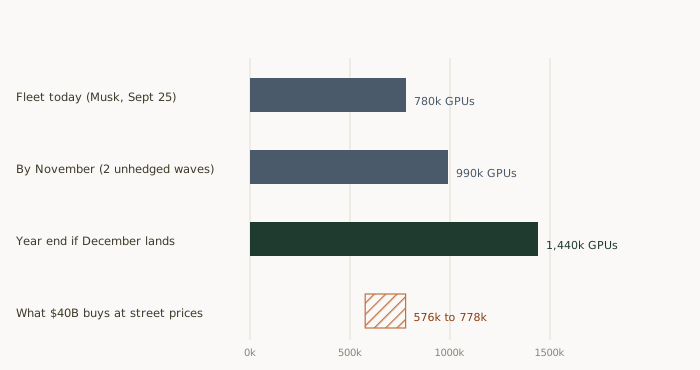
Caption: Musk’s own Colossus counts (Sept 25) against the 576k to 778k GPUs that $40B buys at street rack prices of $3.7M to $5.0M per NVL72 rack.
The deal as reported
Two reports, one day apart, unnamed sources on both sides. The FT’s structure: roughly $10 billion in bank loans plus $30 billion in investment-grade debt, sold to a broad investor base, with Apollo leading and Pimco among the lenders in talks. Completion in 2027 per the FT’s people. Bloomberg’s people describe the talks as early stage, and they could still end without a deal. Reuters, Yahoo Finance, Business Standard and The Next Web all carried the same numbers within hours; SpaceX, Apollo, Nvidia and Pimco did not respond to Reuters’ requests for comment.
The number is large by corporate standards: the biggest AI-infrastructure debt deals before it were Meta’s $30 billion Hyperion SPV financing in Louisiana (October 2025) and Oracle’s $38 billion package for datacenter projects (October 2025), both assembled with similar bank-and-bond structures. A $40 billion raise for chips alone, with no datacenter real estate attached, would be the largest of its kind. Morgan Stanley pegs total AI-related debt issuance at nearly $570 billion for 2026, more than double 2025.
The market reaction to the reports was a shrug: SpaceX fell about 1% after hours Tuesday, Nvidia rose about 0.5%. SpaceX carries a $5.8 trillion market value, so $40 billion of new demand barely moves the stock.
Where the money goes: Musk’s own fleet math
Musk posted the Colossus counts himself on September 25. Colossus 1: 150,000 H100, 50,000 H200 and 30,000 GB200, about 230,000 chips, now rented almost entirely to Anthropic for inference because the Hopper-and-Blackwell mix is inefficient for training Grok. Colossus 2: 110,000 GB200 and 440,000 GB300, about 550,000 chips. Then three more waves of 220,000 GB300 each: one “fully operational next week”, one in November, one more by late December “if we get lucky”. All three landing takes Colossus 2 to about 1.21 million chips and the fleet to roughly 1.44 million, backed by a dedicated 1.2-gigawatt power plant on site.
Against that schedule, $40 billion of debt is the purchase order for the waves. The math is loose but checkable: GB300 NVL72 racks run $3.7 million to $5.0 million at street prices, so $40 billion buys 8,000 to 10,800 racks, 576,000 to 778,000 GPUs. That covers the November and December waves with something left over, which matches Musk’s own >$50 billion estimate for Q4 GPU purchases reported by The Information in late September. The reported number sits inside the range the schedule implies, not above it.
The deadline pressure is explicit. In August, Musk said his companies would build AI infrastructure exclusively on Nvidia hardware. In September he conceded Grok trails Anthropic’s models (“I was clearly wrong about Anthropic. They are obviously currently the leader in AI”) and ordered the fleet doubling in the same week. The debt is how the doubling happens without waiting on $2.17 billion a month of tenant rent to accumulate.
The loop: Nvidia helping buyers buy Nvidia
The Apollo connection is fully public. On August 10, Nvidia announced financing platforms with Apollo, BlackRock, Blackstone, Brookfield, Goldman Sachs and KKR “to mobilize over $500 billion of third-party capital for the buildout of AI infrastructure over time.” The same Apollo is now reportedly leading a $40 billion raise so SpaceX can buy more Nvidia product.
The structure is vendor financing with new furniture, and the comparison to Lucent’s telecom-era playbook is already written: Tomasz Tunguz’s October 2025 analysis laid out the pattern, supplier helps customer buy supplier product, chips as collateral, SPVs keeping it off the balance sheet. xAI has done GPU-backed debt before: a $12.5 billion SPV in the $20 billion Colossus 2 raise (October 2025) where the debt was “backed by the GPUs themselves rather than corporate assets”, and Nvidia itself put up to $2 billion into the equity side of that round.
Nvidia’s own stake makes the entanglement measurable. Its SEC filing on August 14 showed 122.8 million SpaceX Class A shares worth about $21 billion at the end of Q2, its second-biggest holding behind Intel. The stock closed at $140 that Friday, down from $170.86 at the end of June, dragging the stake to about $17.2 billion. The supplier holds equity in the buyer, leads the financing channel for the buyer’s purchases, and signs the buyer’s purchase orders. Jensen Huang told investors these deployments are “not commitments, promises, or legal obligations” in Nvidia’s own filing language for the Vera Rubin buildout.
The HN thread on Nvidia’s SpaceX stake (47 points, mid-August) hashed out the two readings in comments. One: “All these companies making investments in each other, where company A puts 10 billion into company B and company B buys 10 billion of company A’s products can’t work out well in the end.” The counterpoint from the same thread: “They do what everyone in their position would do. What matters are the boxes leaving the warehouse. Dozens of thousands of them.” Both are true, which is what makes this worth tracking rather than dismissing.
The revenue side: can the debt service itself
The revenue that could service this loan is already contracted at Colossus 1. SpaceX’s own regulatory filings show Anthropic paying $1.25 billion a month through May 2029 for the full output of Colossus 1, and Google paying $920 million a month from October 2026 through June 2029 for about 110,000 GPUs, roughly $75 billion contracted across the two, every deal breakable on 90 days’ notice after December 31, 2026.
Debt service on $40 billion at investment-grade rates of roughly 5 to 6% costs $2.0 to $2.4 billion a year in interest, $167 to $200 million a month. Tenant rent runs $2.17 billion a month while both deals hold. Interest coverage of ten times or more holds while both contracts stand, and SpaceX’s own filings disclose the condition: the 90-day cancellation clauses. If Anthropic or Google walks, $2.17 billion a month becomes zero overnight, and the GPU-backed collateral gets sold into a market where every other seller holds the same secondhand Blackwell stock.
The bet comes down to debt service of $167 to $200 million a month against rent contracts that cover it tenfold while the cancellation clauses go unused. Pimco’s willingness to participate is a statement about how bond investors price those clauses today.
The bear-case reading
The bear case on this financing is written and circulating. Michael Burry called the earlier SpaceX-Nvidia arrangement “fugazi” in June (his word, carried by HN at 15 points). The circularity argument: Nvidia invests in SpaceX equity, lends against its own chips, books the revenue from the purchase, and the whole structure reads revenue forward while deferring the risk to the debt side of the ring, where it lands on pension funds through Pimco. The bull case is the same structure with different words: the boxes are real, the tenants pay in cash today, the demand curve is steep, and a default would require both model labs to walk within the same 90-day window.
Which story wins depends on a number nobody has published from a primary source: what a Colossus rack actually earns per month against its debt service once Anthropic and Google capacity is excluded. Until then, the structure is sound on the math and circular on incentives.
Where the money could eventually stop routing through Nvidia
The same filings name the exit: Terafab. The SpaceX-Tesla chip fab filed in Texas at $55 billion initial investment, up to $119 billion if it expands, two-nanometer process, targeted output between 100 and 200 gigawatts of compute a year. Musk’s stated split: 80% of Terafab output for space-based compute, 20% for Earth. None of it arrives before 2028 on any published schedule, and Musk has no fab-building track record. The strategic logic is legible: the $40 billion debt deal is the bridge financing that keeps the fleet growing on Nvidia silicon while Terafab attempts the escape route. If the fab slips, the debt keeps compounding. If it lands, Nvidia loses its single largest buyer queue.
What to watch
- November 1-ish: does the second 220,000-GPU wave actually come online? Musk stated it unhedged on Sept 25. Missed waves are the earliest tell that the schedule is financing-constrained.
- Whether the deal closes as debt or dies in diligence. A cancellation would itself be news: the largest AI-debt deal ever attempted dying before signing says as much about the bond market’s appetite as a closing does.
- The 90-day clauses: any notice from Anthropic or Google between January and May 2029 flips the coverage math from 10x to negative. Watch the SpaceX filings, not the press.
- Terafab permits and ground-breaking in Grimes County, the only announced path off the Nvidia treadmill.
Sources: FT original · Reuters write-up · The Next Web summary · Nvidia financing-platform announcement · CNBC on the $21B SpaceX stake · Tom’s Hardware Colossus fleet math · TechCrunch on the Google $920M/month deal · CNBC on the Groq stockholder lawsuit · Tunguz vendor-financing analysis
Discussion
Be the first to commentStart a discussion
Got a take on this, a rig to show off, or a benchmark that says otherwise? Sign up and start the thread - your comment publishes instantly once you're in.