Meta description (draft): Amazon is in talks to move $8B of installed chips into a fund investors own and lease back. The mechanics, the Lucent precedent, and the counterarguments. —
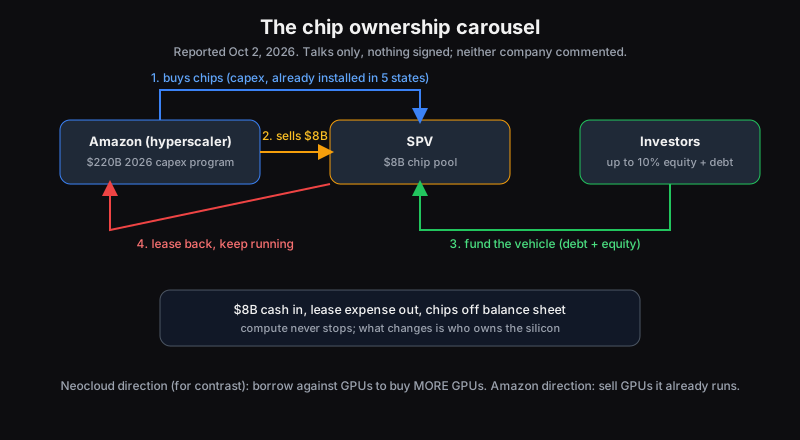
The Financial Times reported on October 2 that Amazon is shopping a new vehicle to outside investors: $8 billion of Grace Blackwell chips, currently installed in more than a dozen US data centers across five states including Nevada and Virginia, would move into a special-purpose vehicle. The investors would own the chips, Amazon would lease them back, and the vehicle could issue debt and sell up to a 10 percent equity stake. Reuters and Bloomberg both picked the report up within hours; nothing is signed and neither Amazon nor Nvidia commented.
The mechanics are not a demand signal in either direction. The chips are already running AWS jobs. Ownership moves, compute stays. Amazon converts $8B of owned hardware into $8B of cash today, plus a lease expense over time, and calls it “continuing our asset-light approach” in the FT’s framing. It is the CoreWeave GPU-collateralized debt structure with the direction reversed: neoclouds borrow against chips to buy more chips; Amazon sells chips it already runs to shrink the balance sheet they live on.
Why this story rhymes with the last two downturns
The precedent everyone reaches for is vendor financing at Lucent and Nortel, and the comparison is narrower than the headline. Lucent in 2000 committed $8.1B, about a quarter of annual revenue, to financing its own telecom customers so they could buy Lucent equipment; WinStar’s $2B commitments turned into a $700M writeoff, bad-debt provisions hit $3.5B across 2001 and 2002, revenue fell from $33.8B to near $12B, the SEC eventually charged revenue manipulation, and the company merged away in 2006. Nortel’s customer-financing book doubled to $2.1B while its bad-debt allowance hit 66 percent of the book by end-2001; the company filed for bankruptcy in 2009.
The current wave keeps two ingredients of that story and drops the worst one. Nvidia’s 10-Q for the quarter ended July 2026 shows $42.8B of marketable equity and $47.9B of non-marketable stakes, a customer-investment book around $99B by press aggregation, and a $105B residual-value guarantee for SB Energy leases on behalf of an OpenAI affiliate. Customer concentration is the second echo: three unnamed direct customers were 54 percent of Nvidia’s revenue in the April 2026 quarter, up from 30 percent a year earlier. The missing Lucent ingredient is revenue recognition: Nvidia’s largest instruments are contingent credit support, booked only when a tenant defaults, not revenue-recognized sales.
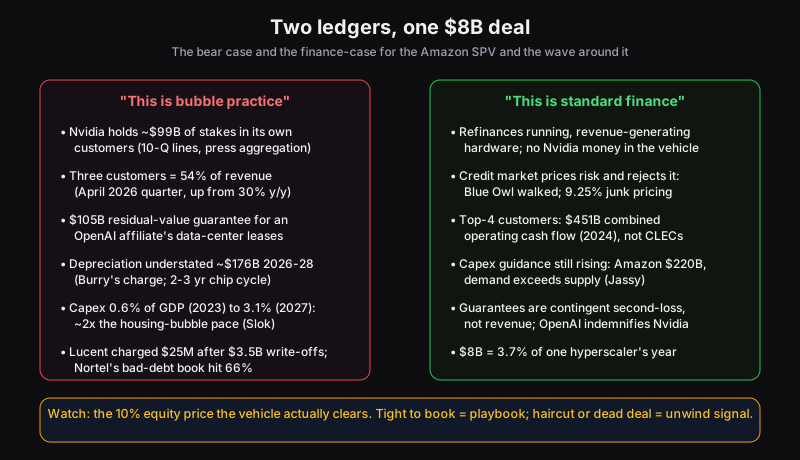
The two ledgers: the bear items and the standard-finance items, with the watch line underneath.
Is it bad practice? The two ledgers
The “yes, it’s a bubble practice” ledger: Torsten Slok of Apollo counts data-center capex rising from 0.6 percent of GDP in 2023 toward 3.1 percent by 2027, nearly twice the pace of the mid-2000s housing build, and argues AI profits are currently funded by investors rather than users. Michael Burry’s accounting charge is narrower and harder to wave off: if chips turn over on a 2 to 3 year product cycle, stretching server useful lives understates depreciation, and he pegs the 2026-2028 overstatement at roughly $176B across hyperscalers. Broadcom lending Anthropic $42B against a $125B five-year lease, disclosed October 1 in Anthropic’s IPO prospectus, is the newest instance of the pattern the FT story now extends to the buyer’s side.
The “no, this is standard infrastructure finance” ledger: the vehicle refinances revenue-generating hardware with no Nvidia money in it, investors price the risk themselves (Blue Owl failed to syndicate a CoreWeave-linked deal in February on junk credit quality, and a CoreWeave-linked borrower paid 9.25 percent on $1.1B in September, so the market does reject weak paper), and Amazon’s top-four-customer cohort generated over $450B of combined operating cash flow in 2024, unlike Lucent’s venture-subsidized CLECs. Jassy’s constraint is the opposite of a pullback: Amazon guided cash capex to about $220B for 2026 and says it still cannot meet demand. At $8B against a $220B program, this vehicle is 3.7 percent: balance-sheet housekeeping, not a strategic retreat.
The price tape supplies a third view: NVDA closed October 1 at $230.86 and AMZN at $248.23, and no reliable premarket move had printed at this writing. Amazon tripling a GPU order in August (2M more through 2028) while seeking to repackage $8B of already-installed chips is simultaneously the strongest demand signal Nvidia has and the first hyperscaler-led move to put resale supply at the edge of the market. Watch what the vehicle pays for that 10 percent equity, not what the FT says Amazon is trying to do: if investors demand deep haircuts or the deal dies, that is the unwind signal. If it closes tight to chip book value, it becomes the playbook every hyperscaler copies.
Not financial advice: this is deal mechanics and history, not a recommendation on NVDA or AMZN.
Sources: Reuters FT wire - Bloomberg Law - Investing.com - Nvidia 10-Q, July 2026 quarter - Broadcom-Anthropic loan - Amazon Q2 2026 filing - Slok via Fortune - Burry on GPU depreciation - Lucent counter-analogy - FourWeekMBA on the SPV
Related on this site: Nvidia guarantees for empty buildings - Open-weights models cost less: a 2026 pricing guide - M5 Ultra: tokens per watt
Discussion
Be the first to commentStart a discussion
Got a take on this, a rig to show off, or a benchmark that says otherwise? Sign up and start the thread - your comment publishes instantly once you're in.