Meta description (draft): NVIDIA’s 64GB DGX Spark costs more per GB than the 128GB while AMD sells 128GB for $1,999. And NVIDIA’s own scaling slide mixes two SKUs. —
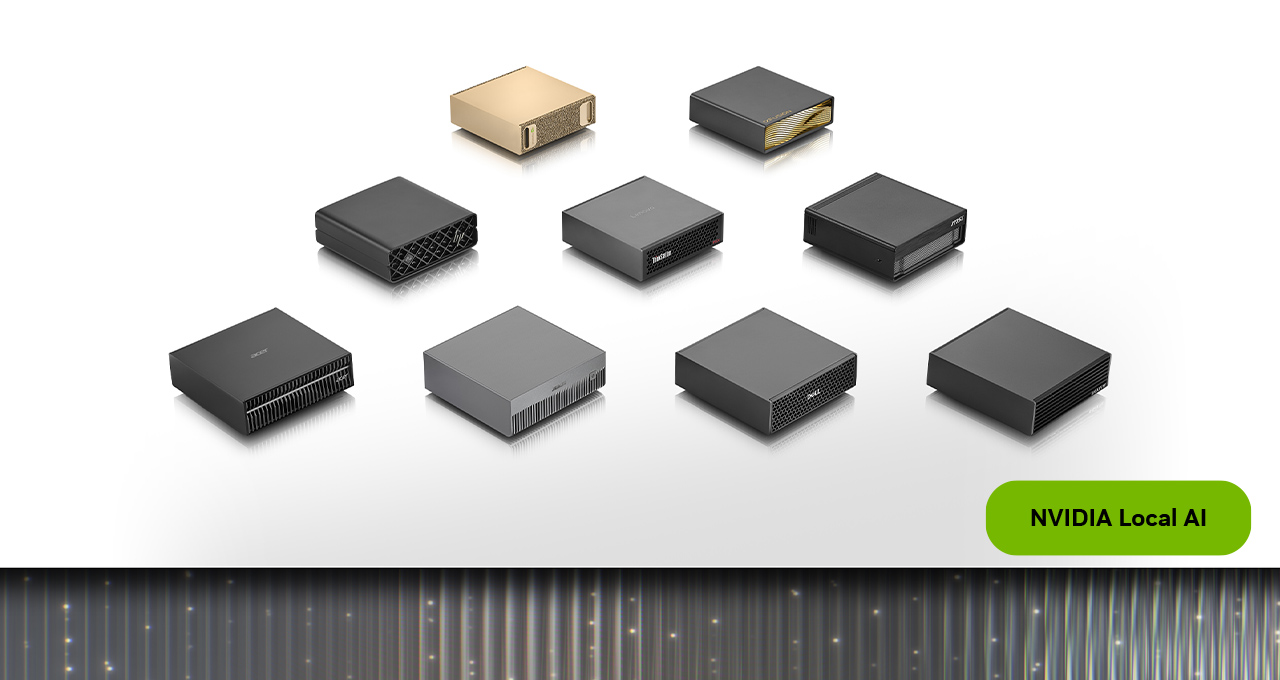
NVIDIA added a 64GB configuration of the DGX Spark on October 2, shipping October 23 from Acer, ASUS, Dell, Gigabyte, HP, and MSI at $4,999. The GB10 Grace Blackwell Superchip, DGX OS, ConnectX-7 networking, and the full CUDA software stack are identical to the 128GB model. NVIDIA’s framing is “a new starting point”: the same platform, a smaller memory floor, and a scaling story built on the new NVIDIA Sync Cluster Assistant, which detects connected units, validates configuration, and brings up the ConnectX-7 network between two boxes over a QSFP cable. Two 64GB units pool to 128GB, double the memory bandwidth, and delivered up to 1.7x performance on NVIDIA’s Qwen3.8 27B test.
The reaction: wrong direction on price
JASON MCNAB’s reply (@JASONMCNAB) carries the community read in one line: “I would pay extra for 128gb, its not even an option! This is a terrible move. they downgraded their system.”
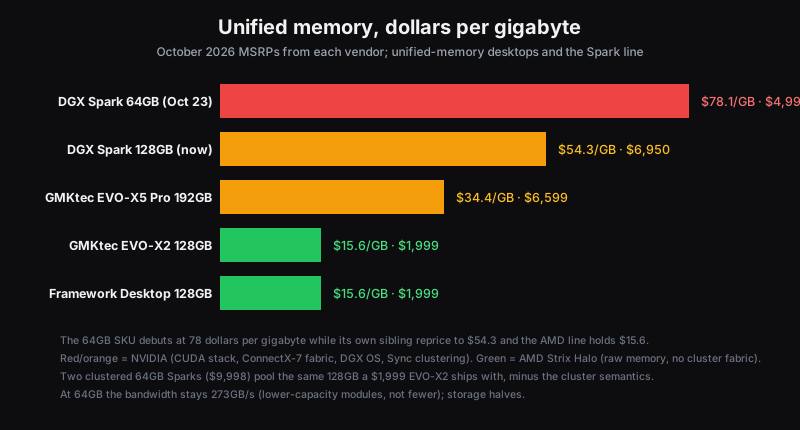
And the price line moved underneath the launch within a day: the 128GB Spark retails at $6,950 as of Friday, which is The Register’s number and CryptoBriefing’s, up from the $3,999 Founders launch price of 2025 and the $4,699 February 2026 increase this site’s catalog already carries; a 73 percent climb in a year. That makes the new-SKU math look deliberately sideways: $4,999 for 64GB is 78 dollars per gigabyte, against the smaller sibling’s launch-time 32 dollars per gigabyte, and the 64GB model costs 25 percent more than the 128GB version retailed for at launch. The per-GB comparison against the AMD Strix Halo fleet in this site’s catalog is sharper: a GMKtec EVO-X2 or Framework Desktop with 128GB of unified memory runs $1,999, one quarter of two clustered 64GB Sparks pooling the same 128GB. What the extra money buys is the fabric and the stack: ConnectX-7 at 200GbE, DGX OS, day-one agent toolkits, and the clustering software that keeps the two-box workflow identical to the one-box workflow. Register’s teardown detail explains how NVIDIA kept the bandwidth honest: memory bandwidth stays 273 GB/s because the 64GB build uses lower-capacity LPDDR5x modules rather than fewer of them, and it also halves the storage; the 20-core MediaTek Arm inside is unchanged.
The slide that broke the math
NVIDIA’s own “Scale up DGX Spark” chart mixes two SKUs on one ladder.
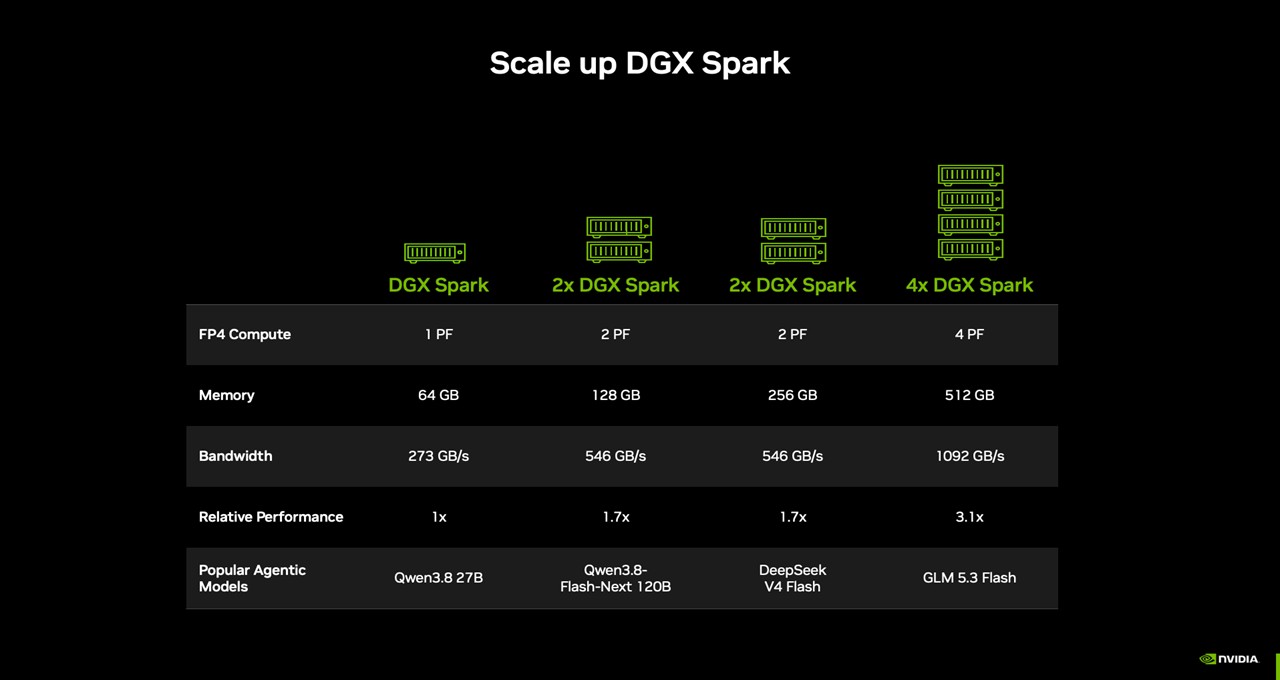
The columns read: one Spark at 64GB, two Sparks at 128GB, then “2x DGX Spark” again at 256GB and “4x DGX Spark” at 512GB. The 256GB and 512GB columns can only be the 128GB-SKU ladder, because two 64GB units pool to 128GB, not 256, and four times 64 is 256, not 512. The slide prints the bigger machine’s scaling curve underneath the smaller machine’s launch announcement without labeling the switch, which is exactly why JASON MCNAB’s screenshot thread reads “4x64gb is not 512gb. Maybe they made an entry device at 64gb and.”
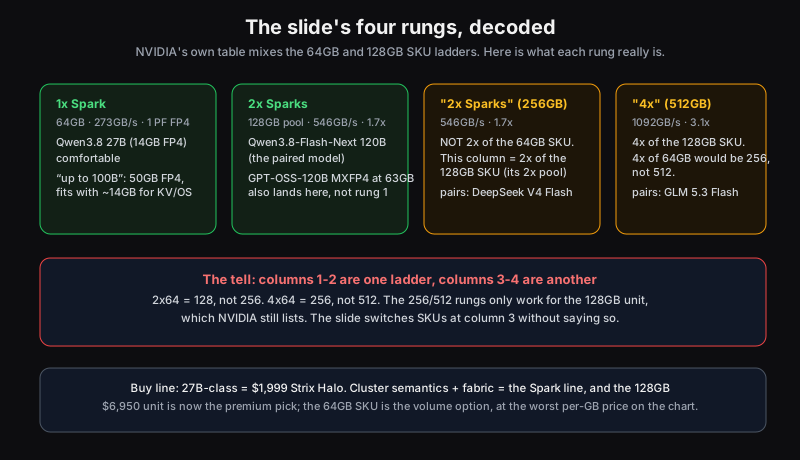
What actually fits at each rung
The capacity math with FP4 weights plus KV headroom: one 64GB unit carries Qwen3.8 27B comfortably and 100-billion-parameter FP4 models tightly, which matches NVIDIA’s “up to 100B” claim. The 120-billion-parameter class, where Qwen3.8-Flash-Next lives, needs the two-unit 128GB pool, which is why the blog pairs that model with the 2x column. GPT-OSS-120B’s MXFP4 build at roughly 63GB straddles the line: too big for one 64GB unit with cache and OS resident, trivial for the 128GB pool. The 512GB four-unit column pairs with GLM 5.3 Flash, which as a hosted class of hardware is comfortably the premier tier.
The Sync software differentiates the line: clusters detect, validate, and route automatically; every node runs the same stack so nothing is reconfigured between one unit and two; and the Sync Model Launcher landing end of month turns the cluster into a one-click download for the paired model, fronted by OpenCode so the browser becomes the terminal. Blender adds a prebuilt installer soon, which makes Spark the first NVIDIA local desktop with a first-party creator app on the box.
For builders, the 64GB SKU is a volume play launched into a memory price crunch, where the flagship line’s pricing history ($3,000 Project Digits concept at CES 2025, $3,999 ship, $4,699 by February 2026, $6,950 now) reads as a single slope. The decision matrix is three-way: $1,999 gets 128GB with no cluster fabric, $6,950 gets 128GB with the fabric and the stack, $4,999 gets 64GB with the fabric and a cheaper expansion path if your workload fits 128GB pooled. If the model you want is 27B-class, the AMD box is the rational buy; if the workload needs the cluster semantics NVIDIA is now shipping as one-click software, the Spark line is the only one offering it. Register expects the 128GB SKU to remain the fine-tuning-capable pick and notes GB10’s GPU still posts substantially higher AI performance in their testing than the Radeon parts, while AMD’s Gorgon Halo SoCs (32 to 192GB) and the RTX Spark notebooks arriving this fall will lean on memory capacity per dollar against a line whose memory keeps repricing upward.
Sources: NVIDIA blog - The Register on the 64GB debut - CryptoBriefing on the price context - Mia’s announcement post - Mia on the $6,950 128GB retail - JASON MCNAB’s reply - Scale-up slide
Related on this site: M5 Ultra: tokens per watt - How to Spend $200/Month on AI in 2026 - Budget builds
Discussion
Be the first to commentStart a discussion
Got a take on this, a rig to show off, or a benchmark that says otherwise? Sign up and start the thread - your comment publishes instantly once you're in.