NVIDIA’s RTX Spark laptops went on sale October 16, and Hermes Agent is on the launch slide. The announcement names the agents available in day-one guided setup: “GitHub Copilot, Hermes, OpenClaw, Perplexity, Pi and WorkBuddy, without requiring a command line.” Dillon Rolnick, CEO at Nous Research, the firm behind Hermes Agent, gets the launch quote: “We brought Hermes to RTX Spark so people can put open AI models and agents to work locally on a Windows laptop, with greater control over their data and the freedom to shape AI around their own workflows.”
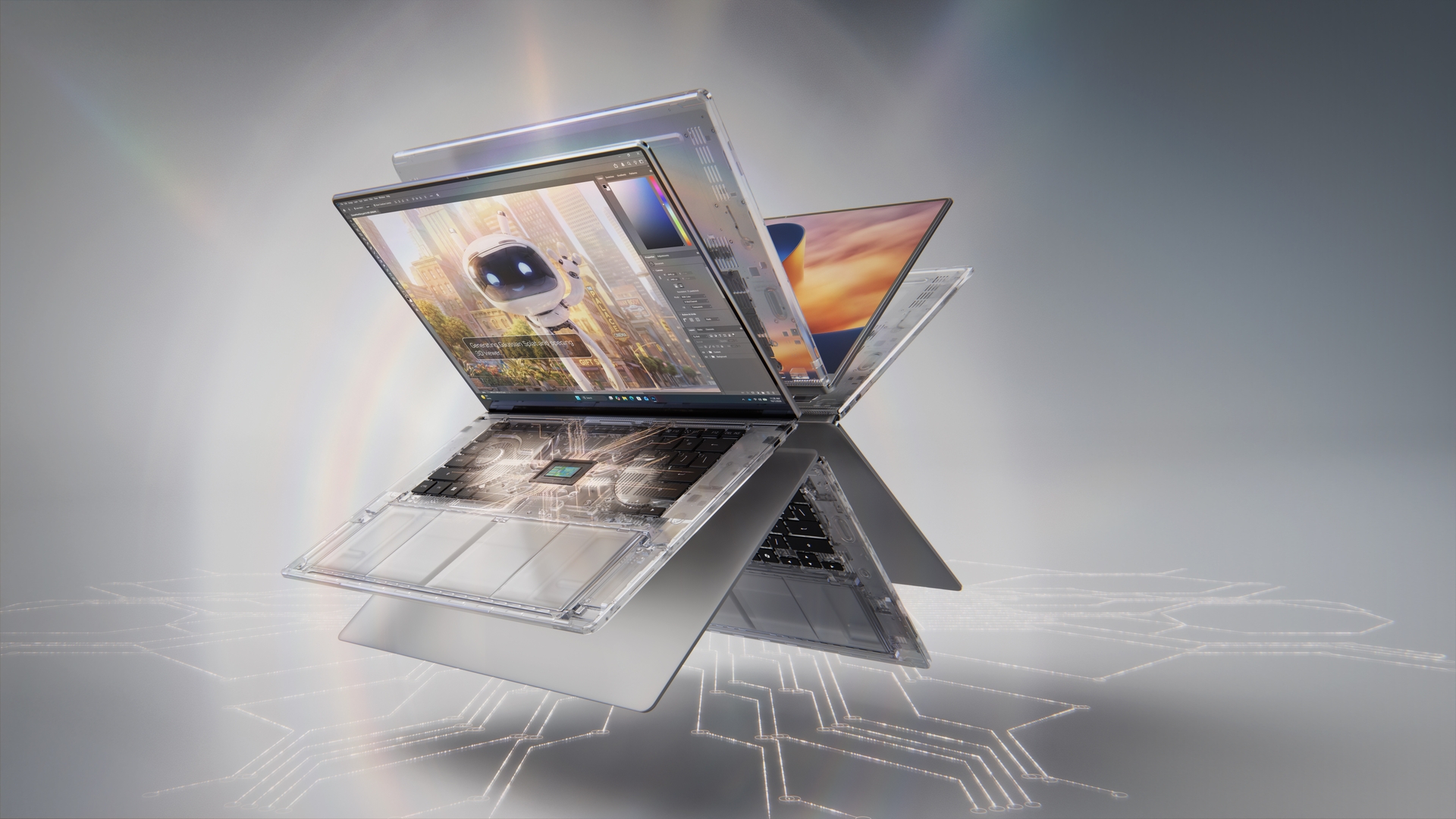
Two Tokenstead threads collide here. The chip widens the fit ladder this site tracks: a 96 GB GPU-visible memory window in a $2,599 laptop. And one of the agents NVIDIA demoed running on it is the same Hermes Agent that runs this site’s publishing pipeline: the operator’s daily stack.
What the chip is
RTX Spark N1X is NVIDIA and MediaTek’s Windows SoC: 18 or 20 Arm cores, a Blackwell RTX GPU with 5,120 or 6,144 cores, and up to 128 GB of LPDDR5X on a 256-bit, 16-channel interface at 300 GB/s. TSMC 3nm, 45 to 140 W depending on configuration. NVIDIA’s spec slide puts the numbers in one card:
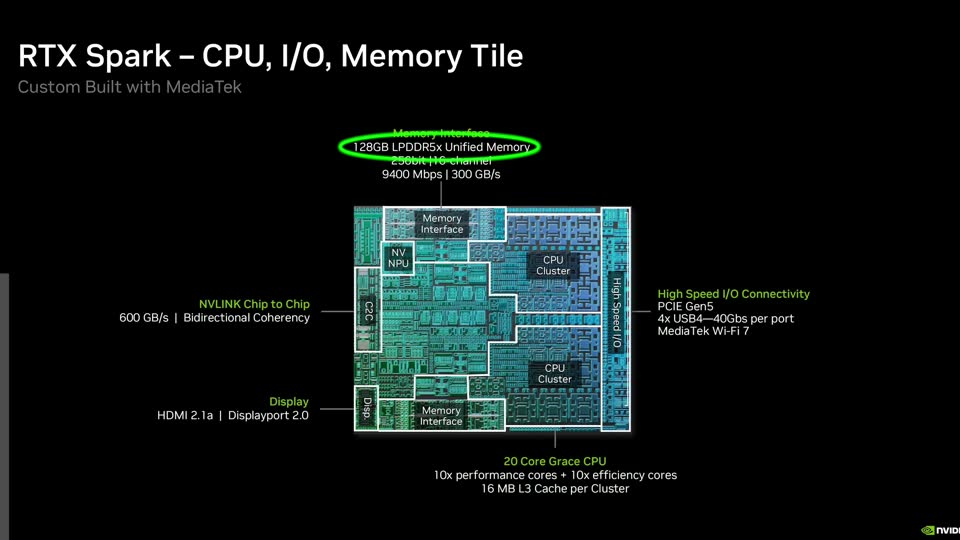
For local AI, memory is what matters. 128 GB of soldered LPDDR5X, of which 96 GB is addressable by the GPU, means the 120B class (Nemotron 3.5, GPT-OSS) runs entirely on the accelerator, and 70B-class models run at 4-bit with a real context. The trade is bandwidth: 300 GB/s is roughly half of what a desktop GeForce card moves, and token generation decodes at bandwidth speed.
What NVIDIA claims, in NVIDIA’s bars
The launch slide’s comparison makes agent performance the headline row: 4.6x over the premium SoC reference running Qwen 3.8 27B locally, 4.0x on Qwen 3.6 35B-A3B, with gaming at 3.7x and image generation at 4.4x alongside.
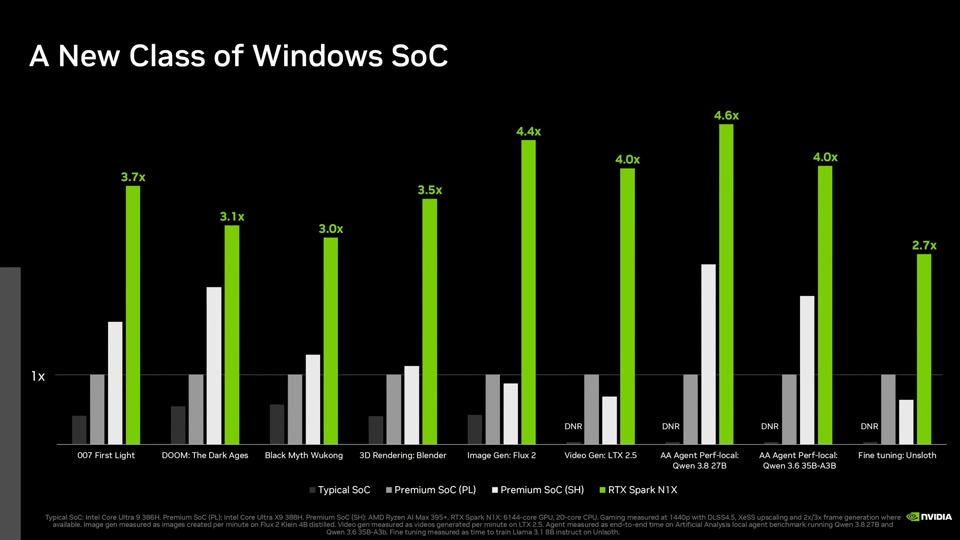
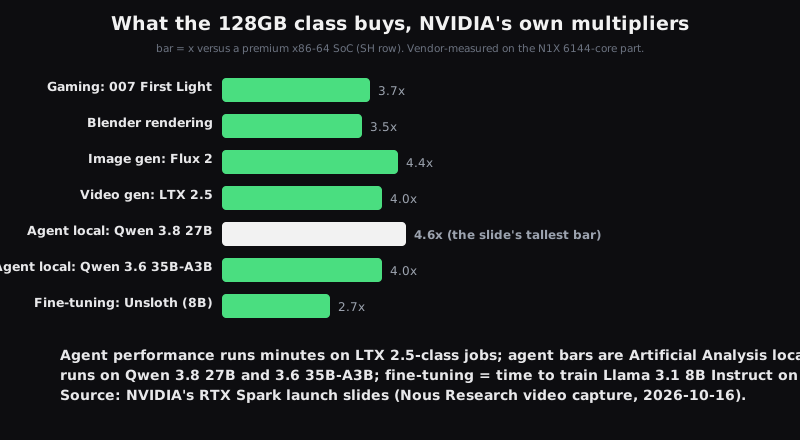
NVIDIA’s multipliers, transcribed. The agent-local rows are Artificial Analysis benchmark runs on Qwen 3.8 27B and 3.6 35B-A3B, measured locally; fine-tuning is time to train Llama 3.1 8B Instruct on Unsloth. All vendor-measured.
Windows Central’s review (embargoed with the launch) ran the same conclusions on retail hardware: Cinebench 2026 multi-core of 6,885, just behind Snapdragon X2 Elite Extreme and Apple M4 Max; Stable Diffusion 1.5 INT8 at 2.77 seconds per image, ahead of the RTX 5080, 5070 Ti, and 5060 laptops it tested; Llama 3.1 8B at 49 tok/s and Phi-3.5-mini at 72 tok/s in on-device generation. Their verdict is worth carrying alongside NVIDIA’s: “It’s a beast, but not at everything,” and “at the prices that these devices are launching at, I think most people would be better served getting an Intel or AMD laptop with a dedicated NVIDIA GPU instead, as these often cost less than the cheapest RTX Spark laptops right now.” Unless, as they put it, you are “knee-deep in local AI workflows.”
The Hermes demo
The launch video, narrated by Linus Sebastian, walks the full path on an MSI Prestige N16 Flip AI+:
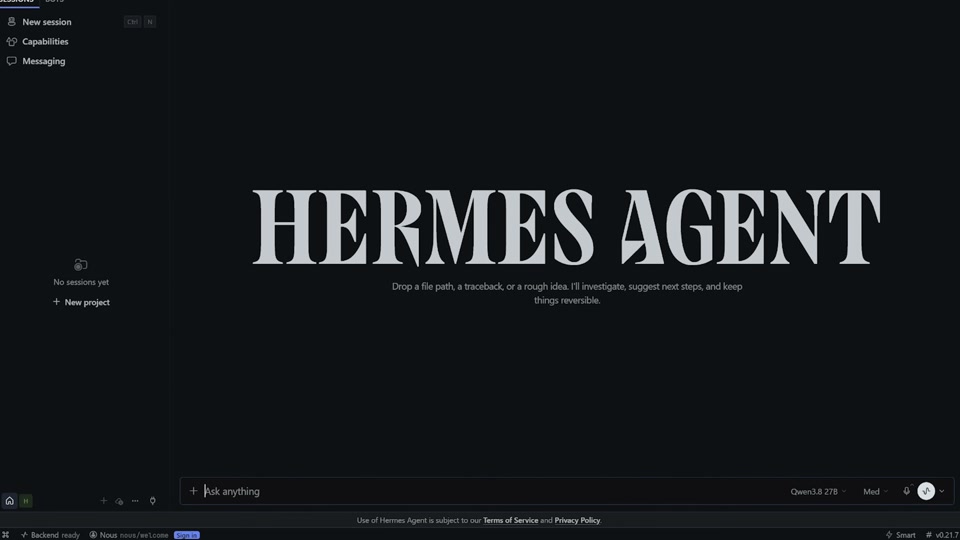
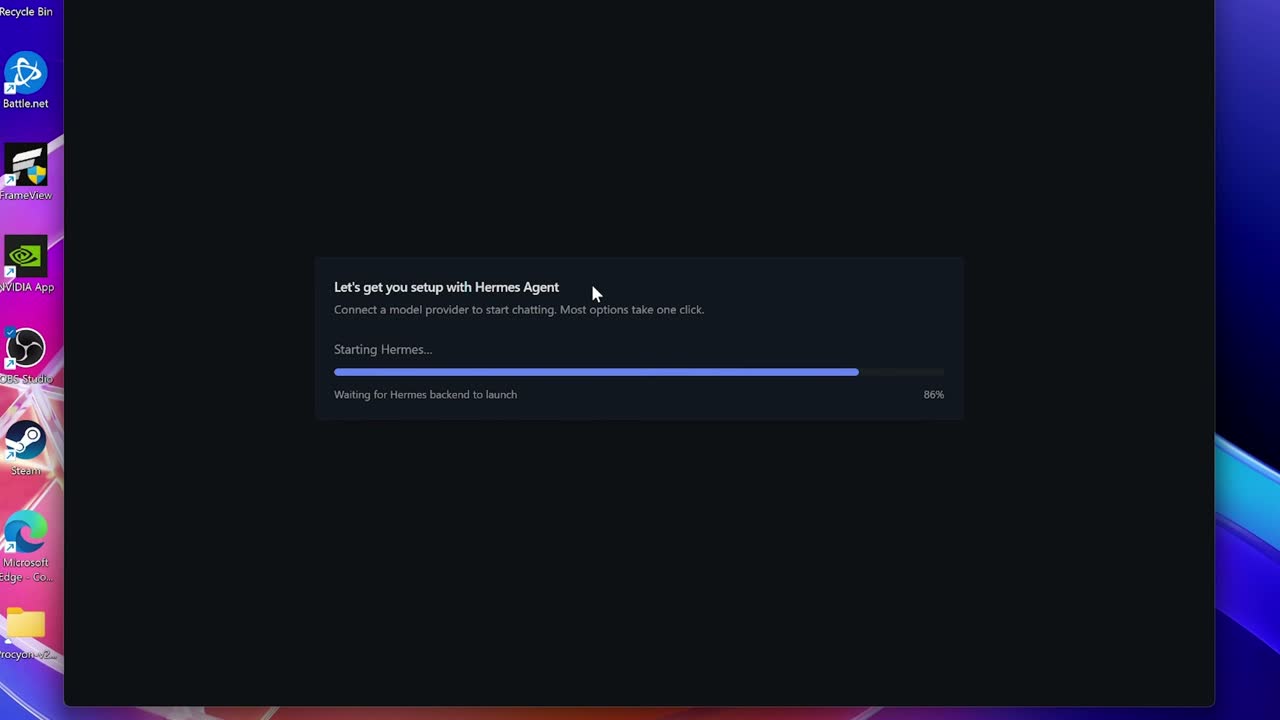
The machine: “Setting up Hermes here is night and day simple, compared to when I set it up on Fedora on my home PC. The initial onboarding is super clean.” He then flips the backend from cloud to local, “because we have all this local horsepower,” and runs Qwen 3.8 27B entirely on the laptop.
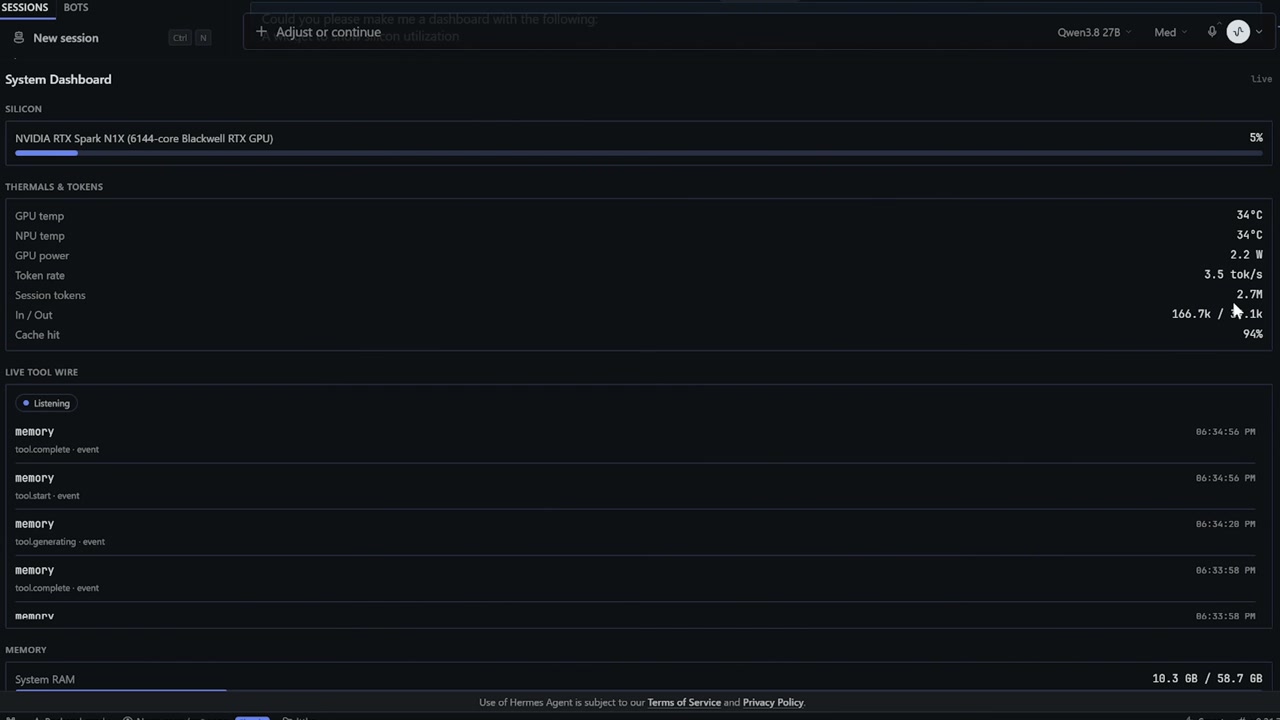
The task he runs is the same shape NVIDIA used in its keynote, and the prompt is quoted on screen: a dashboard with a silicon-utilization widget, thermals and token throughput, a live wire for tool calls, a memory widget, plus installing NVIDIA’s app and broadcast plugins. Entered at 5:21 pm, finished at 6:37 pm: “I didn’t write a single line of code, and we now have this functional, real-time dashboard.” An hour of autonomous tool work, from a 27B model running on the laptop it monitors.
OpenClaw, the other local agent in the lineup, gets the honest mention in Windows Central’s hands-on: “We tested Hermes Agent, as OpenClaw failed to connect to the gateway once setup was complete.”
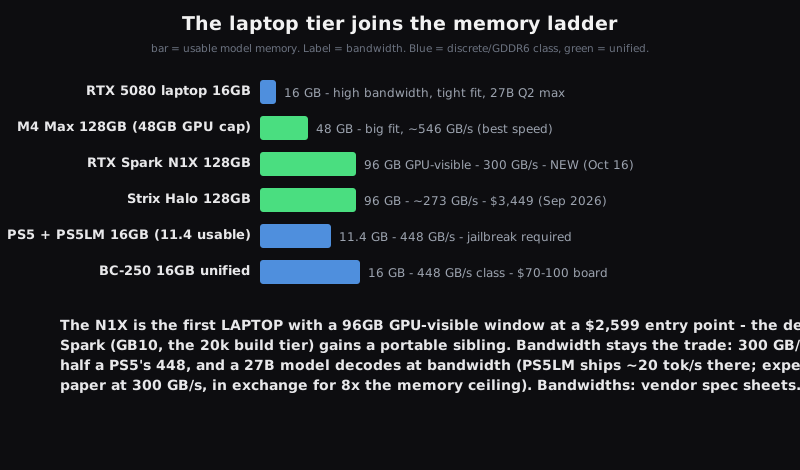
The laptop tier in the site’s memory ladder: usable model memory versus bandwidth. The N1X brings 96 GPU-visible GB to a laptop at 300 GB/s; the desktop GB10 Spark (the $20k cluster build) gains a portable sibling; the PS5 and BC-250 keep the bandwidth crowns at scrap prices. Sources: vendor spec sheets.
Where it lands
The ladder this site tracks now has a laptop row: 96 GB GPU-visible at $2,599 entry, between a 16 GB discrete-GPU laptop and the $3,449 Strix Halo desktops. The desktop Spark cluster build already covers pooled 128 GB machines; this is the version that fits in a backpack and runs its own agent on the train.
The honest frame: NVIDIA’s 4.6x agent bar and Windows Central’s “better served by a dGPU laptop” verdict are both true. If your workload is local agents on open models, the N1X’s memory window is the widest ever shipped in this thickness of device. If it is gaming or editing, the same money buys a faster discrete GPU, as the review says. Hermes shipping in the setup flow is the interesting tell either way: the agent picker is now a first-boot Windows step, and open models running on it is the default path.
Sources: NVIDIA newsroom: RTX Spark PCs available today - Nous Research launch post - Windows Central RTX Spark review - NVIDIA COMPUTEX 2026 RTX announcements
Related on this site: The budget rig under $3,000 is a repurposed console - GPU hosting for the rack you already own - Meta asks your birthday: the Muse Spark Open gate