TLDR: GPU hosting shops that double your VRAM are the used-car dealers of local AI: unglamorous, margin-thin, and more honest than most of the market. The difference between this hosting lane and renting from a cloud is that you bring the hardware you already chose and keep owning it, in a rack that was built for its power draw.
The tweet is a business announcement, and an easy one to scroll past: GPU Lab, an NVIDIA repair shop in Grand Rapids, Michigan, is adding datacenter hosting by the end of the year. Tier 2 facility, bring your own GPU server or buy one of theirs, five kilowatts per node, racks powered and supported on site with SLA-backed contracts.
Scrolling past it would miss two things: what this shop’s product list says about the second-hand GPU market, and the fit math the 48GB 4090 makes possible at prices the big-lane catalogs do not print.
The hosting announcement
View this post on X →
The tweet is a business announcement, easy to scroll past: GPU Lab, an NVIDIA repair shop in Grand Rapids, Michigan, is adding datacenter hosting by the end of the year. Tier 2 facility, bring your own GPU server or buy one of theirs, five kilowatts per node, racks powered and supported on site, SLA-backed contracts, SXM-converted A100 and H100 boards welcome. But the product list behind the account is what makes the announcement real, and the hosting is the third act of a trade that has been building for five years.
Where the swarm left the market
The same week this shop went from upgrades to hosting, Pliny the Liberator’s screenshot of Meta’s identity-gated download page crossed three thousand likes, and a BitTorrent archive listed 533 GB of the same weights with verified checksums. The market the hosting announcement lands in is the one those two posts drew: weights that escape any single host, buyers who want the hardware they choose, and a rack shortage in between.
View this post on X →View this post on X →
The shop behind the product list
GPU Lab has been reballing, repairing and rebuilding NVIDIA cards since 2021, IPC-7095 certified for BGA work, and its live product API reads like the inventory of a very specific trade: the 48GB 4090 upgrade service at $1,699 on a customer-supplied 24GB 4090, the complete 48GB 4090 at $4,989.99, a 32GB 4080 Super upgrade at $1,459.99, a CMP-170HX mining-card rebuild for $489.99, water blocks, backplates, a $600 queue reservation.
The 48GB mod deserves its own paragraph of receipts: full AD102-300-A1 cores (the complete US-market die, not the crippled China-market 4090-D’s AD102-250), Micron OEM GDDR6X modules on NVIDIA’s PG139 reference layout to hold the full 900 GB/s, 13-phase power rated 450 W TGP, and a dual-slot A6000-style form factor sized for dense racks. The independent coverage of this mod market (dasroot’s May review) names the two honest risks, no NVIDIA support and overclocking headroom limited by reworked memory. GPU Lab’s page answers with per-card nvidia-smi screenshots, thermal imaging, and a warranty section that excludes 12VHPWR connector burns and PCB kits in the same breath it promises workmanship coverage.
The fit math
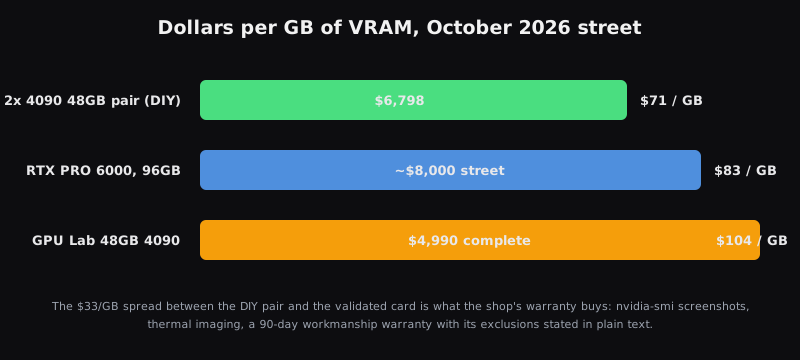
At 48 GB, one card holds the 70B-class dense models at 4-bit with room for context, which is the exact tier decision-model serving and agentic workloads need most. Two upgraded used 4090s pool 96 GB for about $6,800 all-in, against roughly $8,000 street for a single 96 GB RTX PRO 6000: $71 per GB versus $83. The complete new card runs $104 per GB, the tax for buying it validated with screenshots instead of gambling on a mod kit.
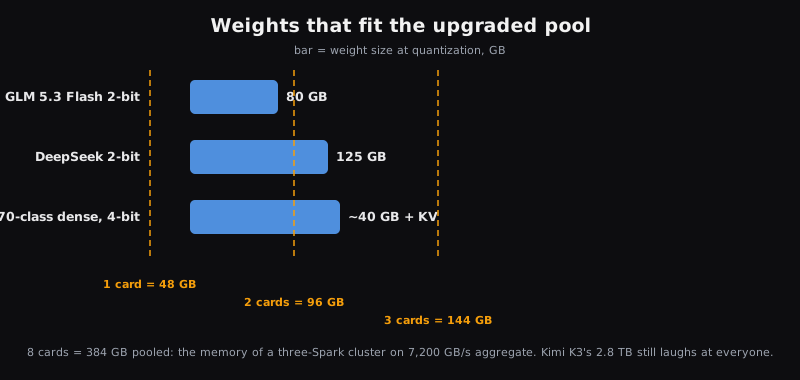
Three cards pool 144 GB: GLM 5.3 Flash at 2-bit (80 GB) and DeepSeek V4.1 Flash’s 2-bit build (125 GB) both fit with KV room.
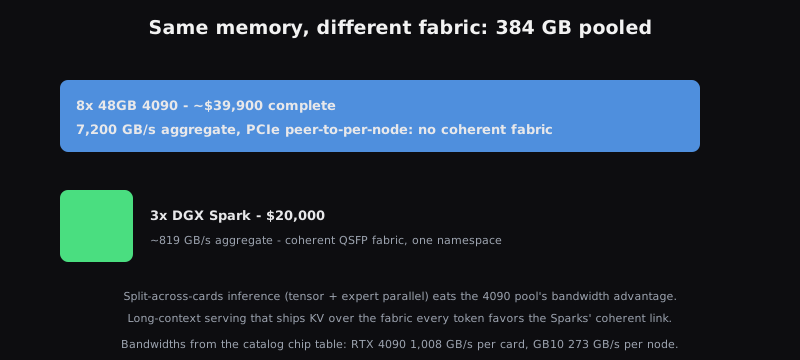
Eight 4090s on a PCIe switch move roughly 7,200 GB/s aggregate; the three-DGX-Spark cluster’s coherent fabric runs about one ninth of that for the same memory. For inference workloads that split across cards (tensor-parallel the MoE layers, expert-parallel the rest), the 4090 pool wins on throughput per dollar; for long-context single-model serving where the fabric carries KV traffic, the Sparks remain the cleaner design for that case. Which pool wins is workload-shaped, which is what the price table cannot say and the hosting contract has to.
The new lane completes the loop this shop has been building since the 4090 upgrades started selling to VAST hosts: repair, upgrade, then rack. Five kilowatts per node is the number that matters, dual-slot 450 W cards fit ten to a chassis with headroom, and the facility is sized for GPU-density power rather than the 2 kW office circuit. Bring your own server means the buyer keeps capital ownership of a depreciating-but-real asset instead of renting someone else’s margin, and SXM-converted A100 and H100 boards are the salvage lane: datacenter silicon pulled from decommissioned servers into customer-owned racks at prices per GB of HBM the cloud does not quote.
No hosting rates exist yet; the tweet is a promise for year end, not a product page. But the pipeline it describes is the missing middle of the local-AI market: the model weights are downloadable, the hardware is buildable, and now the rack space has a shop counter attached to it.
Related on this site: the budget builds price the alternatives at every tier, the Muse Spark Open page carries the largest weights that fit a bought rack, and the opencode-2-serve piece covers the software side of running agents on hardware you own.