On August 31, 2026, PCPartPicker listed the ASUS TUF Gaming RTX 5090 OC at $5,099. In January, MSI priced its RTX 5090 LIGHTNING Z at $5,090.99 - 1,300 units, liquid cooled, sold by public draw. A standard air-cooled board now costs more than the limited halo card did. NVIDIA’s official MSRP is still $1,999.

The official NVIDIA logo, from nvidia.com’s own brand assets. NVIDIA, the NVIDIA logo, DGX, DGX Spark, and GeForce RTX are trademarks of NVIDIA Corporation.
The new-card floor
The cheapest in-stock US listings on August 31: the Gigabyte AORUS Master at $4,929.99 and the Zotac Solid OC at $4,999.99. The AORUS was $4,159.99 in early August and $4,929.99 on August 21, a $770 move in three weeks. PCPartPicker’s cheapest RTX 5090 was $4,099.99 at the start of the month, and Newegg’s median across the model had reached $4,699.99, per VideoCardz’s price reports.
Canadian readers see worse. The floor on ca.pcpartpicker sat near $6,800 CAD before tax on August 31, about 1.4 times the US floor.
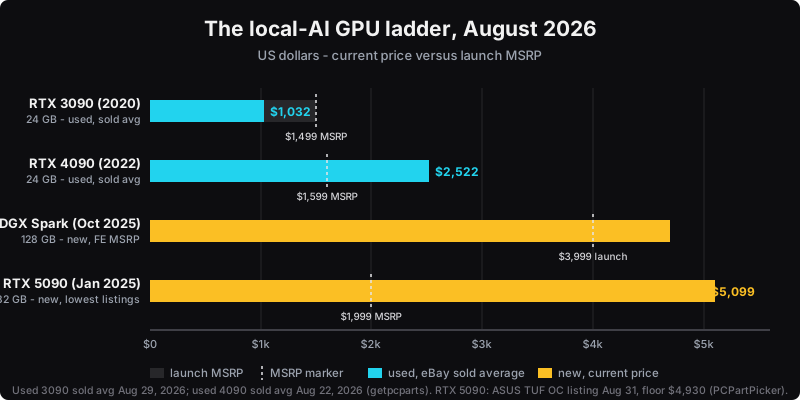
Current prices against launch MSRP, in US dollars: the used 4090 sold average passed its $1,599 MSRP, the DGX Spark’s MSRP rose $700 in February, and the cheapest regular 5090 listings sit at 2.5x MSRP.
Why the price moved: GDDR7
The mechanism has been public since May, when NVIDIA told board partners the per-board cost of the RTX 5090 and 5090D V2 kits was rising by about $300, citing GDDR7 costs (Board Channels report, via TweakTown). On July 23, TechPowerUp reported a second round of GDDR6 and GDDR7 kit price increases; July trade reporting put GDDR7 modules at $60-70 per 3GB chip.
The 5090 carries the largest memory load in the consumer lineup: 16 GDDR7 chips on a 512-bit bus. Micron has said it can meet only 55-60 percent of core customer demand, and wafer capacity that does exist goes to HBM for datacenter accelerators first. Add reported production cuts of 30-40 percent across the RTX 50 line in the first half of 2026, discontinuation reports for the 5060 Ti 16GB, and a Super refresh that slipped to around CES 2027, and the supply picture has no near-term relief. AMD raised Radeon prices 10-15 percent in the second half of 2026.
The horizon matters as much as the mechanism. SK Hynix’s CEO said on August 27 that the shortage could run through 2030, and this site’s memory-price receipts for the past year read the same way.
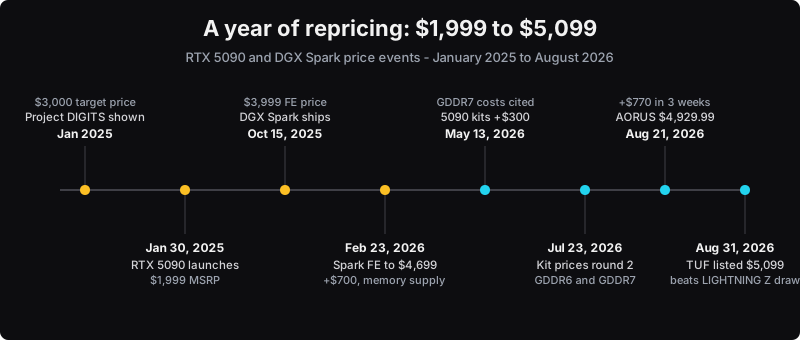
The 2025-2026 repricing in one line: launch MSRP $1,999 in January 2025, Spark FE to $4,699 in February 2026, two GDDR7 cost rounds in May and July, and the regular-card 5090 floor at $5,099 by August 31, 2026.
The used market moved with it
A used RTX 4090 sold for an average of $2,522 on August 22, per getpcparts’ sold-listing tracker - the highest reading in 30 weekly observations since January, up 14.6 percent in one week and 10.4 percent over 30 days. A second tracker measuring asking prices shows an average of $2,776 for the three cheapest listings through August, up 12.4 percent over four months. New-old-stock 4090s list at $3,049-$3,550 on Amazon. The $1,599 launch MSRP sits below every current price for the card, and a used one costs 58 percent more than that MSRP.
The RTX 3090 tells the same story from a lower rung: a $1,032 sold average on August 29 (getpcparts), up from $775 in mid-January, a 33 percent climb year to date, and $1,186 average asking (GPU Poet, up 26.7 percent over four months). In February, D-Central’s guide called the used 3090 the $/VRAM king at $600-850.
Canadian captures run higher: used 4090 listings near $4,000 CAD and used 3090s at $2,000-3,000 CAD on eBay.ca as of August 31. Twenty-four gigabyte cards are scarce locally and AI demand prices them accordingly.
One caveat on the sold-price data: the 3090 tracker shows corrupted July readings, and every figure quoted here comes from its consistent pre-July and August observations, cross-checked against the second tracker.
The DGX Spark: an MSRP change in February, a Canadian floor in August
NVIDIA set the current Founders Edition price on February 23, 2026, in a forum announcement: “We have adjusted the MSRP of DGX Spark (Founders Edition) due to worldwide constraints in memory supply.” The move took the price from $3,999 to $4,699, a 17.5 percent increase, global, with no hardware change and no retroactive effect on existing orders. The system had already repriced once before shipping: announced as Project DIGITS at $3,000 in January 2025, it launched in October 2025 at $3,999.
Every GB10 box carries the same silicon: a 20-core Arm CPU, 128 GB of LPDDR5X at 273 GB/s, about 1 PFLOP of FP4 compute, and a ConnectX-7 NIC. The differences between vendors are SSD size, chassis, and warranty, so the cheapest in-stock unit is the value pick unless a 4 TB internal drive matters. Our benchmarks guide covers what the 273 GB/s ceiling does to decode speed.
The Canadian ladder on August 31, with the ASUS listed on Newegg.ca here:
| System |
Storage |
Price (CAD) |
Availability |
| ASUS Ascent GX10 |
1 TB |
$5,499.99 |
In stock: Memory Express (per-store counts), Canada Computers, Newegg.ca |
| ASUS Ascent GX10 |
2 TB |
$6,499.00 |
Newegg.ca |
| NVIDIA DGX Spark FE |
4 TB |
$7,348 |
DirectDial, in stock |
| ASUS Ascent GX10 |
4 TB |
$8,299.00 |
Newegg.ca |
| NVIDIA DGX Spark |
4 TB |
$8,449.99 |
Canada Computers, 15-day low-price guarantee |
| Gigabyte AI TOP ATOM |
4 TB |
$8,494.99 |
Canada Computers, 2 online / 1 Mississauga |
| DGX Spark (ExtremePC) |
- |
$8,497.00 |
Out of stock |
| DGX Spark (D-Central, Montreal) |
- |
$9,449 |
Configured, Canadian RMA |
NVIDIA sells direct from its marketplace but only to US customers: $4,699 for the 4 TB unit plus a free Deep Learning Institute course listed at $90, one per customer, or $9,449 for a two-unit bundle with the ConnectX-7 cable for cluster builders. D-Central’s configured single unit lists at $9,449 CAD, the same digits as NVIDIA’s two-unit US bundle.
The pricing gap is the tell. The $5,499.99 ASUS is 1.18 times the new $4,699 US Founders price. The RTX 5090 sells at 2.5 times MSRP in the US and about 3.4 times at the Canadian floor. Partner GB10 systems have not fully caught up to February’s MSRP change, and trade reporting (NotebookCheck, ServeTheHome) expects the gap to close upward. That makes the in-stock $5,499.99 ASUS likelier to rise than fall. Channel shrinkage points the same direction: MSI’s EdgeXpert is delisted at Canada Computers, and Best Buy Canada’s GX10 page is dead.
What the ladder means for a local-AI build
Divide price by VRAM and the ladder reads like this:
| Rung |
Price (US) |
VRAM |
Per GB |
Against launch MSRP |
| Used RTX 3090 |
$1,032 sold avg |
24 GB |
$43 |
69% of $1,499 |
| Used RTX 4090 |
$2,522 sold avg |
24 GB |
$105 |
158% of $1,599 |
| New RTX 5080 |
$1,150-1,400 |
16 GB |
$72-88 |
115-140% of $999 |
| New RTX 5090 |
$4,930-5,099 |
32 GB |
$154-159 |
247-255% of $1,999 |
| DGX Spark FE |
$4,699 MSRP |
128 GB |
$37 |
117% of $3,999 launch |
The DGX Spark is the cheapest memory per gigabyte in the ladder, and that is the trade its buyers accept: 273 GB/s of decode bandwidth against a used 3090’s 936 GB/s, covered in the self-host guide. The used 3090 remains the cheapest $/GB among discrete cards, which is why its price keeps climbing. The used 4090, the standard 2025 advice, now sells 58 percent above its launch MSRP. The 5080’s 16 GB caps out below 32B-class models at useful quants.
The planning rule from the SK Hynix piece carries over unchanged: do not defer a memory purchase waiting for prices to fall back, and treat any in-stock unit at a price you can afford as worth buying the week you find it. To check what a given box actually runs, use the rig finder and the model catalog; every price on this site should still be verified at purchase time.