At its IFA 2026 keynote in Berlin, AMD announced the Threadripper Halo Station, billed as “the most powerful workstation in the world” and pitched squarely at running trillion-parameter models locally. Jack Huynh, AMD’s SVP and GM of Computing and Graphics, presented it as a fully liquid-cooled tower: a Threadripper PRO 9995WX CPU paired with dual Instinct MI350P accelerators, with a configuration path to four accelerators. No price, no ship date, and no OEM partner were announced.
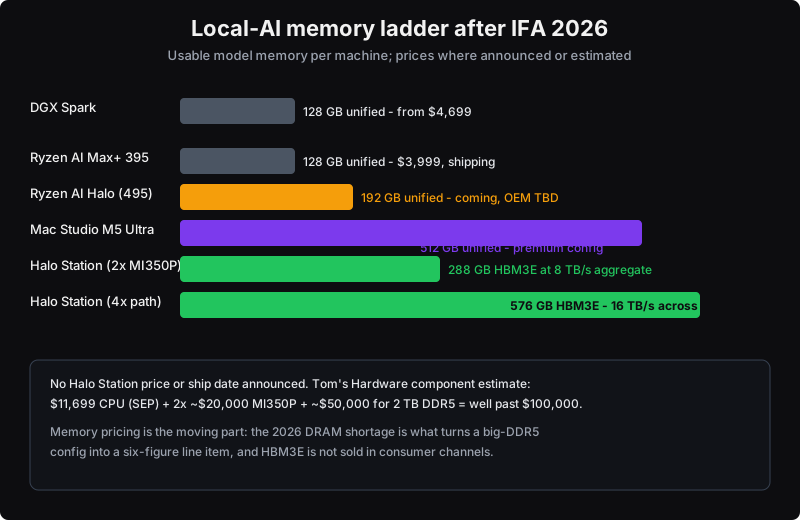
Usable model memory across the local-AI ladder after IFA 2026. The Halo Station’s HBM3E pool starts where consumer unified memory tops out - and its bandwidth is in a different class.
What is actually inside
The CPU is the top of AMD’s stack: Threadripper PRO 9995WX, 96 Zen 5 cores and 192 threads, 5.4 GHz boost, 384 MB of L3, 350 W, and 128 PCIe 5.0 lanes. The accelerators are Instinct MI350P, AMD’s data-center CDNA 4 part with 144 GB of HBM3E each at 4 TB/s. Two of them give the machine 288 GB of accelerator memory with 8 TB/s of aggregate bandwidth; the four-accelerator configuration doubles that to 576 GB at 16 TB/s. A 2 TB DDR5 pool (8-channel DDR5-6400) sits behind the CPU for data staging.
The headline comparison is raw numbers: NVIDIA’s DGX Spark tops out at 128 GB unified memory, and Apple’s Mac Studio M5 Ultra maxes at 512 GB unified. The Halo Station’s 288 GB configuration already exceeds the Spark by 2.25x on memory and, more to the point, its bandwidth per accelerator is four times what most consumer unified-memory platforms move. For a trillion-parameter model quantized down, memory capacity is the gate, and this is the first announced machine with more than half a terabyte of it on the accelerator side.
What it will cost
AMD said nothing about pricing. Component math from the coverage is the only yardstick: the Threadripper PRO 9995WX runs about $11,000 to $12,000 single-unit price, each MI350P is estimated near $20,000, and 2 TB of DDR5 is estimated at roughly $50,000 at current pricing. That puts the component bill alone between $100,000 and $150,000, before the liquid-cooling loop, board, chassis, and assembly, and before any OEM margin. Tom’s Hardware also noted the machine is aimed as a competitor to NVIDIA’s GB300 workstation class. For calibration: the most expensive prebuilt workstation we have covered, a maxed ThinkStation P8, listed at $334,463 - so this class of machine has precedent, but the Halo Station would enter a market that previously topped out around a third of that for AI-focused builds.
The DDR5 line item is the volatile part. We covered the memory shortage running through 2030 earlier this year: DRAM supply is contracted years out, and retail pricing reflects it. A 2 TB DDR5 pool was already a five-figure part before the shortage; the shortage is what pushes it toward $50,000. Anyone pricing a Halo Station today is pricing into that curve.
The rest of the keynote
AMD packaged the Halo Station as the top of a new “Ryzen AI Halo” platform spanning five tiers:
-
Ryzen AI Max+ 395, 128 GB: shipping now at $3,999, positioned against the DGX Spark ($4,699). AMD claims 7 to 14 percent higher tokens per second and one-sixth the three-year cost of running equivalent cloud workloads. AMD says it supports models up to 200B parameters.
-
Ryzen AI Halo with Max+ PRO 495, 192 GB: coming, in systems like Lenovo’s ThinkCentre X Ultra (November 2026, from $3,699), which supports clustering up to four units. That clustering feature is the same idea NVIDIA shipped in Personal AI Router - multiple boxes presented as one local endpoint.
-
Threadripper Halo Station: the 288 GB to 576 GB HBM3E machine described above.
- Also announced: a Microsoft “Kraken Halo” reference design and a SUSE partnership for enterprise AI stacks.
The pattern across all five tiers is memory. Every rung is sold first on how many parameters it fits, and AMD’s slide math treats model size as the primary spec. That is a different emphasis from NVIDIA’s Spark line, which leads with developer ecosystem and interconnect.
Who is this for
Not households. At a plausible $150,000, the Halo Station competes with renting - and against per-seat cloud inference it loses on economics for anyone without a compliance reason to stay on-prem. The audience is narrow: labs and enterprises that need a trillion-parameter model resident and offline, where a $150,000 one-time box beats GPU cloud rentals and data-egress fees. For everyone else, the consequential announcements are the $3,999 Max+ 395 and the clustered 192 GB Halo systems, because those move the price tiers that most local-AI budgets actually live in. We will update this piece when AMD names a price, a date, or an OEM.
Sources
Primary: Tom’s Hardware, Halo Station announcement · VideoCardz, Halo Station specs · TechPowerUp, IFA 2026.
Component context: Tom’s Hardware, MI350P accelerator · Tom’s Hardware, Ryzen AI Halo vs DGX Spark.
Related on this site: DGX Spark benchmarks 2026 · The memory shortage through 2030 · NVIDIA PAIR: route local AI across every PC