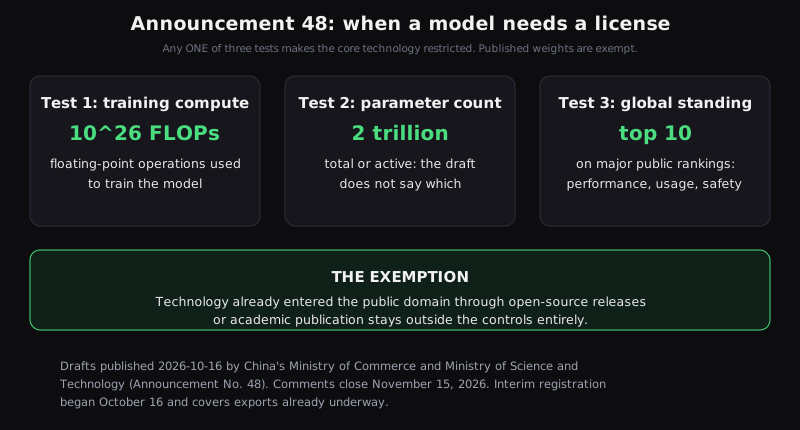
On October 16, China’s Ministry of Commerce and Ministry of Science and Technology published draft revisions to the Catalogue of Technologies Prohibited and Restricted from Export (Announcement No. 48 of 2026): 40 technologies, 23 of them AI, spanning large models, agents, computing clusters, chip design and information processing. Public comments run to November 15. The reading that matters for this site’s audience: published weights are exempt. “For technologies that have entered the public domain through open sourcing or academic publication, they are not included in the scope of management,” the announcement states verbatim.
What is actually restricted
The draft targets the “core technology” of large models: weights, key checkpoints, source code, architecture designs, and training and inference optimization methods. It becomes restricted when any one of three tests passes: 10^26 FLOPs of training compute, 2 trillion parameters, or a global top-10 rank on public evaluations at the time of export. The draft does not say whether parameters means total or active, and the top-10 test is broad: it covers overall performance, specialized capability, global call volume, and safety.
Two of the biggest open-weight releases in this site’s catalog clear the parameter test today: Moonshot’s Kimi K3 (2.8 trillion parameters) and Alibaba’s Qwen3.8-2.4T-A95B (2.4 trillion). Both are already public, so both stay outside the rules. A successor release of similar size would ship under the new regime: open-sourcing restricted technology qualifies for automatic licensing, which the ministry describes as clearance upon filing, “basically” no blocking.
The line is transfer, not use
The ministry’s Q&A draws a line at deployment: serving a restricted model to overseas users through an API, an app, a website or SaaS is not a technology export. Installing it on servers abroad is. Deploying to your own overseas cloud qualifies for the faster automatic-license path.
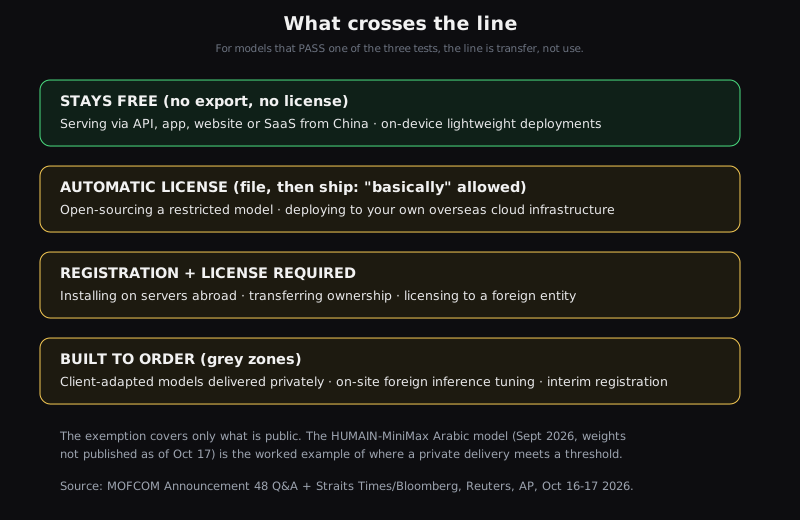
That line protects the way international users actually run Chinese open models today: a 2026 DeepSeek V4.1 Flash or GLM 5.3 Flash session served from the vendor’s API or a gateway like OpenRouter does not move weights across a border. What the draft adds is a gate on the next frontier drop: if Moonshot ships K3’s successor above 2 trillion parameters, the release needs a filing first.
What it means for the fit tables
- The catalog is unchanged today: published weights (Kimi K3, Qwen3.8, DeepSeek V4.1 Flash, GLM 5.3) remain downloadable everywhere.
- The 2-trillion test is now a policy number to watch alongside parameter counts: every future release above it files before shipping.
- Private, client-adapted builds are where it bites: a model meeting a threshold and delivered privately needs a license. Saudi Arabia’s HUMAIN Arabic model, commissioned from MiniMax in September with weights pending on Hugging Face as of October 17, is the shape of a covered delivery.
- Interim registration is already live: since October 16, exporters register covered transfers on the ministry’s platform, including deals underway.
The draft is a proposal, not a rule. Comments close November 15, and the text leaves open the questions that decide how heavy this gets: total versus active parameters on the 2T test, whether one top-10 rank on one leaderboard is enough, and whether interim registration applies to open-sourcing. If the final text keeps the published-weights exemption, the open-weight supply this site tracks keeps flowing; it gains a filing step for the new releases at the top.
Sources: MOFCOM Announcement 48 (primary, Chinese) - Reuters: China to restrict open-weights model exports - FT: China unveils draft export controls - AP: China moves to curb tech exports - Straits Times/Bloomberg wire
Related on this site: Meta asks your birthday: the Muse Spark Open gate - Hermes Agent ships on NVIDIA’s RTX Spark launch - DeepSeek V4.1 Flash (model page)