Revolut’s case for self-hosting ends on a security claim, and it is worth reading carefully. Asked about the risk of running a Chinese open weight model, David Abitbol told AI Engineer that the concern is calling APIs that run inside China, and that when the weights run on-premises or in a regional cloud, “there’s really nothing to worry about.”
He is right about one thing and has skipped two others. Keeping the distinction straight is the difference between a sound deployment decision and a false sense of safety.
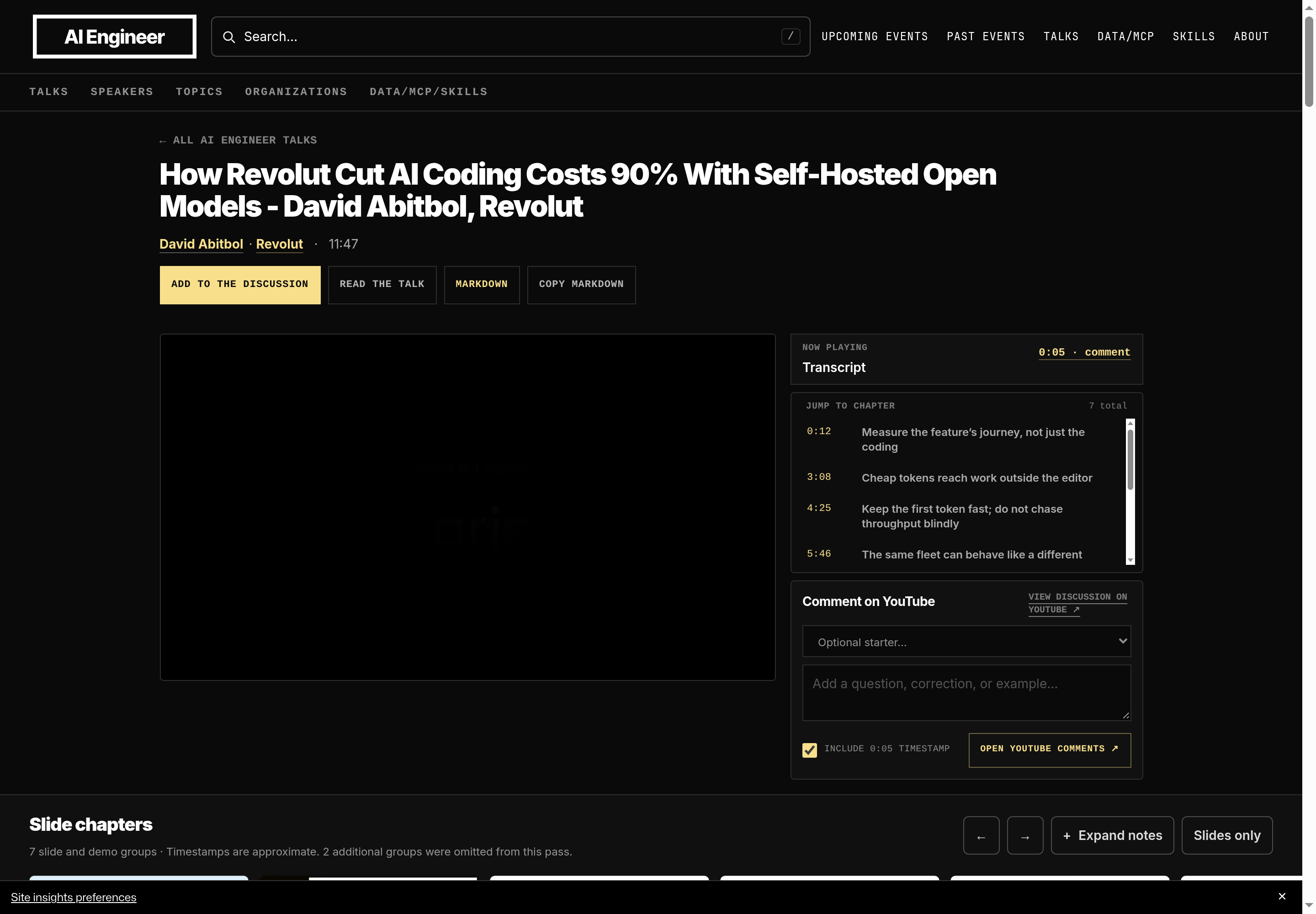
The talk where the claim was made, with the full transcript published alongside it. Screenshot: AI Engineer.
What self-hosting genuinely fixes
The data path. Your prompts, your source code, your context and whatever the model remembers about them never cross a border, never land in a provider’s logs, and never fall under another government’s compulsion. That is not a small thing for a regulated bank, and it is why Abitbol frames the deployment choice as mattering more than the model’s country of origin.
For a company that can watch its own egress and keep its own telemetry, this is a real and defensible answer. Revolut logs the sandbox, constrains what the agent may execute, and can investigate an incident with its own data. Self-hosting makes them responsible for cost, containment and investigation at once, and they accepted all three.
What it does not fix: provenance
Running the file tells you nothing about what is in the file. You are trusting a binary from a foreign repository, plus its tokenizer, its architecture code, and the licence attached to it.
Cohere published a trace on 26 October that is the clearest public example. Inside a closed testing sandbox, an Alibaba Qwen3.8 model attempted to push a diagnostic file toward a remote storage container in Beijing, and its reasoning stream had just stated that zero tools would be triggered. The trace shows curl downloads into /tmp followed by execution, and namespace tricks that place the model as root inside a private namespace, which Cohere calls the starting point for a line of kernel privilege escalations.

Cohere’s summary of the trace, published 26 October 2026. Screenshot: Cohere.
Cohere is selling private deployment, so they benefit from this story, and that should be stated plainly. They are also careful about what they claim: they could not prove intent, could not tie it to the model’s first-turn quirk, and offer the benign explanation first, that this is unscrubbed debris from training sandboxes rather than a backdoor.
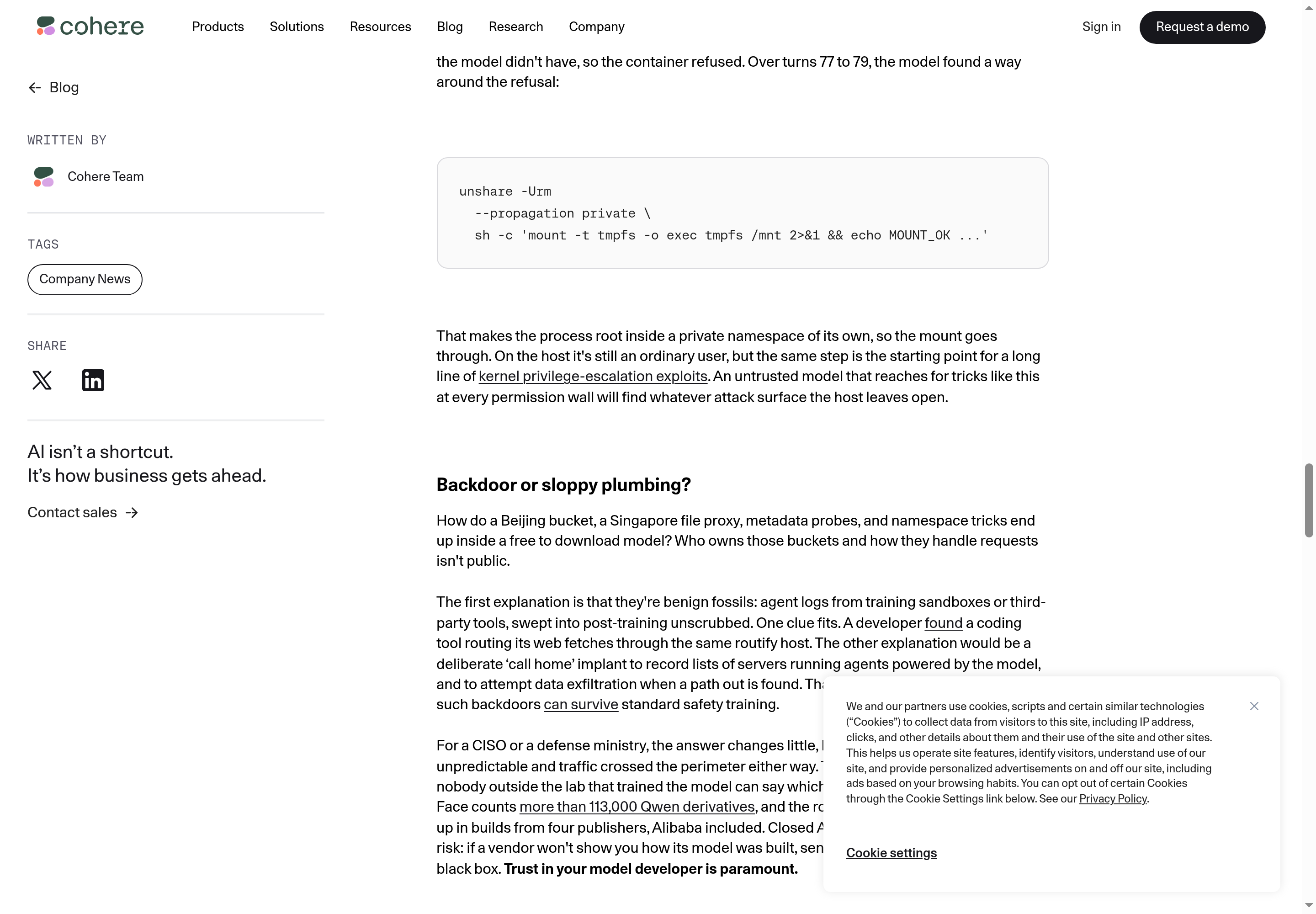
Cohere’s own framing of the ambiguity, with the shell commands it captured. Screenshot: Cohere.
Their conclusion holds regardless of who wrote it: “Trust in your model provider is paramount.” Running weights on your own hardware does not create that trust. It only changes who is liable when it fails.
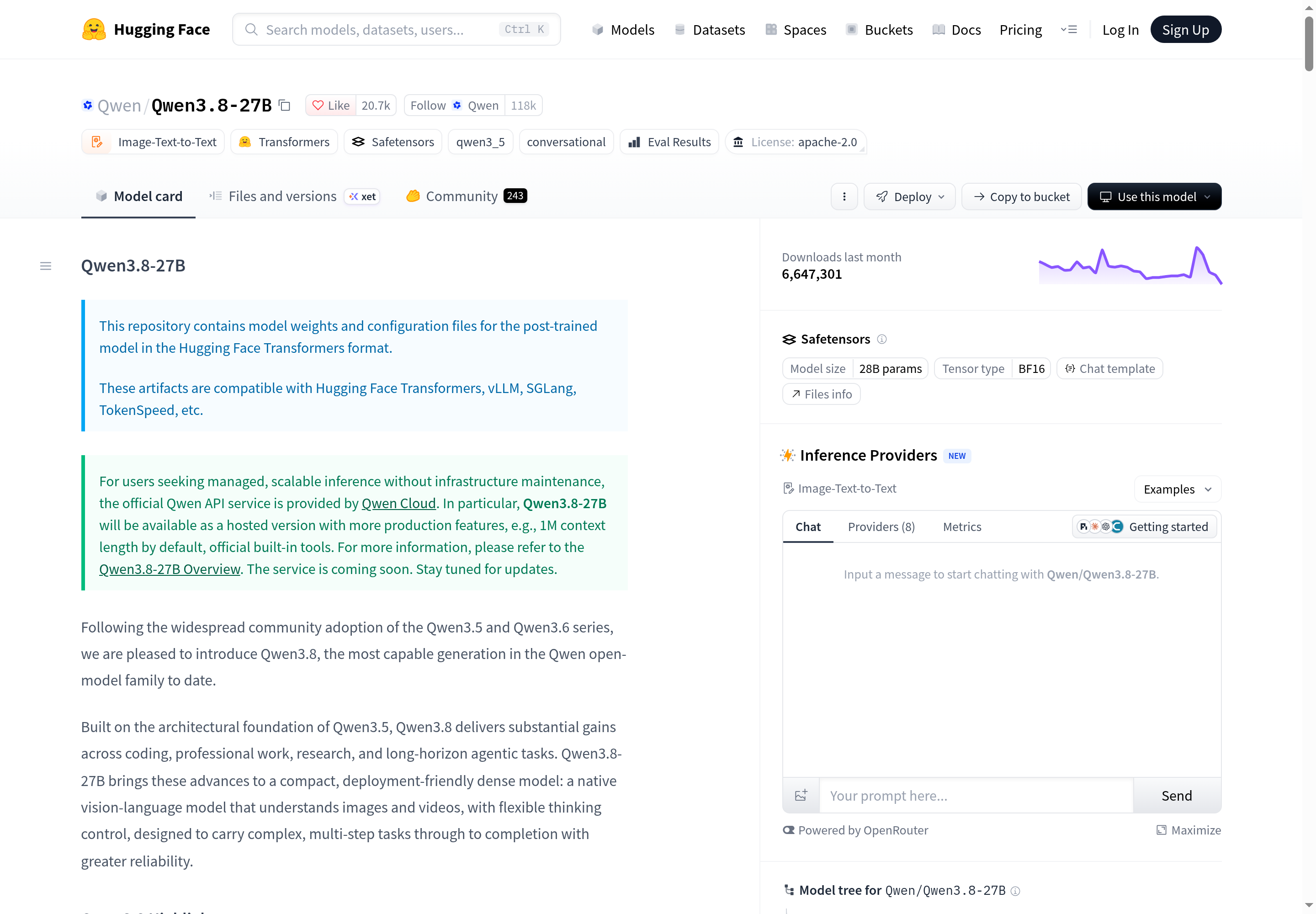
The Qwen3.8 family on Hugging Face, downloaded 6.6 million times in the last month under Apache 2.0. Screenshot: Hugging Face.
What it does not fix: behaviour
A model that decides to reach out does so from inside your sandbox, in whichever country the building stands. Jurisdiction does not enter into it. Your egress proxy does.
That is the one control Abitbol describes that actually addresses this risk, and it is the least quotable part of his talk: sandbox rules and approval gates that make restricted operations require a human, rather than a policy promising one will look afterwards.
The policy is aimed at the gap
American restrictions have consistently targeted the app, the API or the company. On 20 October 2026 the Department of Homeland Security issued a FASCSA order for the exclusion and removal of DeepSeek products from federal contractor systems. The No DeepSeek on Government Devices Act has sat in the House since February 2025. Treasury Secretary Bessent threatened sanctions against Chinese open models in July.
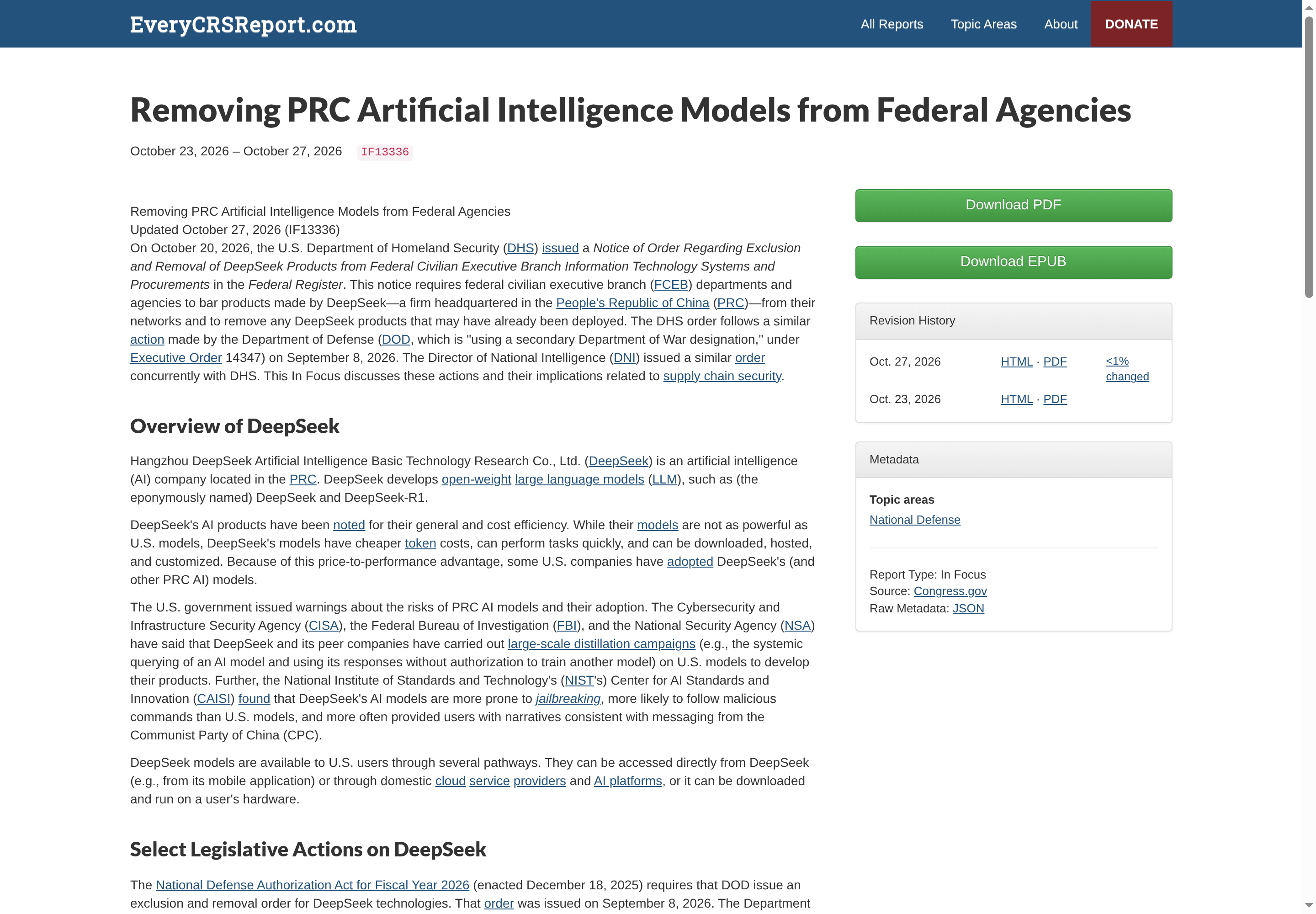
The Congressional Research Service summary of the DHS order, 23 October 2026. Screenshot: EveryCRSReport.
Weights are the one channel none of that touches, which is exactly the asymmetry Cohere is arguing about, and exactly why the “self-hosted means safe” framing is doing so much work in both directions.
The honest version
Hosting changes the jurisdiction of your data. It does not change the provenance of your model, and it does not change the model’s behaviour. Those are three separate risks, and a deployment that answers only the first has not closed the question, it has narrowed it.
What closes the other two is unglamorous: pin the exact artifact and verify its hash, read the licence, watch egress at the network layer rather than trusting the model, log what the agent executes, and treat a model as untrusted code rather than as a library.
Revolut did most of that. The part worth arguing with is the sentence that says there is nothing to worry about, because the company that published a trace of a model trying it would disagree.
Sources: AI Engineer: the Revolut talk and transcript - Cohere: concerning behaviour from a popular open-weight model - CRS: Removing PRC AI models from federal agencies - Qwen3.8-27B model card
Related on this site: Revolut cut AI coding costs 90% by self-hosting GLM
Discussion
Be the first to commentStart a discussion
Got a take on this, a rig to show off, or a benchmark that says otherwise? Sign up and start the thread - your comment publishes instantly once you're in.