A fintech with 2,000 engineers moved its default coding model off commercial APIs and onto its own GPUs, and says the bill fell by roughly 90 percent in under a year.
David Abitbol, who leads ops and infrastructure at Revolut, described the migration at the AI Engineer conference in New York, and The Register reported it on 3 November. The company had run Gemini from early 2025 and Claude Code from early 2026, with strict token budgets because the numbers did not make sense. “We were highly skeptical about the cost of AI. We were seeing engineers spend $1,000 a month, $10,000 a month with not so much ROI.”
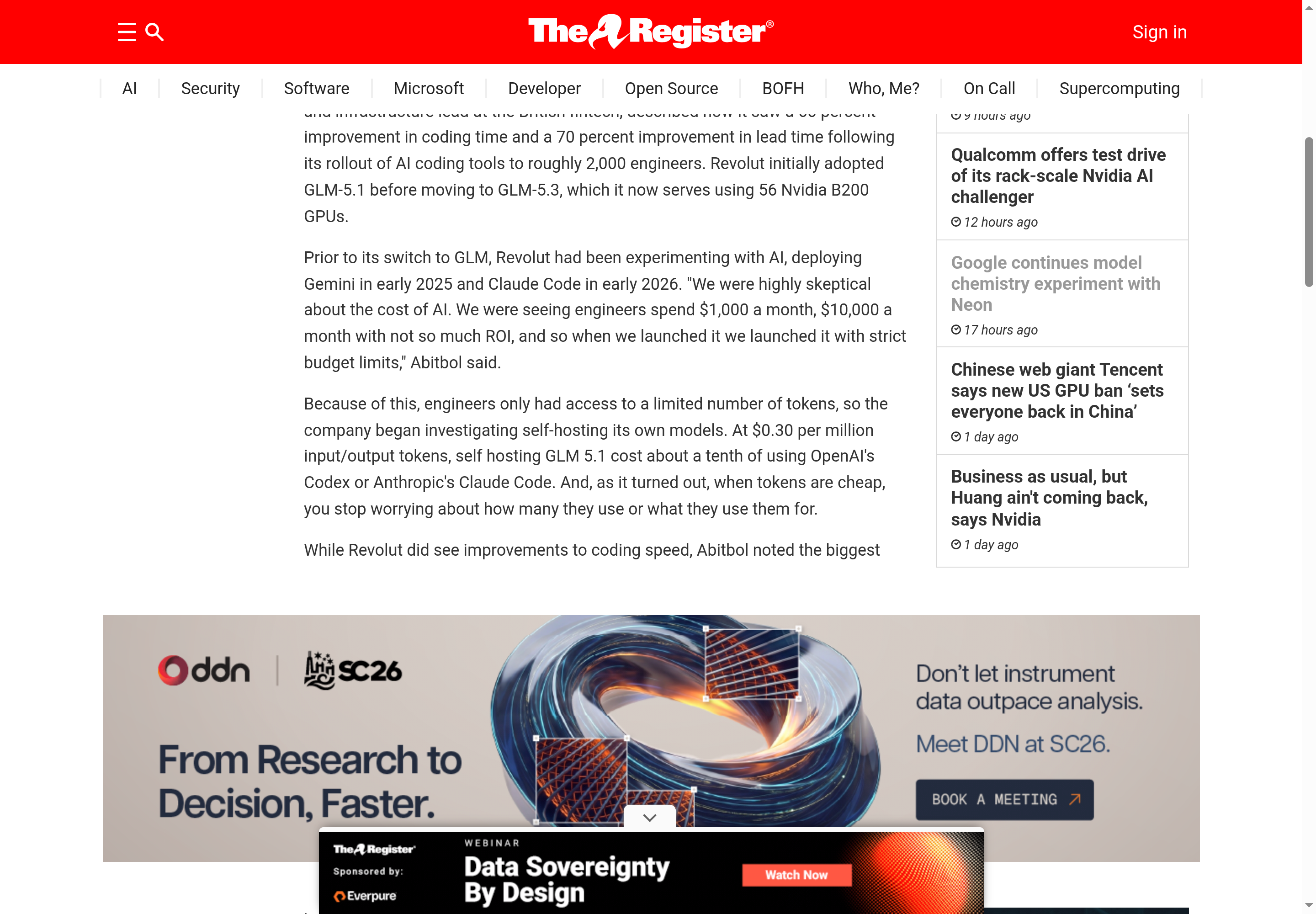
The cost paragraph, with the 60 and 70 percent figures and the 56-GPU deployment. Screenshot: The Register.
What they run
Revolut started on GLM-5.1 and moved to GLM-5.3, served on 56 Nvidia B200 GPUs, the equivalent of seven eight-GPU DGX B200 systems. Self-hosting GLM-5.1 came in at $0.30 per million input and output tokens, about a tenth of what Codex or Claude Code cost them.
The model is not small. GLM-5.1 is roughly 754 billion parameters with 40 billion active per token, needs about 380GB of GPU memory to hold the weights, and another 6 to 26GB per user for context. That is a data center deployment, not a workstation one, and it is the reason the savings require capital rather than a subscription.
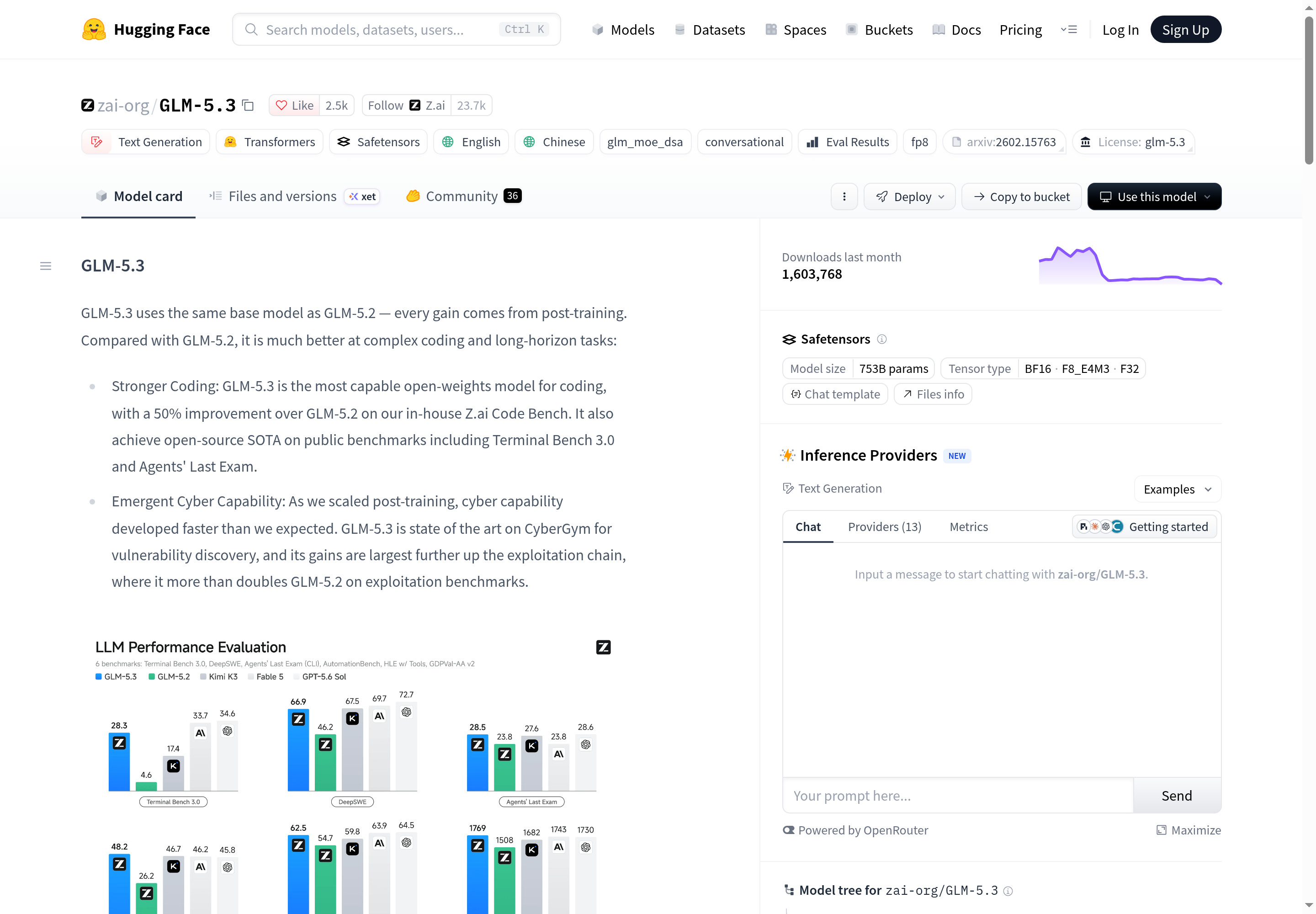
GLM-5.3 on Hugging Face, 755B parameters and 1.6 million downloads in the last month. Screenshot: Hugging Face.
The tuning mattered more than the hardware
Abitbol’s most useful claim for anyone running inference at scale is that adding GPUs was not what fixed performance. The gains came from hyperparameter tuning, switching to NVFP4 quantization, disaggregating prefill from decode, and tuning context lengths.
The result is on a slide with the GPU count held constant: tuning from the migration setup to a stable eight-way tensor-parallel configuration raised requests per second by 76 percent and cut time to first token by 88 percent, from 14.26 seconds to 1.68 seconds, on the same 56 B200s. Adding GPUs would not have produced that curve, and Abitbol’s advice is to resist buying more before the existing fleet is tuned.
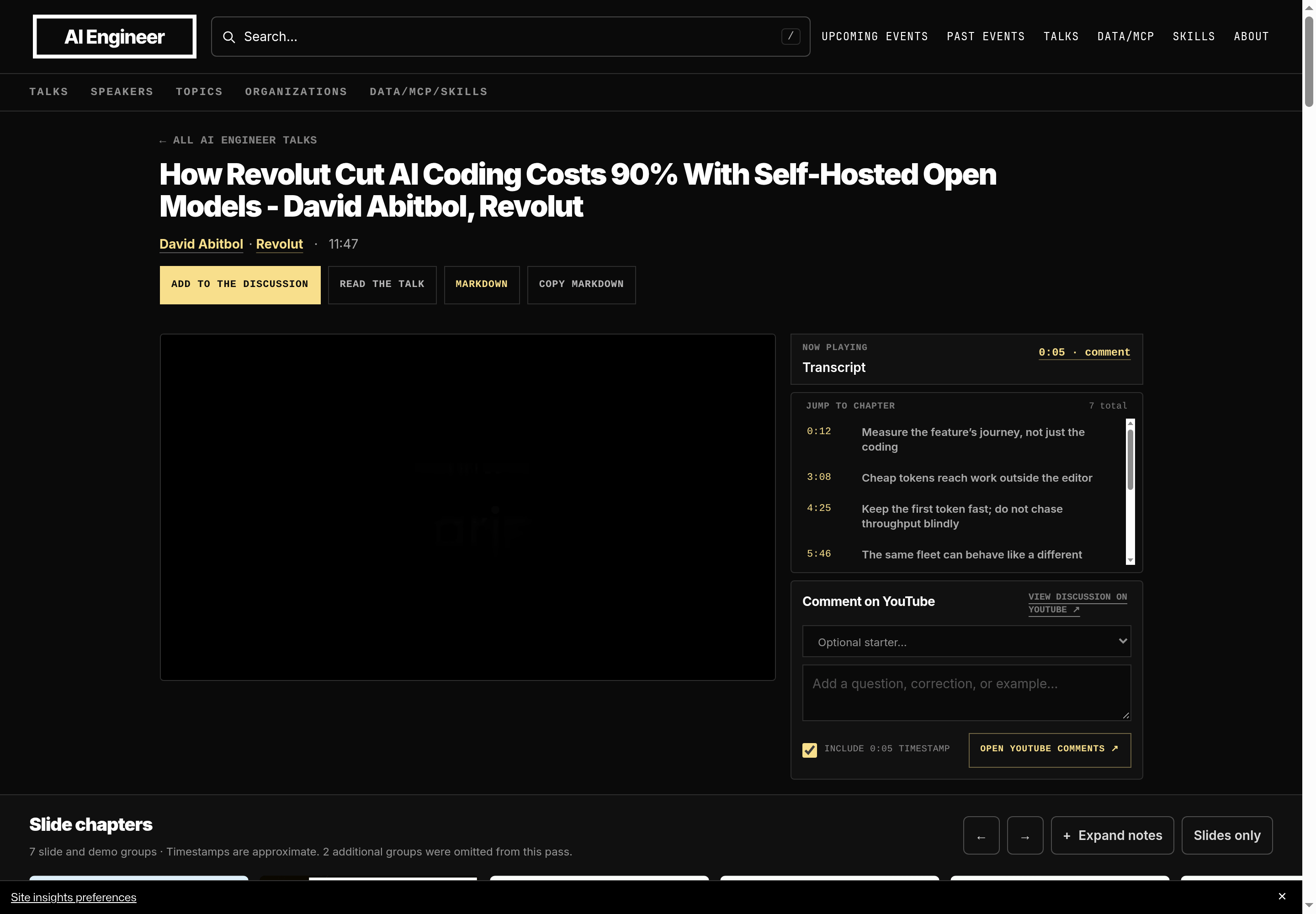
The chaptered talk page, where the tuning figures and the transcript are published. Screenshot: AI Engineer.
Then the line that will annoy every vendor selling a million-token window: “Long context is a scam. You really need to be mindful of that. Even though you can serve one million tokens, 256 [thousand] is really what you need.”
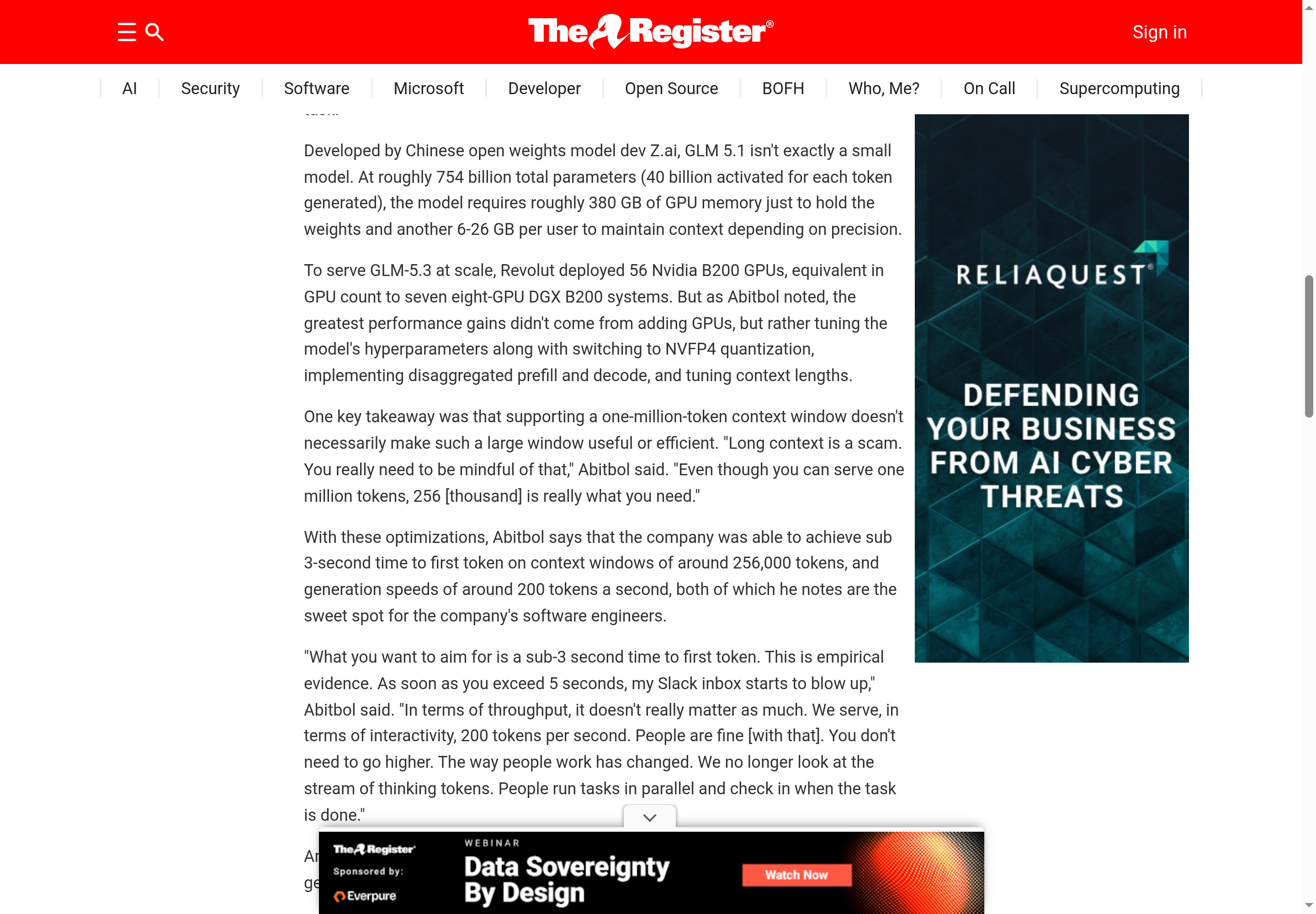
The tuning paragraph, including the long-context remark and the latency targets. Screenshot: The Register.
The targets they tuned toward are concrete: under 3 seconds to first token at a 256,000-token context, and about 200 tokens per second of generation. “As soon as you exceed 5 seconds, my Slack inbox starts to blow up.” Engineers signing in after 5pm see closer to 800 tokens per second because the fleet is idle.
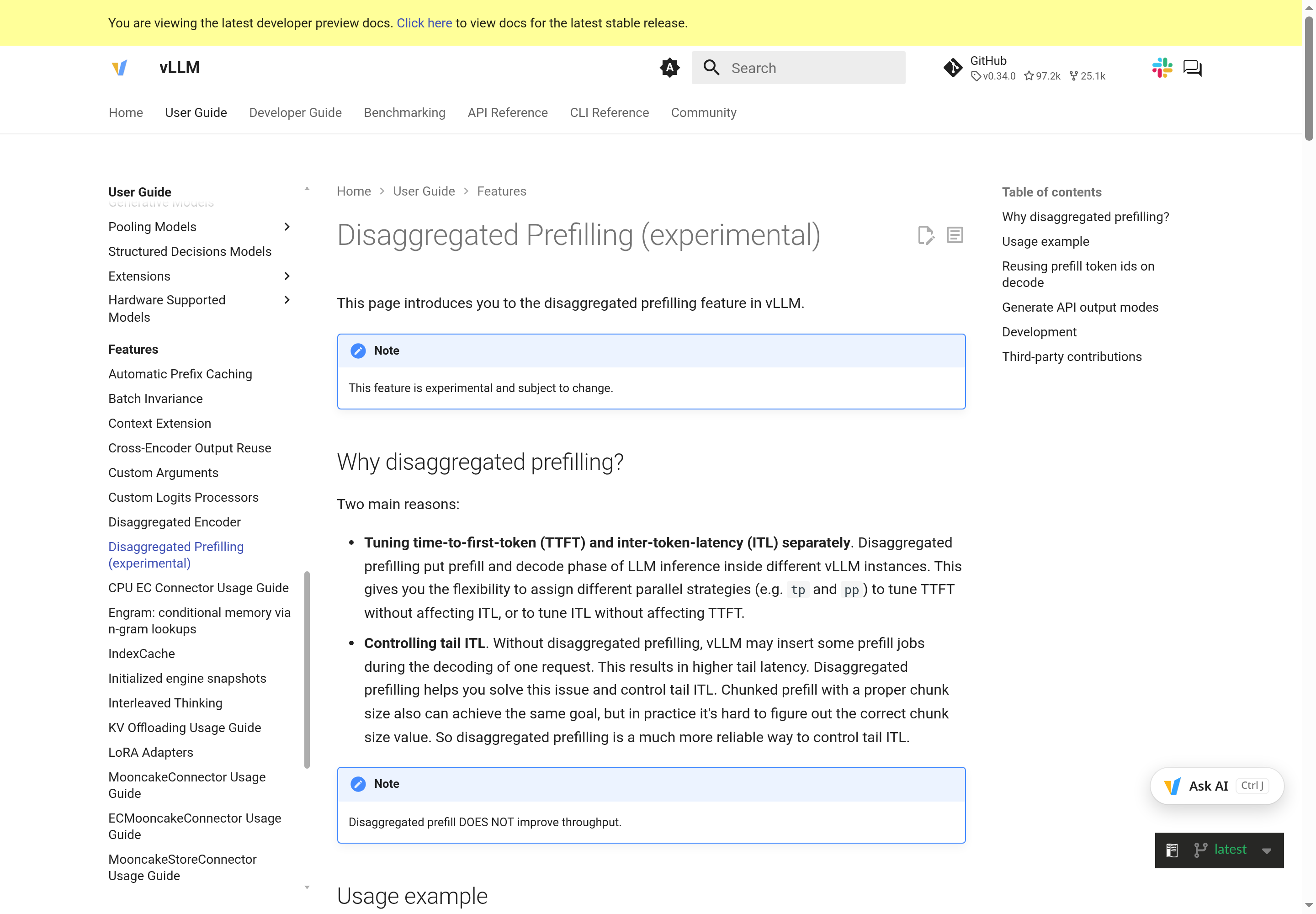
Disaggregated prefill, one of the four techniques Revolut credits for the performance. Screenshot: vLLM documentation.
The part that surprised them
Coding speed improved 60 percent and lead time 70 percent, by Revolut’s own measurement, and Abitbol says the bottleneck was never the code. The gains came from letting the model handle debugging, Jira tickets and Confluence pages, work nobody had budgeted tokens for before.
“When you have unlimited tokens, you’re free to do that. You no longer have to save your tokens for the end of the quarter or the most difficult task.”
That is the real argument for ownership, and it is behavioural rather than financial. A metered API does not just cost money, it shapes what people ask for.
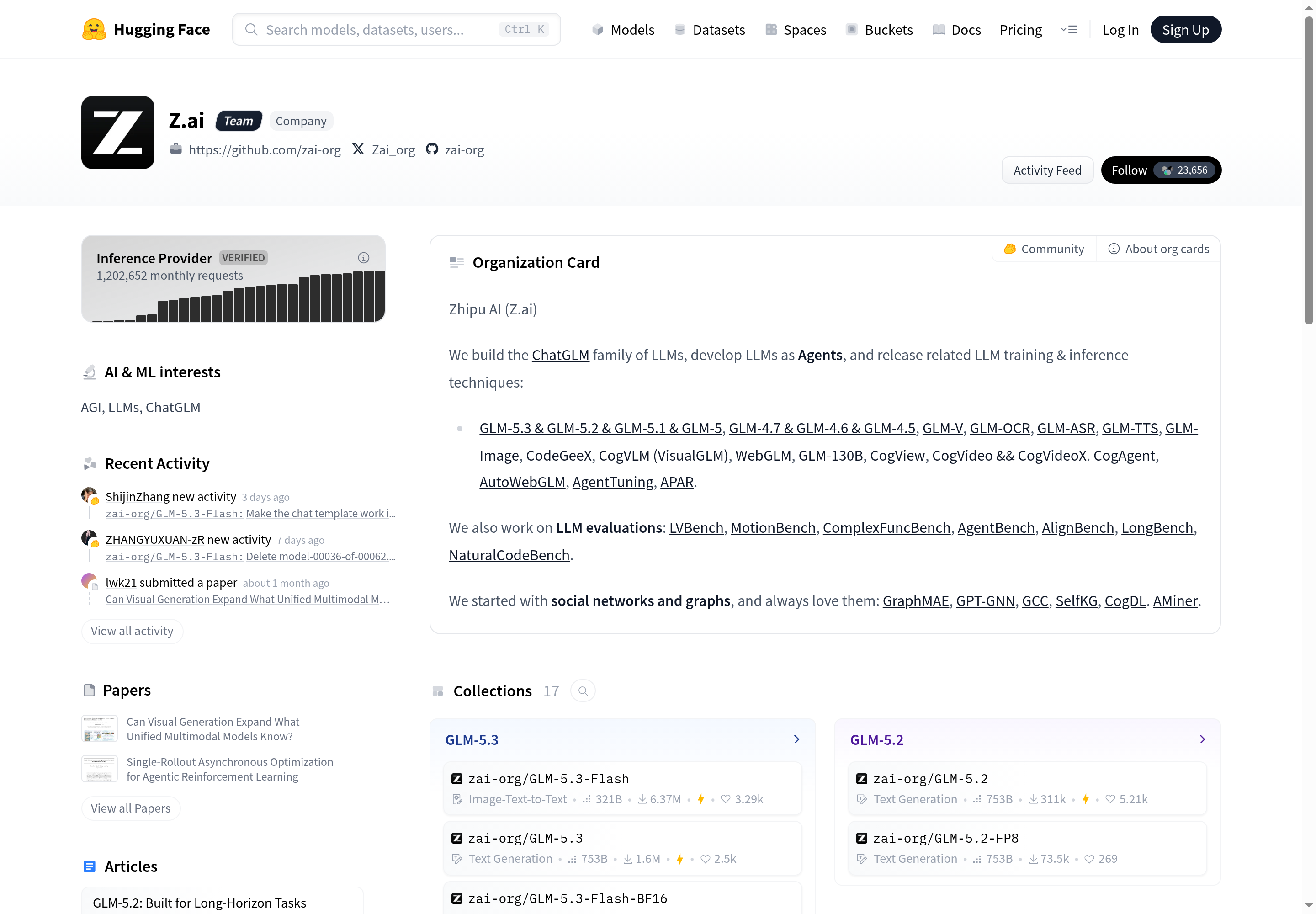
Z.ai’s model family on Hugging Face, where GLM-5.3 sits alongside the 5.1 release Revolut started on. Screenshot: Hugging Face.
What it does not prove
The 90 percent is an inference cost comparison, not a total cost of ownership. Fifty-six B200s is seven figures of hardware before power, rack space and the engineers who keep it serving. At low utilisation the maths inverts, which is the case every small team should check before copying this.
The 60 and 70 percent figures are self-reported with no control group, and “coding time” is a metric companies measure generously.
GLM is text only, so Revolut routes vision work to Gemini and GPT Luna through a model router. Code generation runs on the Chinese model; the frontier models are still on the bill, just less often.
Abitbol addressed the obvious security question directly: the concern with Chinese open weights is calling their APIs inside China, not running the files on your own hardware or regional cloud.
Why this lands now
It is the clearest public case for a position the industry has been arguing about all year, and it arrived in the same fortnight as Microsoft publishing an Ignite session titled “How much should you own?” Revolut answered with a number.
Sources: AI Engineer: the talk and full transcript - The Register report - GLM-5.3 model card - vLLM disaggregated prefill
Related on this site: Microsoft demos Hermes at Ignite without announcing it
Discussion
Be the first to commentStart a discussion
Got a take on this, a rig to show off, or a benchmark that says otherwise? Sign up and start the thread - your comment publishes instantly once you're in.