On 19 November Nous Research posted that it had “partnered with Microsoft to bring Hermes Agent to the enterprise”, and that Hermes now works inside Microsoft Teams, the Microsoft Store and Azure. The post has 3,918 likes and reads like a platform win.
Microsoft’s own record of Ignite 2026 says something more interesting and less flattering to the announcement format. Hermes appears in four sessions at Ignite. It appears in no keynote, no press release, and not once in the Book of News.
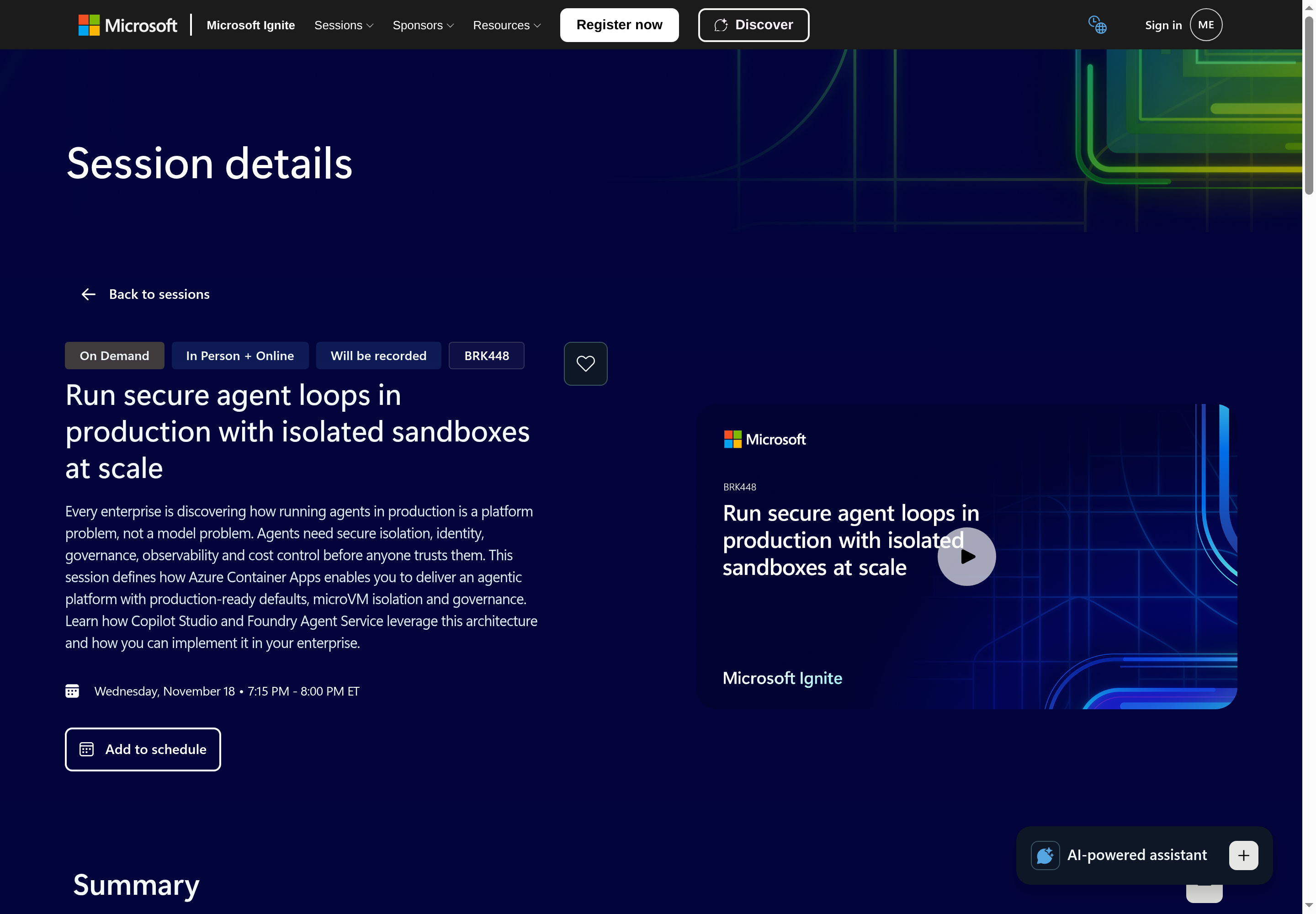
Session BRK448, with Nous Research CTO Jeffrey Quesnelle listed among the speakers. Screenshot: Microsoft Ignite.
What Microsoft actually scheduled
BRK448, “Run secure agent loops in production with isolated sandboxes at scale”, ran Wednesday at 7:15pm ET with Quesnelle alongside Jan Kalis of Azure Container Apps and Devanshi Joshi of Microsoft. Microsoft’s description frames the whole problem in one line: “Every enterprise is discovering how running agents in production is a platform problem, not a model problem.”
BRK243, “How much should you own? Choosing the right agent architecture”, is the one worth reading twice. Microsoft’s own description tells companies how to decide between foundry-built agents and “full control of your code and framework, including OpenClaw or Hermes”. A vendor that wanted hosted everything would not schedule that session.
BRK254 lists Hermes as a distribution channel for Microsoft’s MAI models, in the same breath as GitHub, Windows, Foundry, OpenRouter, Vercel, OpenCode, Figma and Adobe.
THR889 demonstrates Hermes running under Microsoft Execution Containers on Windows, with contained and unrestricted behaviour compared side by side.
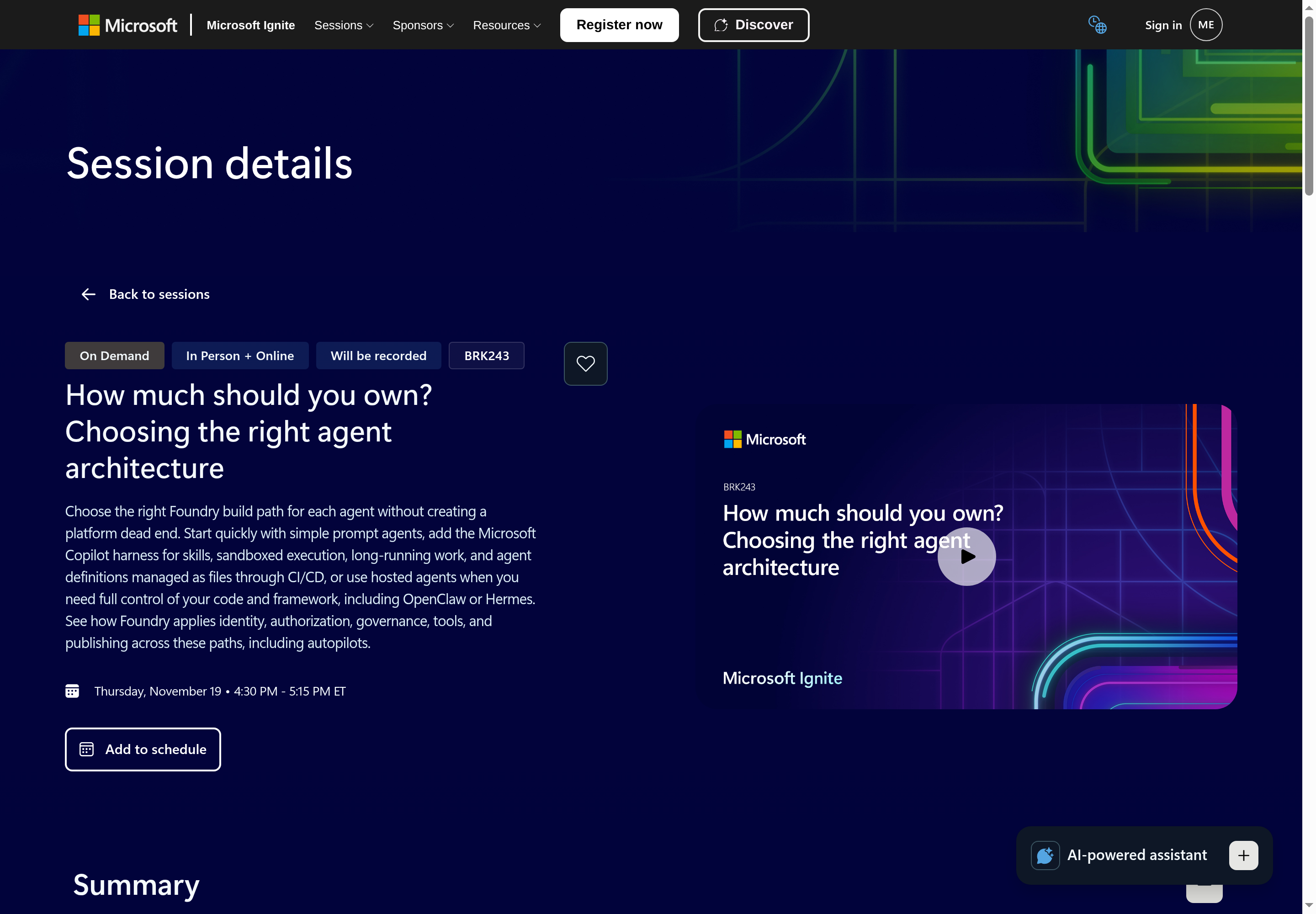
BRK243 names Hermes as the self-hosted alternative to Microsoft’s own agent platform. Screenshot: Microsoft Ignite.
The one sentence Microsoft published
The Azure Container Apps Ignite post lists Nous first among its customers: “Nous Research runs Hermes Agent workloads on ACA Sandboxes, where agent execution happens in isolated microVMs that start in under a second and release compute when idle.” It links to Nous’s own page rather than a Microsoft page, and Nous is one of six customers named there.
Microsoft’s AI-generated summary of BRK448 adds figures that appear nowhere in Microsoft’s marketing: Hermes as “the top-ranked open agent on OpenRouter, processing nearly 2 trillion tokens daily”, a self-improvement loop that “automatically builds skill files and deterministic workflows based on usage patterns”, and scaling to “around 20,000 active sandbox instances after migrating from another cloud provider.”
That last number is the only public figure on what this migration cost in capacity. It comes from a machine-written summary, and the same summary misspells the speaker’s name.
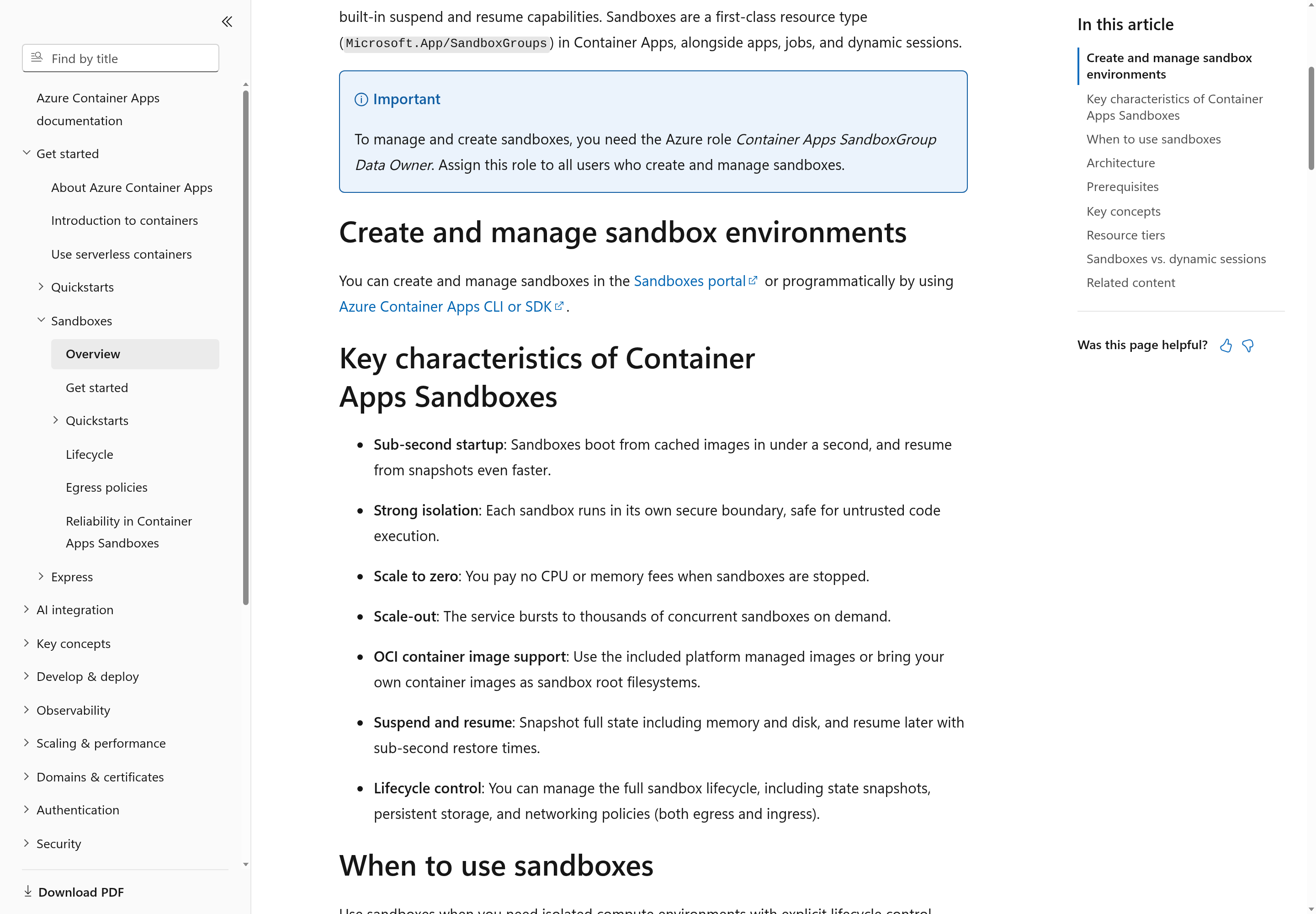
Azure Container Apps Sandboxes, generally available since 23 September. Screenshot: Microsoft Learn.
The sandboxes were not built for this
Container Apps Sandboxes reached public preview on 2 June and general availability on 23 September, five months before the partnership announcement. Each sandbox is a hardware-isolated microVM with its own kernel, booting from a cached image in under a second, suspending with memory and disk snapshotted, billed per second at $0.000024 per vCPU-second and $0.000003 per GiB-second after a monthly grant of 180,000 vCPU-seconds and 360,000 GiB-seconds. Stopped sandboxes cost nothing. A subscription is capped at 2,000 cores.
The isolation is real and Microsoft is careful about what it claims: “Sandboxes reduce the risk of running untrusted code, but they don’t make that code inherently safe.”
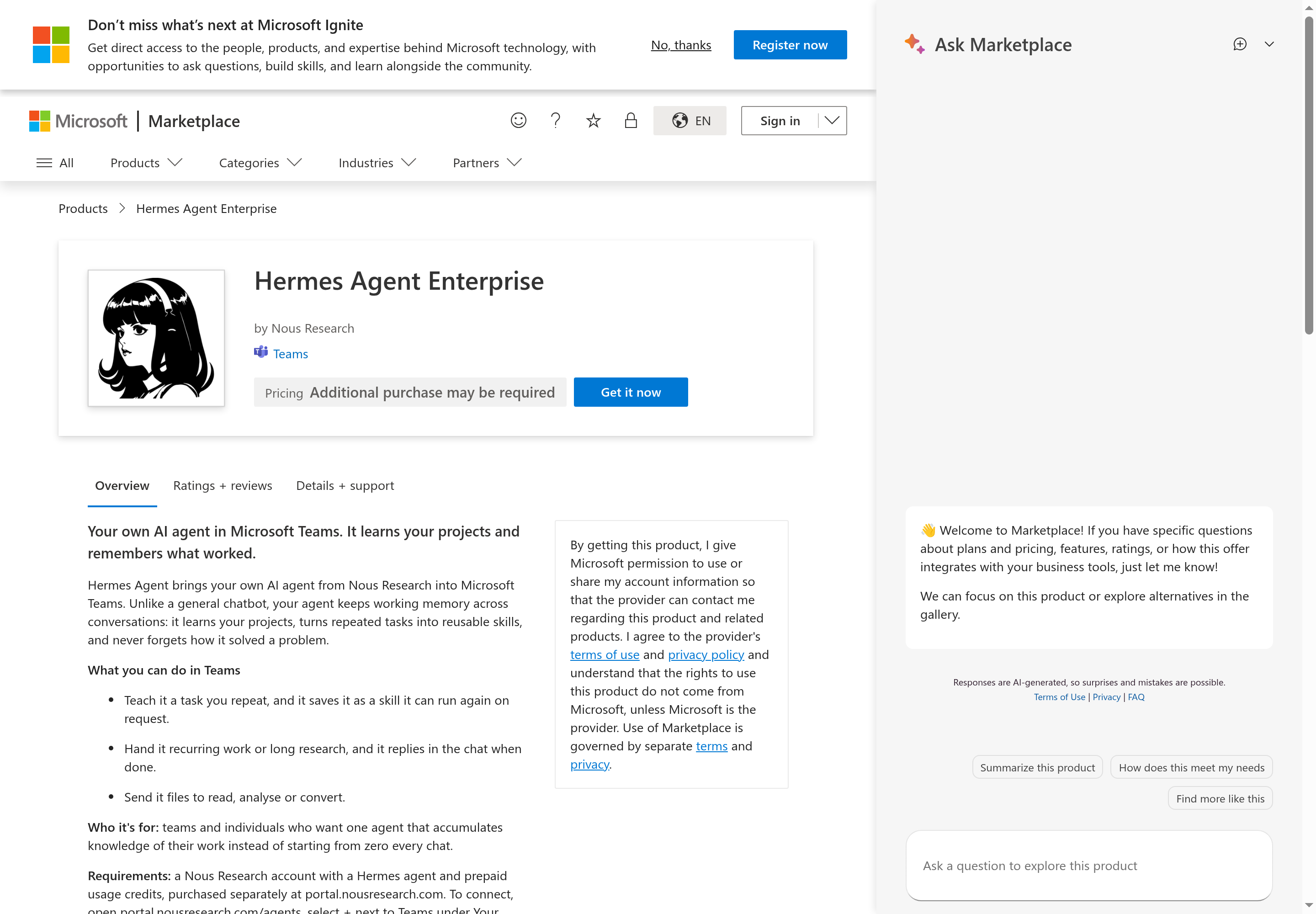
The Teams app listing, published under Nous Research’s name with no Microsoft endorsement attached. Screenshot: Microsoft Marketplace.
Two things the announcement overstates
The Store listing is not new. Hermes Agent has been in the Microsoft Store since 9 September 2026, repackaged on 16 November. “Now available in the Microsoft Store” describes a two-month-old listing.
Two Microsoft-hosted pages contradict each other. The Teams listing says “the app works in private 1:1 chats only; group chats and channels are not supported.” The Azure marketplace SaaS page for the same product says you can “@mention it in group chats and channels.”
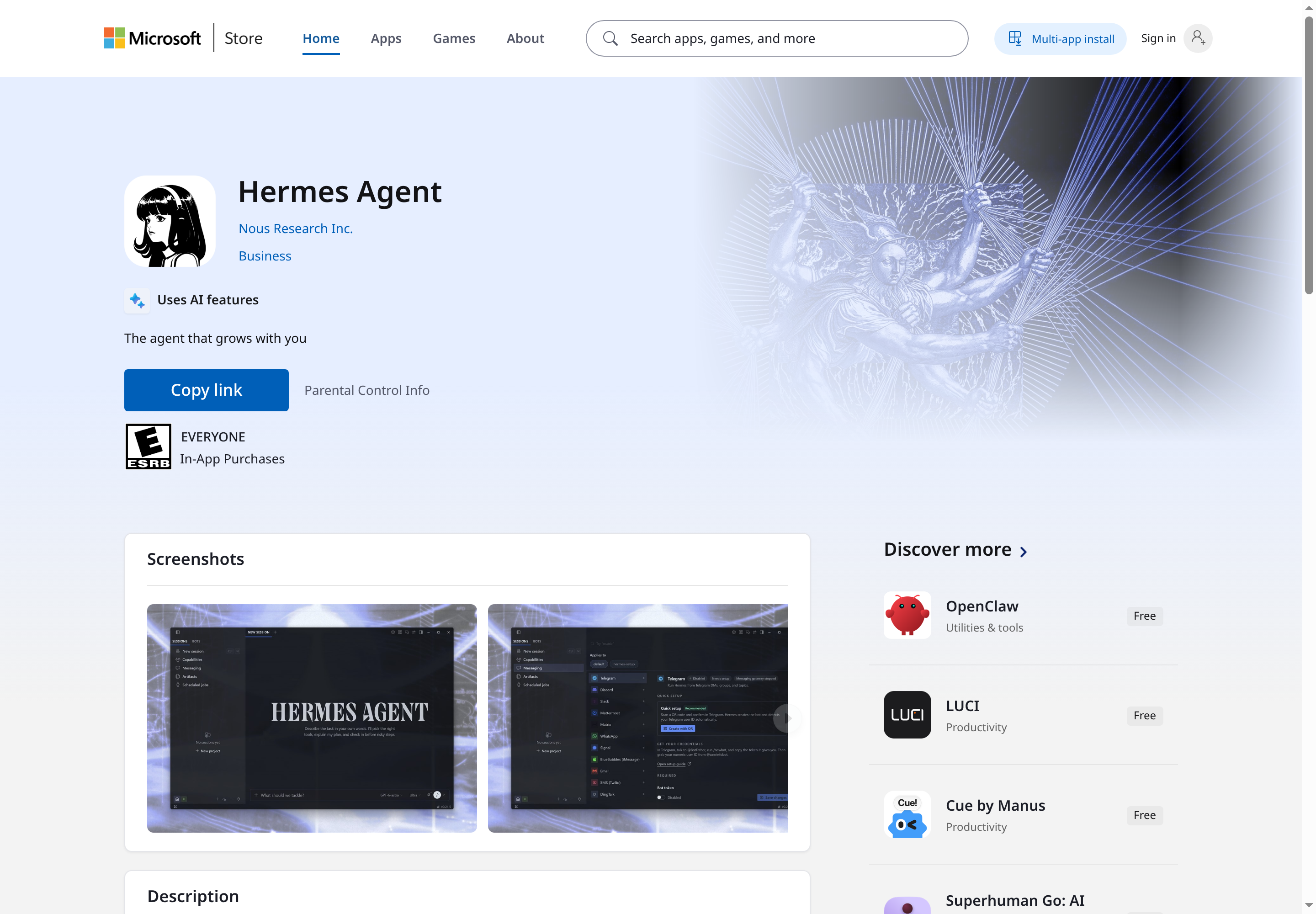
The Microsoft Store listing, first published 9 September, two months before the partnership post. Screenshot: Microsoft Store.
What this is, then
Not a hostile reading, a structural one. Microsoft needs an agent that enterprises can sandbox, audit and pool, and it is buying that layer from an open-source project rather than shipping its own. Its own marketing does not lead with that. The customer logos in the Azure blog do.
For anyone running Hermes on their own hardware, the interesting question is the one Microsoft put in a session title: how much should you own. The company that sells the sandbox is publicly asking whether you need one.
Sources: Nous Research: Hermes Enterprise in Microsoft Teams - Ignite session BRK448 - Ignite session BRK243 - Azure Container Apps at Ignite 2026 - Container Apps Sandboxes overview - Teams app listing
Related on this site: Qwen promises open weights for smaller Qwen4 models
Discussion
Be the first to commentStart a discussion
Got a take on this, a rig to show off, or a benchmark that says otherwise? Sign up and start the thread - your comment publishes instantly once you're in.