TLDR: Microsoft published a patent application on November 5 for splitting AI training jobs into small pieces and running them on idle phones, laptops and gaming PCs, with owners earning credits, software or money. It enables a company that cannot buy enough data-center GPUs to rent the graphics cards already sitting in people’s homes. The difference between this and the crypto-style compute networks is that it names the exact mechanism for the hard part, which is deciding which pieces fit where and whether the answer that comes back can be trusted.
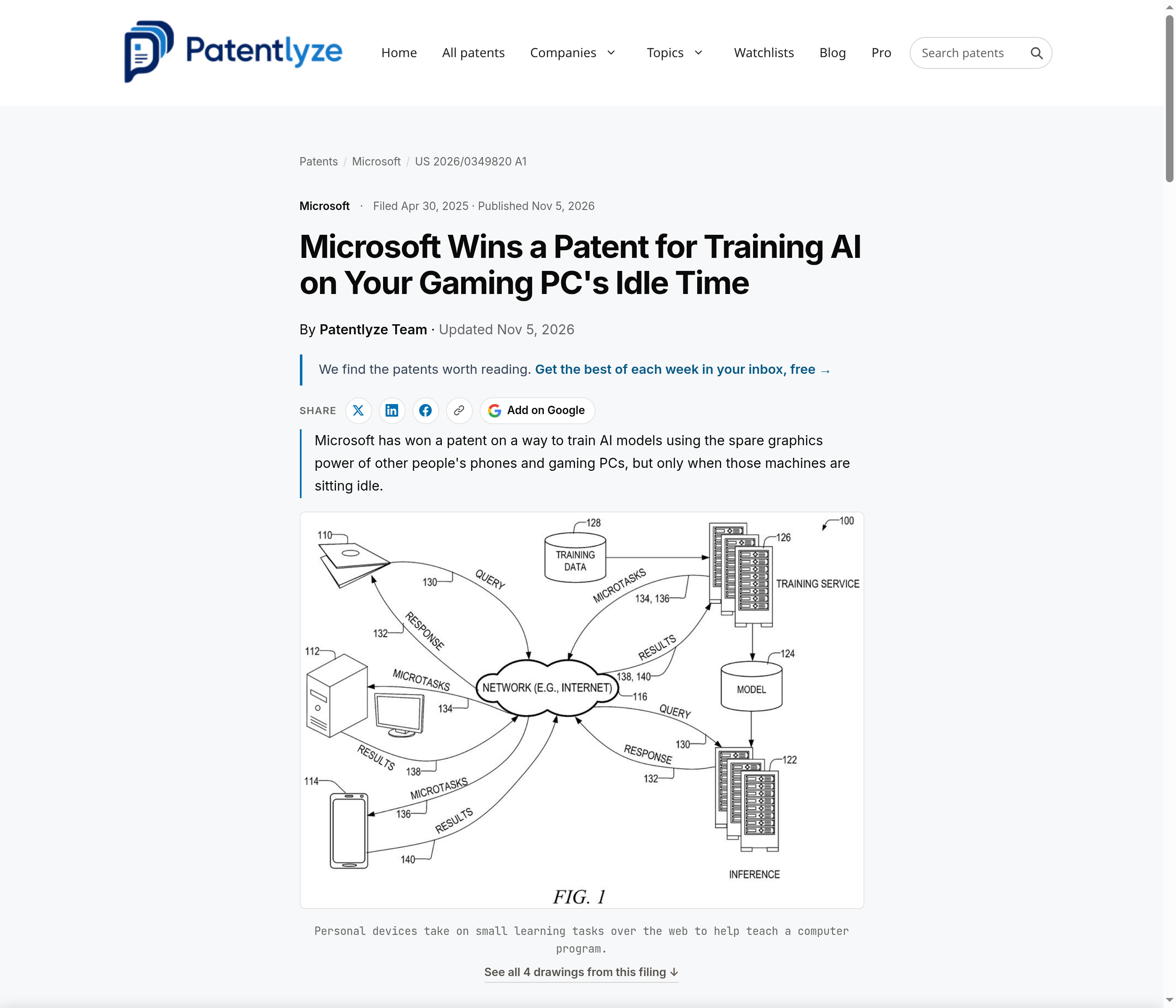
Caption: Figure 1 from the filing, which shows the shape of the whole idea: personal devices take micro-tasks over the internet, return results to a training service, and the trained model feeds an inference service. Image: US 2026/0349820 A1 via Patentlyze.
What the filing actually describes
The application is US 2026/0349820 A1, titled “Opportunistic Micro-training on Edge Devices Using Spare GPU Utilization.” Microsoft Technology Licensing filed it on April 30, 2025, and the patent office published it on November 5, 2026. It names one inventor, Aditya Vasanth Challapally, and carries 20 claims.
The abstract is dry, but it is specific about the mechanism:
“The system monitors edge devices to detect available compute capacity and decomposes training tasks into independently trainable micro-tasks by analyzing model dependencies and identifying optimal split points based on communication cost, memory overhead, and data locality.”
Unpacked, the system works in four steps:
Map the model. Build a dependency graph of every calculation and what has to finish before what.
Find split points. Look for places where the work becomes independent enough to cut.
Score each split. Every candidate cut gets a cost based on how much data would have to move between devices, how much extra memory the temporary results need, and how often a device would have to fetch data it does not store. Lowest cost wins.
Match to a device. The service watches GPU use and memory, temperature and power draw, and forecasts when each machine will be free, blending a neural network guess with a Bayesian forecast and a long-term trend. Busy or hot machines get sampled less often. Tasks are sized to the device, smaller for machines that come and go unpredictably.
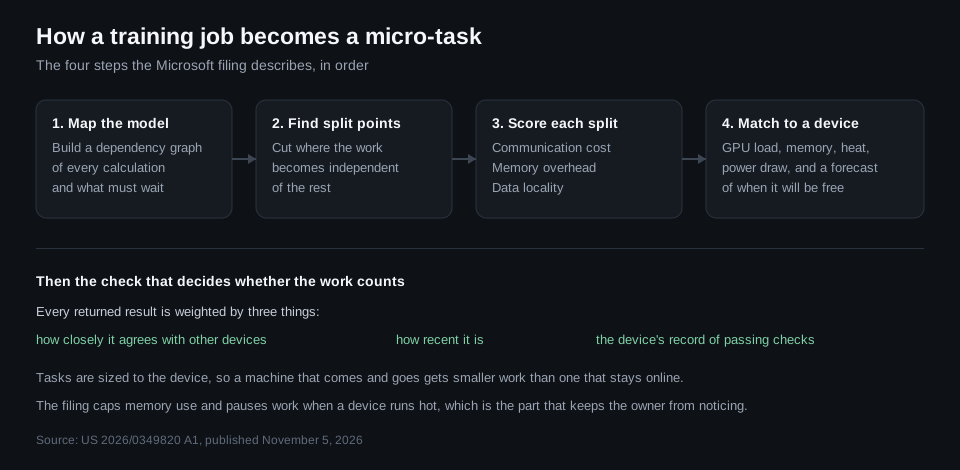
Caption: The four-step split in the order the filing describes it, plus the check that decides whether returned work counts. Figure: Tokenstead, from the published application.
The part the headlines skipped
Two corrections before the excitement gets out of hand.
It is a published application. The USPTO database lists it as US-20260349820-A1 in the pre-grant publication collection, dated November 5, 2026, 19 pages. One patent-tracking site labels the filing as granted in late October, which the record does not support for that document number: a grant would carry a patent number, not an A1 application publication.
Payment is described, not promised. The filing says owners could earn credits, free software, access to the model, or money. It publishes no rate, no formula, no currency and no program. Microsoft has announced nothing, has no sign-up page, and has not said it intends to build this. A patent application is a claim on an idea. It is not a product roadmap, and it is certainly not an income stream.

Caption: Coverage from November 7, two days after publication, framed around the payout rather than the scheduling problem the filing actually spends its pages on. Screenshot: Insider Gaming.
What the 19 pages actually say
I pulled the whole document from the USPTO database, which lists it as US-20260349820-A1, 19 pages, published November 5, 2026. The claims are what matter, and they are narrower than the coverage suggests.
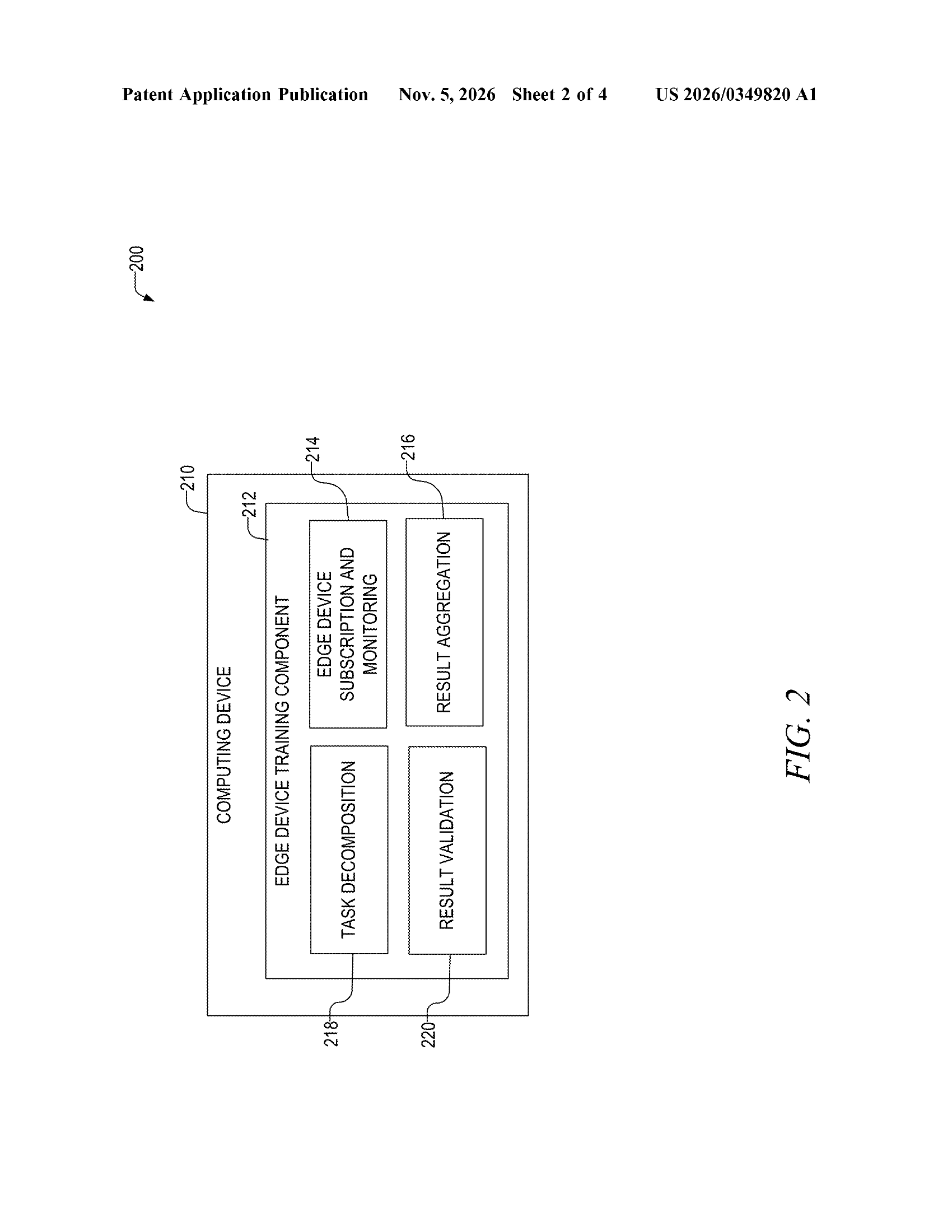
Caption: FIG. 3, the method the patent actually claims, start to finish: decompose, find split points, cost them, distribute, receive, then update the model with a weighted result. Image: US 2026/0349820 A1, sheet 3 of 4.
All 20 claims cover the scheduling and checking machinery. Claim 1 is a method claim for decomposing a training job by dependency graph, scoring candidate split points on communication cost, memory overhead and data locality, distributing a micro-task, getting a result back, and weighting that result by validation score, staleness and device reliability. Claims 2 to 7 add availability prediction, telemetry, the dependency graph, task sizing and the reliability average. Claims 8 to 14 repeat the same material as a device claim. Claims 15 to 20 repeat it again as a machine-readable medium.
Not one claim mentions payment. I searched the claims for reward, credit, compensation, payment, monetary, incentive, token and crypto. The count is zero for every one of them. Compensation appears once in the whole document, in paragraph [0019] of the description:
“In some examples, the system may track the amount of computations each edge device has provided and may compensate the owners of the edge devices. For example, each computation may result in a credit being applied to an owner’s account. The credits may be exchanged for free software, model access credits allow the user to access the model being trained, money, or the like.”
That is the entire basis for every “Microsoft will pay you to train AI” headline. One “may” in a described embodiment, not a claimed feature. A competitor can pay users however it likes without touching these claims, and Microsoft has protected the splitting and the checking, not the payout.
The numbers in the fine print
The document is unusually specific for a patent application. It gives worked formulas:
Capability factor, used to size tasks: C = w1 × (compute/reference) + w2 × (memory/reference) + w3 × (reliability) + w4 × (thermal headroom/reference). A reference machine at 100 GFLOPS against an edge device at 150 scores 1.5.
Availability prediction: P(t) = 0.6 × LSTM(history) + 0.3 × Bayesian(recency) + 0.1 × statistical trend. Sixty percent of the answer comes from a neural network guess, thirty from a probability model, ten from the trend line.
Monitoring rate: Sample_Rate = min(100 ms, max(5 ms, beta × utilization × thermal factor)), with beta between 0.1 and 0.3. The system looks at a busy or hot machine four times less often than an idle one.
Validation of results: an agreement check against other devices at 40% of the score, a math check at 30%, and a range check against historical boundaries at 30%.
Reliability: a rolling score over roughly the last 100 tasks, an exponential average that weights recent work more heavily, a starting score of 0.8 for a new device, and a bigger penalty, 0.05 instead of 0.01, for a suspicious outlier than for a simple failure.
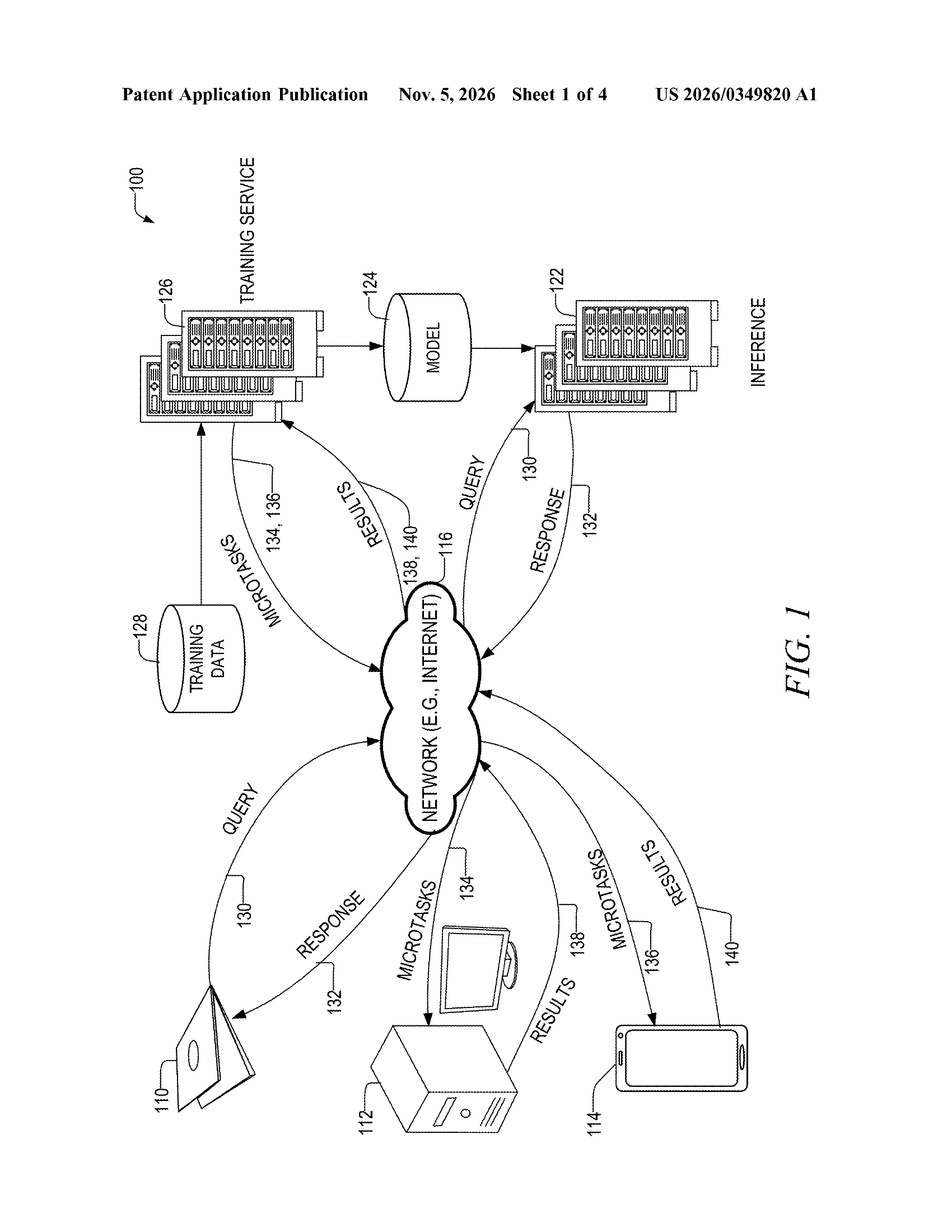
Caption: FIG. 2, the device-side component: subscription and monitoring, task decomposition, result validation, result aggregation. Image: US 2026/0349820 A1, sheet 2 of 4.
The word that never appears
The filing has a lot to say about integrity, which is whether an answer is correct. It says nothing at all about confidentiality, which is whether the device owner can see the data.
I searched the full text for privacy, confidential, encrypt, sensitive, malicious, poisoning, Sybil and adversarial. Every one of those searches returns zero hits across all 19 pages. The document uses “untrusted devices” four times and “Byzantine-resistant” five times, and its threat model is entirely about wrong answers, not about watching.
That is the tell. A system that ships a company’s training data to a stranger’s gaming PC has one hard problem, and the patent does not mention it. The claims protect the part Microsoft can build. The part nobody has solved stays out of the document.
Why this is not fantasy anymore
Training a language model across machines you do not own used to be hopeless. Every step of training normally requires all the workers to exchange gradients, and on consumer hardware the link between machines is the internet, which is thousands of times slower than the interconnect inside a data center.
That changed in a specific way. Google DeepMind’s DiLoCo, published in November 2023, showed that eight workers could match fully synchronous training while communicating 500 times less, by letting each worker take many local steps and only syncing occasionally. The follow-on work since then has mostly been about making that sync cheaper and more tolerant of a worker disappearing mid-run.
The Microsoft filing attacks the same problem from a different angle. Instead of syncing one big model across many machines, it cuts the model into pieces that can be trained independently and shipped to whatever machine is free. The cost function it describes, communication, memory overhead and data locality, is exactly the set of constraints that decides whether a split is worth making.
The physical limits are still there. Consumer cards have no NVLink, no ECC memory, and a fraction of the memory bandwidth of a data-center part. Whatever runs on them will be fine-tuning, small models, or narrow pieces of a larger job. Nobody trains a frontier model this way.
The trust problem, which the filing does name
Strangers’ machines are slow, flaky, or dishonest, and the filing knows it. Results come back weighted by three things: how closely a result agrees with what other devices returned, how recent it is, and the device’s own record of passing checks. Reputation scoring is the same idea every distributed compute network has landed on, and it is the reason those networks are good at rendering and bad at anything secret.
The unsolved part is not cheating. It is confidentiality. If someone else’s laptop is training on the data, someone else’s laptop has the data. That single sentence rules out most of the workloads a company would actually pay to run, and it is why this model fits Microsoft’s own models far better than it fits a customer’s private corpus.
The money, measured
Here is where the story gets concrete, because somebody already runs this business.
Salad, a consumer GPU network, publishes measured earnings every week from machines that actually ran. For the week of November 2 to 8, 2026, the numbers look like this:
- RTX 5090: $0.363 per hour average, most machines between $0.329 and $0.396, top 1% at $0.629, with a job running 97% of the time.
- RTX 4090: $0.272 per hour average.
- RTX 3090: $0.098 per hour average, with a job running 93% of the time.
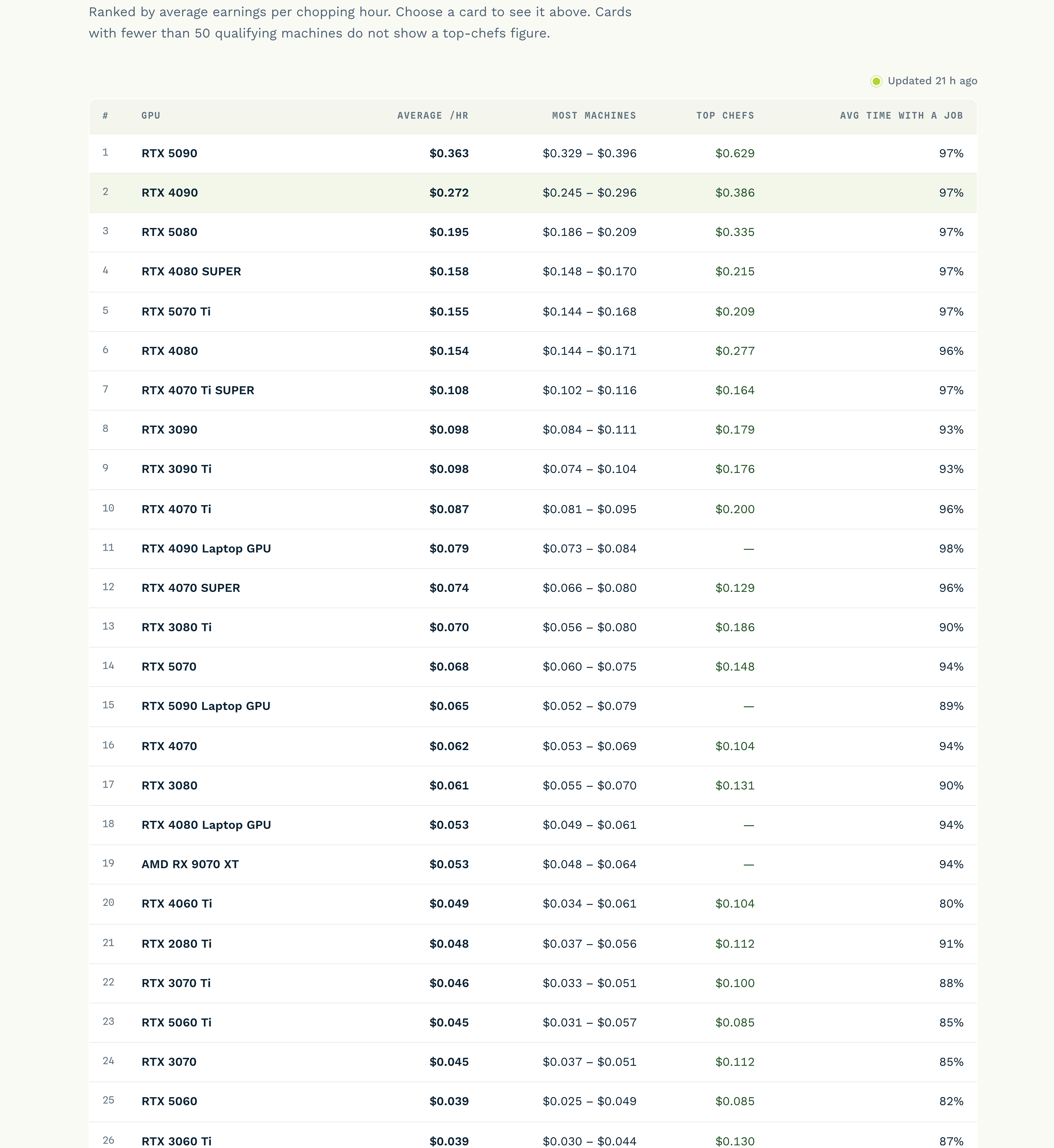
Caption: Salad’s published earning rates for the week of November 2 to 8, 2026, measured from real machines including the hours they had no work. Screenshot: Salad.
Those numbers are per hour of availability, not per hour of work, which makes them unusually honest. Now subtract the electricity, at the US residential average of 18.16 cents per kWh in August 2026:
- A 5090 pulling about 450W costs $0.082 an hour to run, so it nets roughly $0.281 an hour. Electricity takes 23% of the gross.
- A 4090 at about 350W costs $0.064 an hour, netting $0.208.
- A 3090 at about 300W costs $0.055 an hour, netting $0.044. Electricity takes 56% of the gross.
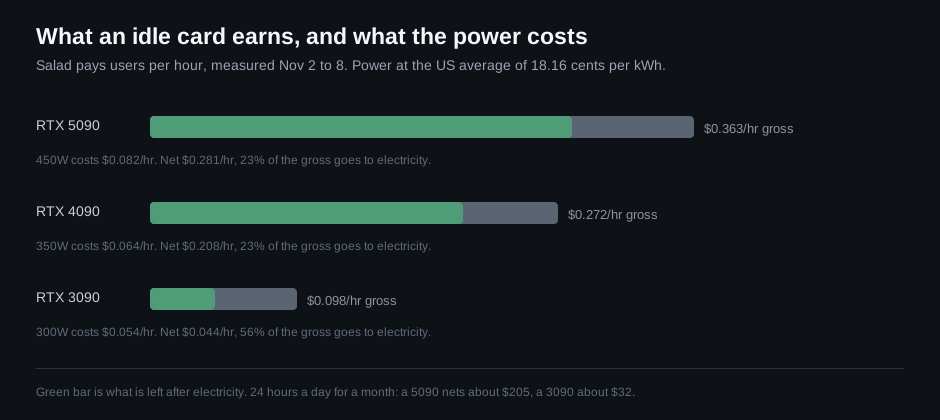
Caption: Gross earnings against the electricity bill for three cards people actually own. Power draw is an assumption for a card under load, not a measurement. Figure: Tokenstead, from Salad’s measured rates and EIA’s August 2026 price.
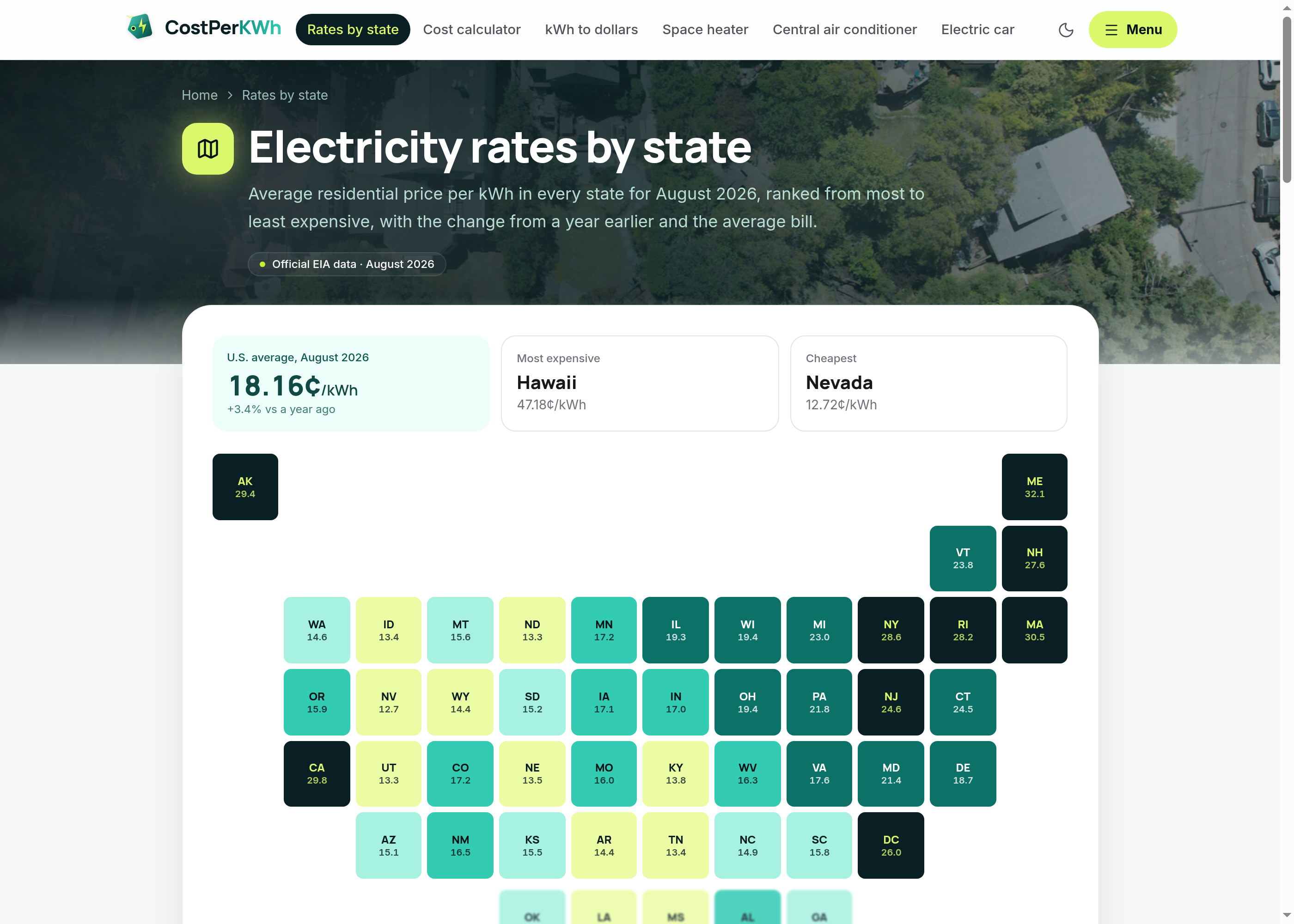
Caption: The US average residential price in August 2026 was 18.16 cents per kWh, up 3.4% on the year, with Hawaii at 47.18 and Nevada at 12.72. Screenshot: CostPerKWh, from EIA data.
Run a 5090 flat out for a month and you net about $205. Run a 3090 and you net about $32, which is close enough to nothing that the old mining cards in a closet are not a business.
What this means if you own the hardware
Three things follow, and none of them are “buy more cards.”
A Microsoft network would compete with Salad, not with data-center rental. The payout would have to clear a consumer’s electricity bill and beat what Salad already pays, or nobody installs it. Salad’s measured $0.363 an hour for a 5090 is the number to watch, and it sits well below the $0.49 median that Vast pays for the same card with a real customer attached.
More supply means softer prices at the bottom. If Windows shipped an opt-in switch that turned idle gaming PCs into training capacity, the marginal price of a consumer GPU hour falls. That is good for buyers of compute and bad for anyone holding cards as an appreciating asset.
The payout will probably be credits. Microsoft’s most valuable currency is not cash, it is Game Pass months, Store credit and Copilot capacity. The filing lists credits and software access first and money later, which is a hint about how a real program would be structured.
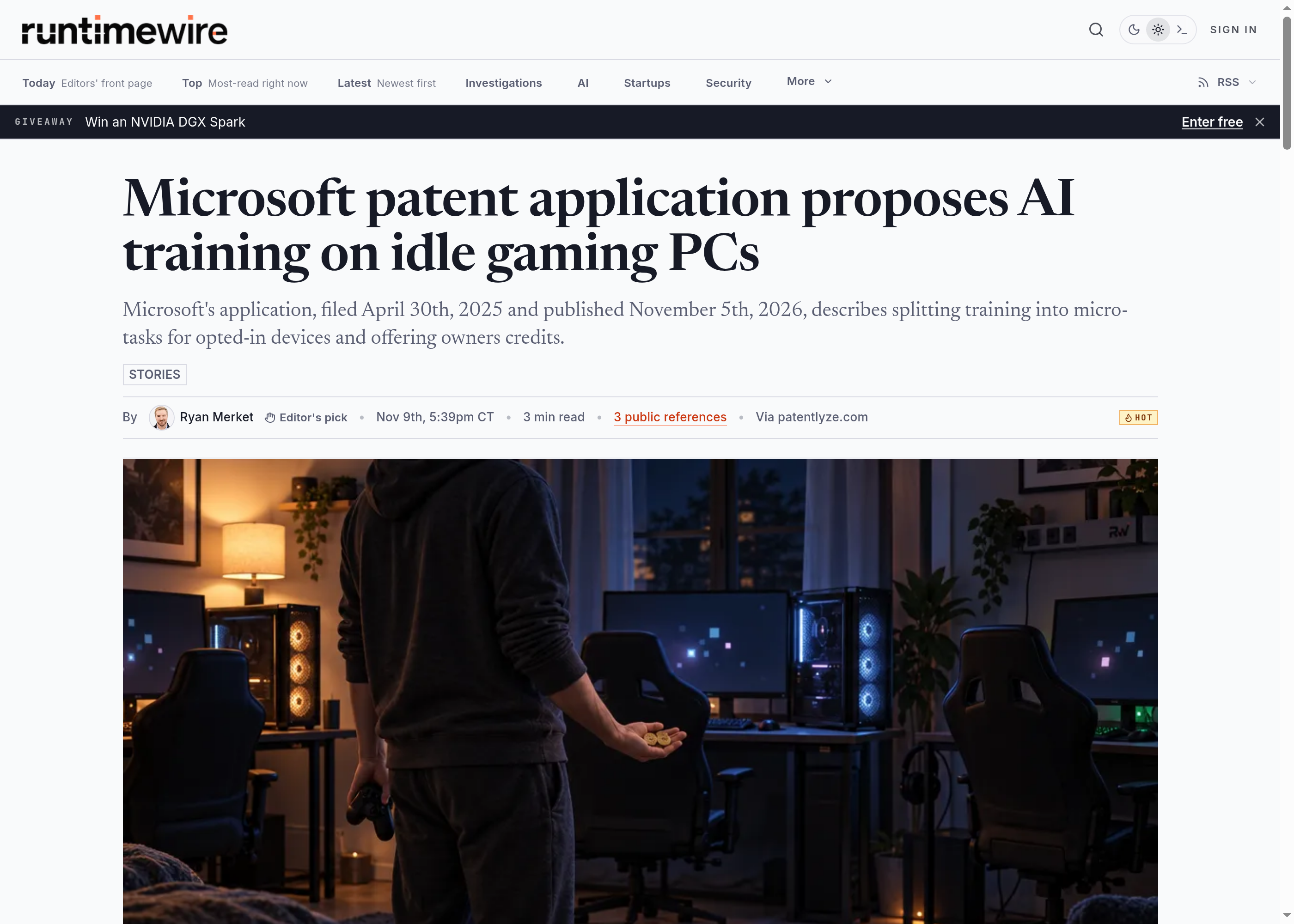
Caption: Coverage on November 9 noted the gap that matters commercially: no payout rate exists against the electricity cost the owner pays first. Screenshot: RuntimeWire.
What to watch
- Any Microsoft program page. Until there is a sign-up link, a rate, and terms, this is a document and nothing else.
- The final claims, if it issues. A patent’s value is in the claims, not the description. What is actually protected will look narrower than the stories suggest.
- Salad’s weekly rate for the 5090. It is the best public measure of what an idle consumer card is worth right now. If it climbs above $0.50, the consumer market is tightening and a Microsoft program becomes worth running.
- Whether anyone solves confidentiality. Until training data can be used without the device owner being able to see it, this stays a tool for a company’s own models.
The honest summary: a real technique, described in real detail, attached to a payout almost nobody would notice. The filing is a bet that spare consumer GPUs become a meaningful source of training capacity. The measured earnings say that today, for most people who own the hardware, it is a rounding error with a power bill attached.
Discussion
Be the first to commentStart a discussion
Got a take on this, a rig to show off, or a benchmark that says otherwise? Sign up and start the thread - your comment publishes instantly once you're in.