TLDR: Google released Gemini Decision 1 and a Decisions API on November 11, which scores up to 1,000 closed questions against one shared input in a single pass and returns a probability plus a confidence number for each answer. It enables routing, policy checks and tool selection at 150 to 250 milliseconds for $0.10 per million input tokens, with no charge for output. The difference between this and a normal model call is that nothing is generated: the model never writes a token, so you cannot be billed for one.
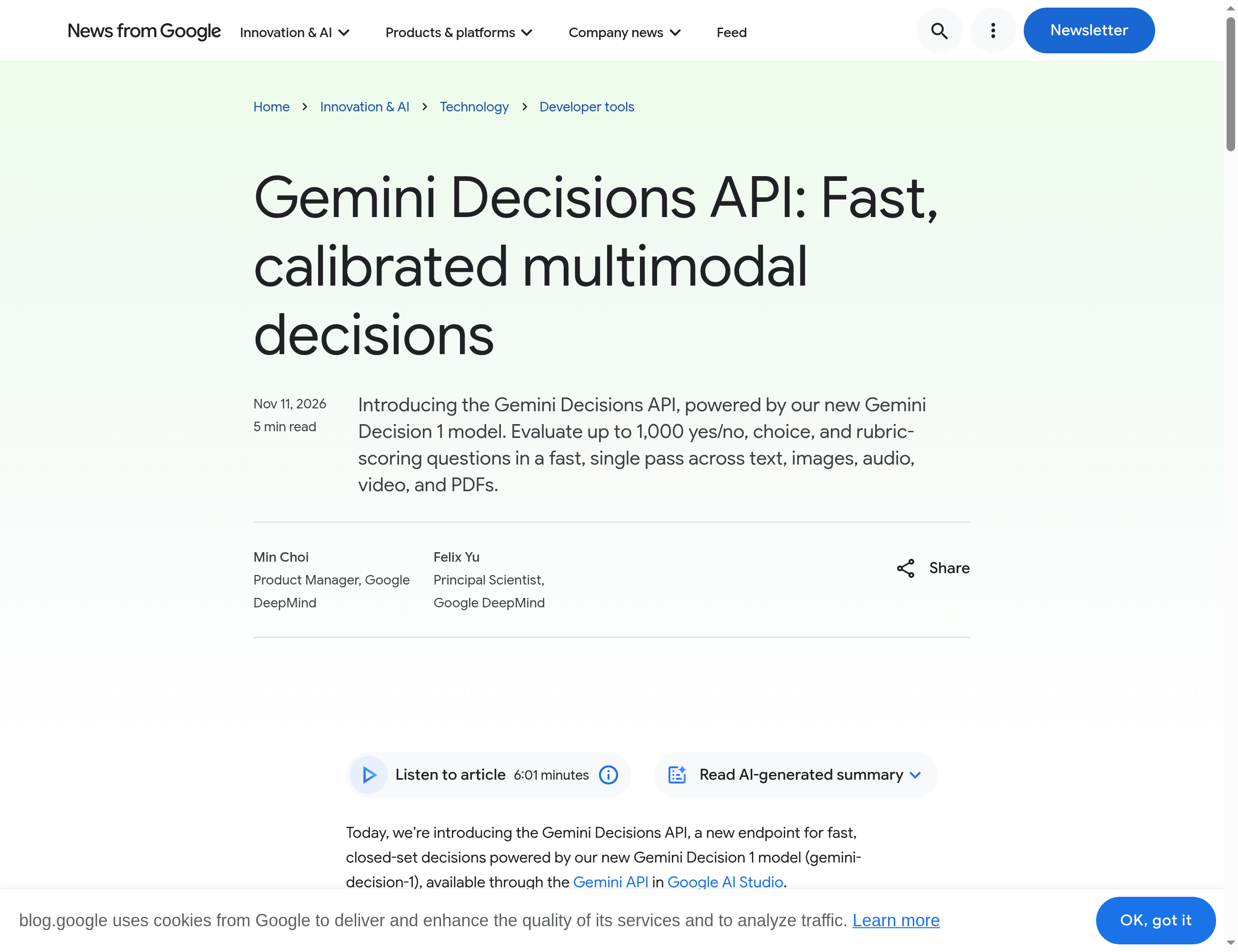
Caption: The announcement, November 11, 2026. The claim in the title is speed and calibration, not intelligence. Screenshot: Google.
What the API actually does
You send one input, up to 262,144 tokens, which can be text, images, audio, video or PDFs. You also send a set of questions with a fixed answer shape: yes or no, multiple choice, or a rating on a scale. Google says it accepts up to 1,000 of them against that single input, and returns, for each, a probability per option and a confidence value.
That is the whole product. No paragraph of explanation, no reasoning trace, no JSON to unpick from a chatty response.
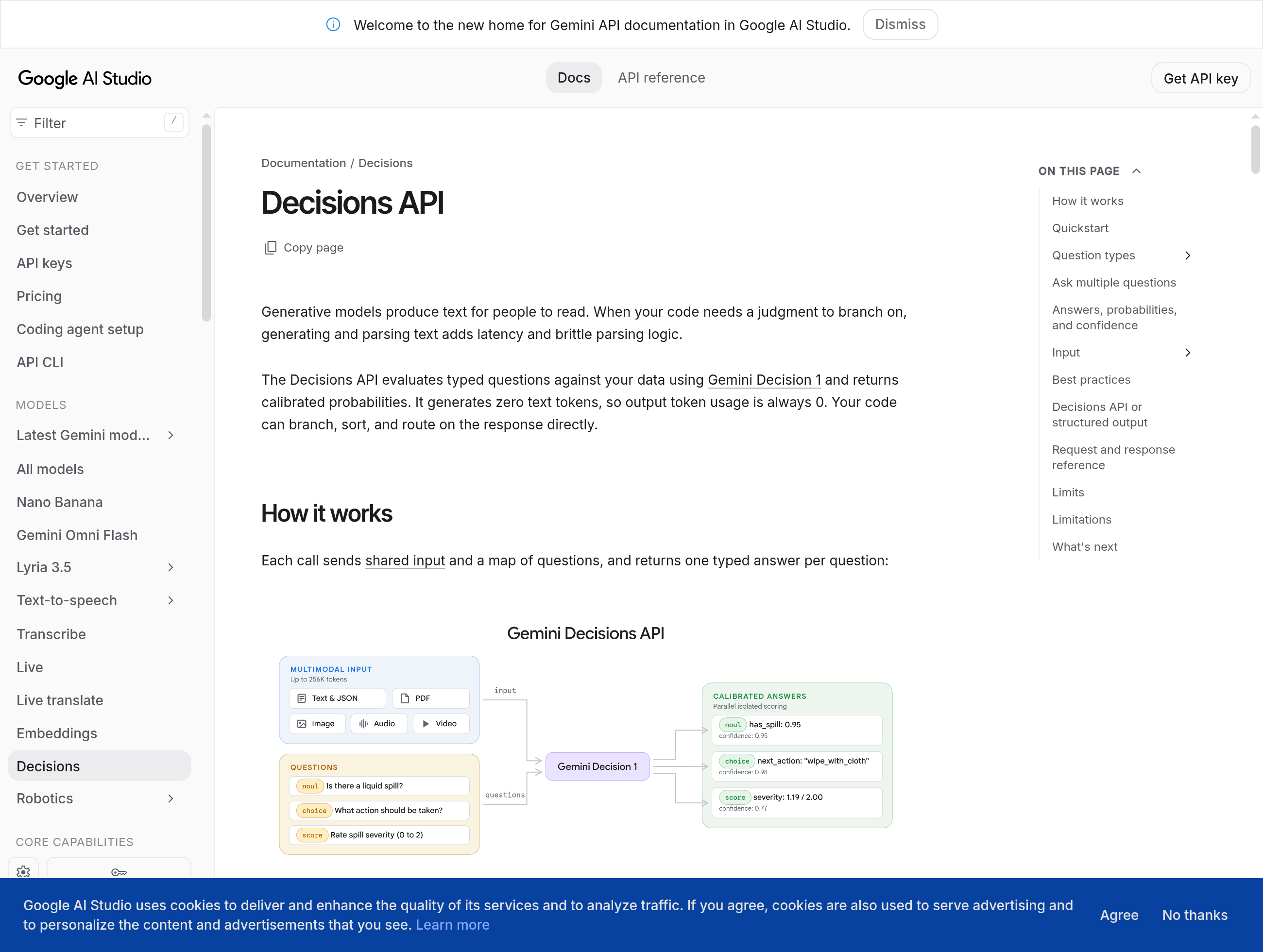
Caption: Google’s own diagram of the flow: one shared input, many fixed-choice questions, one set of numbers out. Screenshot: Google AI Studio.
Pricing follows the same shape. $0.10 per million input tokens, output free, because there is no output. Google quotes 150 to 250 ms end to end, and publishes a free tier of 200 requests and 50,000 input tokens per minute.
The company also says it uses the API internally, for dynamic model routing and safety checks in Google Search.
Why this category exists
Three labs have now shipped the same idea inside a quarter. Jev opened it, OpenAI followed, and Google is the third. A decision model does one thing: it holds a fixed set of options and returns a distribution over them, rather than generating text and hoping the answer parses.
The economics are what make it a category rather than a feature. A classification job on a frontier model pays for tokens the model spends explaining itself. A decision model pays only for what it reads.
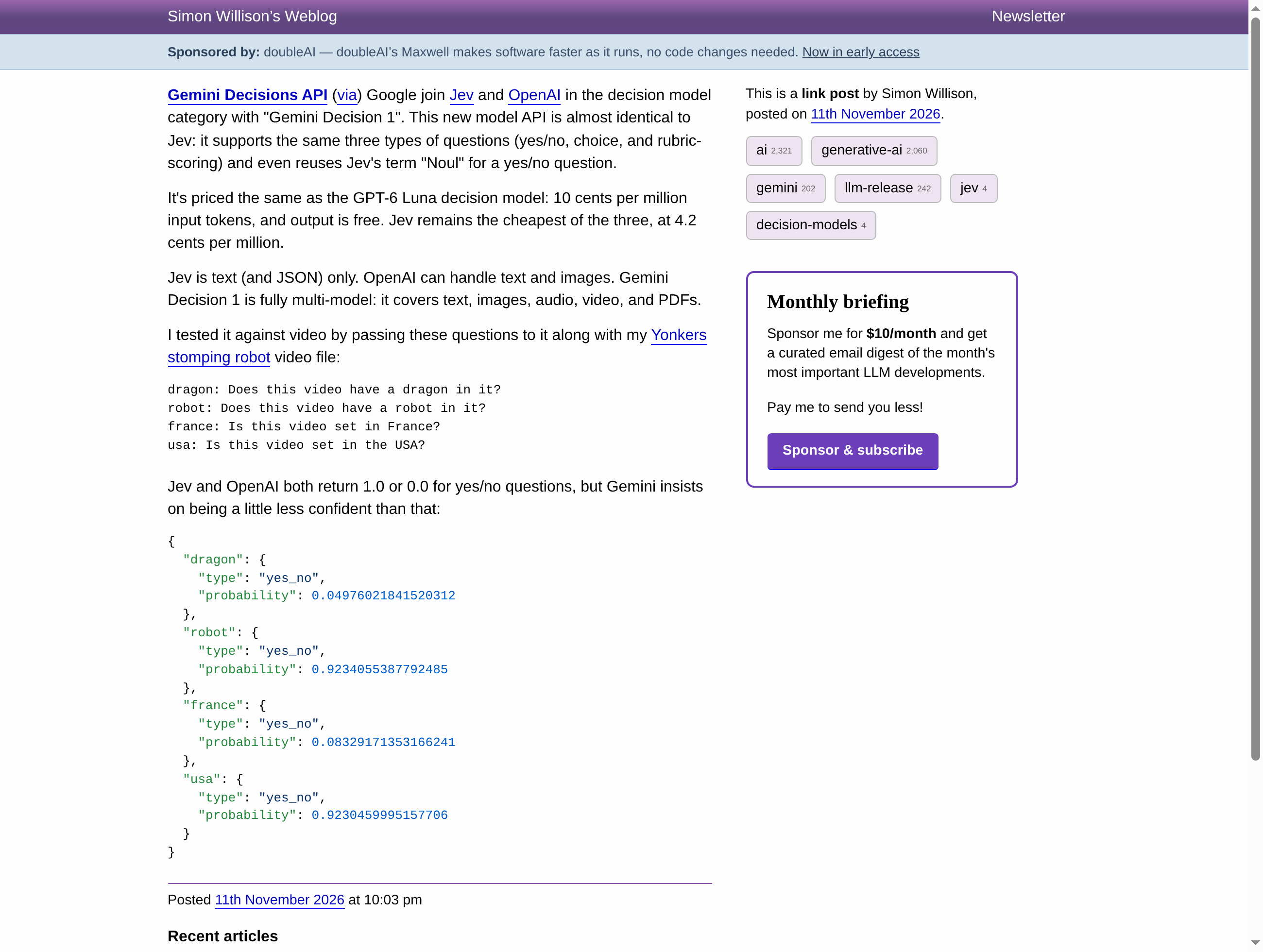
Caption: Simon Willison’s note on launch day, which puts it plainly: this is the same shape as Jev, by a company with a much bigger distribution channel. Screenshot: simonwillison.net.
The claim to be careful with
Google’s headline number is 92.2 percent on JevBench, against 90.9 for GPT-6 Luna and 90.0 for Jev 1.14, as reported by VentureBeat. That is a meaningful margin and it is also a vendor-run comparison on a benchmark named after the category’s first product.
The three scores sit within 2.2 points of each other. Treat the ranking as close, and treat all three as better than the language models they replace at this specific job, which is the part that matters.
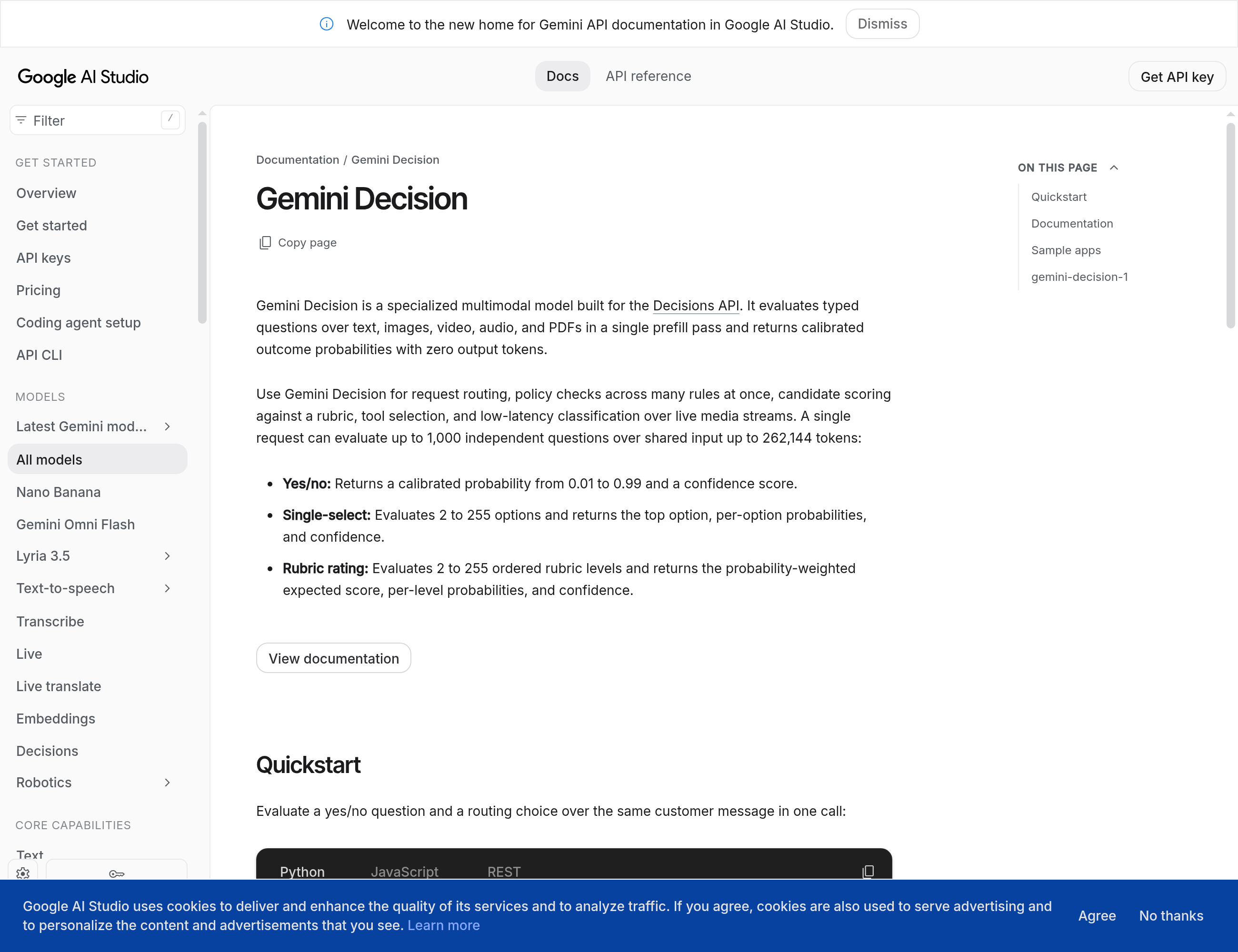
Caption: The model page, which confirms closed weights and API-only access. There is nothing to download and nothing to run locally. Screenshot: Google AI Studio.
What it changes for builders
If you already run the loop that Amazon documented this week, where a 4B decision model labels millions of tickets at $500 per million instead of $22,200, this is the hosted version of that idea with multimodal input attached.
The trade is the familiar one. Google’s version reads images, audio and PDFs, which a local 4B text model does not. It also cannot be run on your own hardware, which matters if the input is a document you would not send to an API.
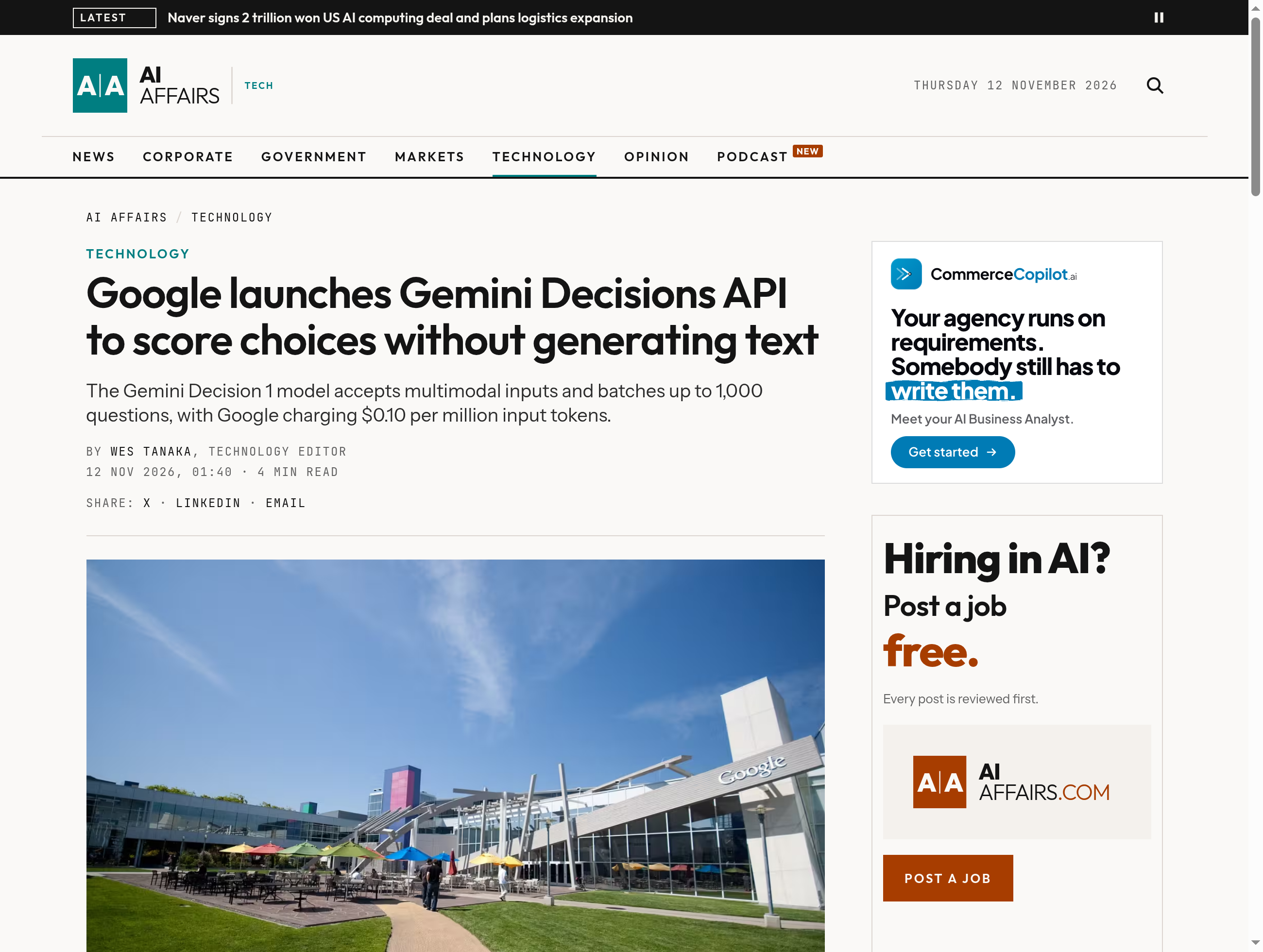
Caption: The trade coverage framed it the same way Google did: scoring choices, not generating text. Screenshot: AI Affairs.
What to watch
- Whether the 1,000-question ceiling survives real inputs. Cost scales with the shared input, not the question count, so a long document plus many questions is the case that decides whether this is cheap or expensive for you.
- Calibration, not accuracy. A confidence number is only useful if it is honest. Ask for the same question twice with a perturbed input and see whether the confidence moves.
- The local option. A 4B decision model on one 24GB card already matches a frontier model on ticket labelling. Every price Google sets here is measured against that.
Discussion
Be the first to commentStart a discussion
Got a take on this, a rig to show off, or a benchmark that says otherwise? Sign up and start the thread - your comment publishes instantly once you're in.