TLDR: Meta released Muse Ember on November 9, its smallest model, aimed at the work agents repeat all day: tool calls, routing, extraction, coding subtasks and long document parsing. It enables high-volume agent loops at a price where you stop counting tokens. The difference between it and every other cheap model is the position on the cost curve: Artificial Analysis scores it 36, the same as Claude Haiku 5.5’s best effort, at about a third of the cost per task.
Caption: The launch post, November 9, 2026. Meta’s framing is not “smarter” but “more intelligence per dollar”, and the whole post is built around the cost axis. Screenshot: Meta AI Research.
What it is
A closed-weight model, available as muse-ember-1.0 on the Meta Model API and inside Muse Code. No weights, no local deployment, no Hugging Face repository. Pricing is $0.10 per million input tokens, $0.004 per million cached input, and $0.50 per million output. The context window is 1M tokens with up to 512K output tokens, which is enough to take a whole repository or document set in one call.
It supports the Responses API, and Meta says it was trained using its larger Muse Wonder models.
Read that as a structural statement: the small model is a distillation of the big one, pointed at the repetitive layer rather than the reasoning layer.
The chart that matters
Meta published the Artificial Analysis numbers directly, and they make one argument.
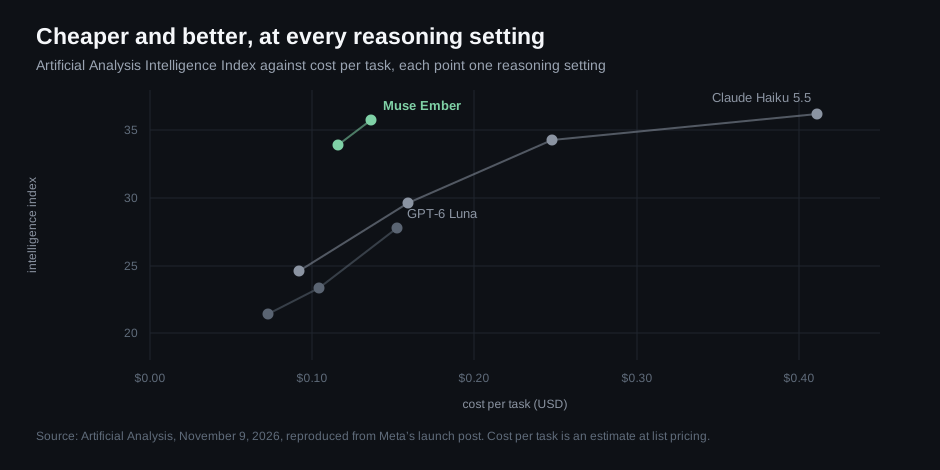
Caption: Intelligence against cost per task, each point a reasoning setting. Muse Ember reaches 35.8 at $0.136, while Claude Haiku 5.5 needs $0.411 to reach 36.2. GPT-6 Luna tops out at 27.8 in this set. Figure: Tokenstead, from Artificial Analysis data in Meta’s post.
In Meta’s words: Muse Ember “matches Haiku’s best score at about a third of the cost and beats every Luna setting.”
The independent page mostly agrees. Artificial Analysis gives it an intelligence score of 36, ranking it second of the models it compares, at a cost per task of $0.14. It is not the cheapest per task in absolute terms, and it is not the smartest. It sits where those two lines meet.
What the benchmarks say
Meta’s own numbers, at maximum reasoning effort, against Haiku 5.5 and GPT-6 Luna:
- AutomationBench-AA (end-to-end business workflows): 37.8, against 13.9 and 20.2. That is close to triple.
- Agents’ Last Exam (end-to-end agent tasks): 61.6, against 57.0 and 57.1.
- Personal Superintelligence Index: 46.8, against 36.1 and 37.0.
- Terminal-Bench 4.0: 40.9, against 39.2 and 16.4.
- Agent Index-AA: 46, against 37 and 31.
- PerceptionBench with tools: 80.6, against 78.6 and 62.8.
Treat all of that as vendor-reported. The gaps are largest on the agentic workflows, which is exactly where the model is marketed, and that is not a coincidence.
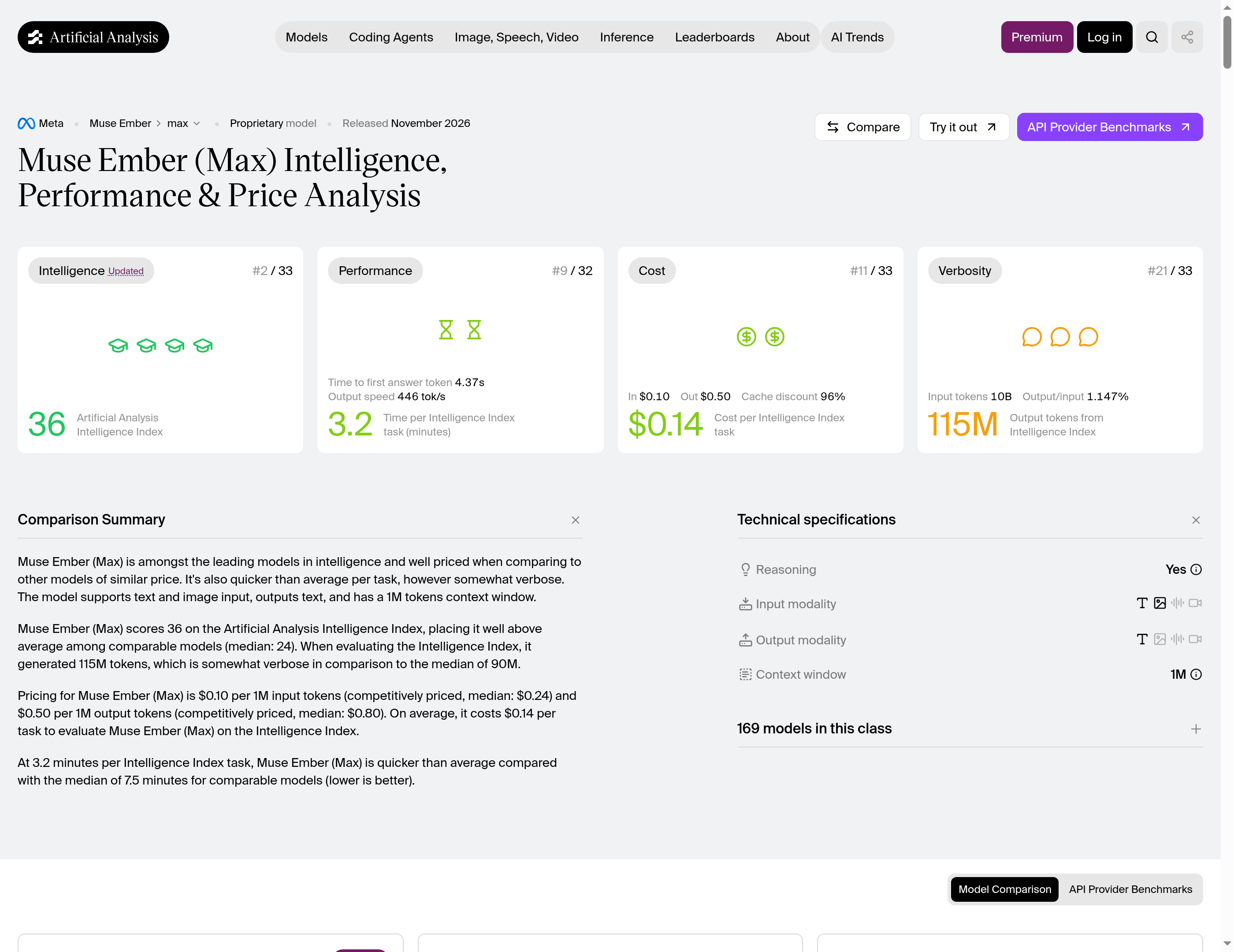
Caption: The independent page, which puts it second for intelligence among the models it compares, with 4.37 seconds to first token and 446 tokens per second. Screenshot: Artificial Analysis.
Where it does not win
Three things worth saying plainly.
It is closed. If your reason for wanting a small model is that you want it on your own hardware, Meta has not made that possible. There is no weight download, no GGUF, no local path. This is a cheap API, not a cheap model you own.
The price is an estimate at proposed list pricing. Artificial Analysis measures cost per task using published rates, and Meta is the one publishing them.
Verbosity is a hidden cost. The model produces about 1.15 output tokens per input token on the index, which is fine for extraction work and less fine for anything chatty.
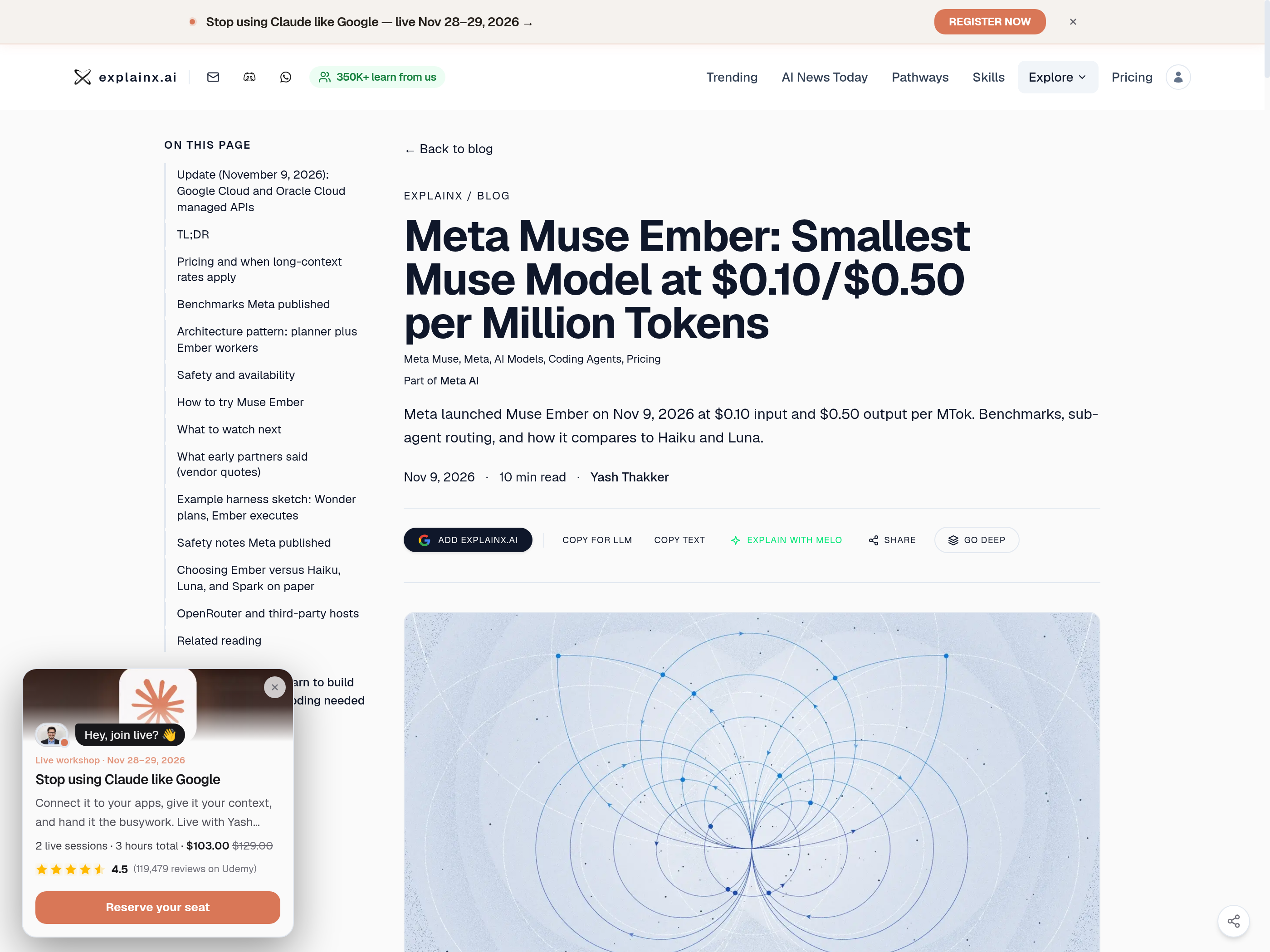
Caption: The trade press covered it the same day as “Haiku-level AI at a third of the cost”. That framing is close to what the data shows, with the caveat that the comparison is at Haiku’s most expensive reasoning setting. Screenshot: ExplainX.
What this does to the build decision
This site has been tracking a specific fork in the road for anyone running agents: pay per token to a lab, or buy a 24GB card and run a 27B locally.
Muse Ember moves the API side of that trade. A 27B four-bit model on a 5090 costs you nothing per token but gives you roughly 40 to 60 tokens a second shared across every job on the machine, and it stops when the card is busy. Muse Ember costs $0.14 an index task and runs at 446 tokens a second with no queue at all.
The honest shape of the answer: if your workload is volume of small decisions, the API wins on both speed and price until you are big enough to buy hardware outright. If your workload is sensitive documents, the API is not available to you at any price, because the weights are not yours.
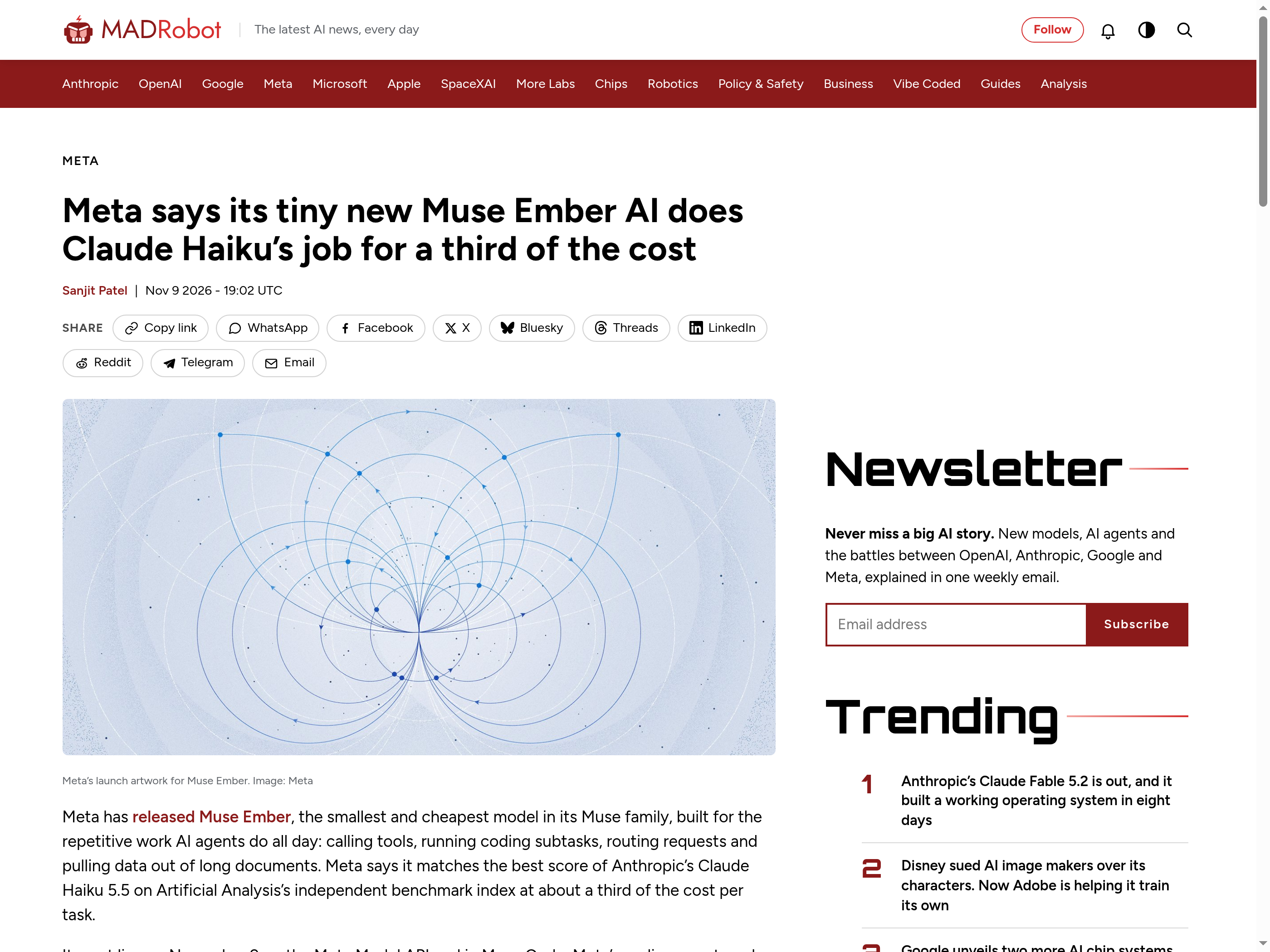
Caption: Another same-day write-up, which lands on the same framing: Haiku-level output for a third of the money. Screenshot: MadRobot.
The pattern across this week
Look at what shipped in three days. Amazon published an account of replacing a frontier model with a 4B decision model at 98 percent lower cost. Anthropic shipped Fable 5.2 and deliberately capped it at kernel optimisation, its own predecessor’s level. Meta shipped a distilled small model positioned entirely on cost per task.
Every one of those is the same movement: the frontier keeps getting more expensive and more restricted, and the useful work keeps sliding down to cheaper models that are good enough at a narrow job. The companies that win the next year may not be the ones with the best model. They may be the ones who noticed which tasks never needed the best model in the first place.
Discussion
Be the first to commentStart a discussion
Got a take on this, a rig to show off, or a benchmark that says otherwise? Sign up and start the thread - your comment publishes instantly once you're in.