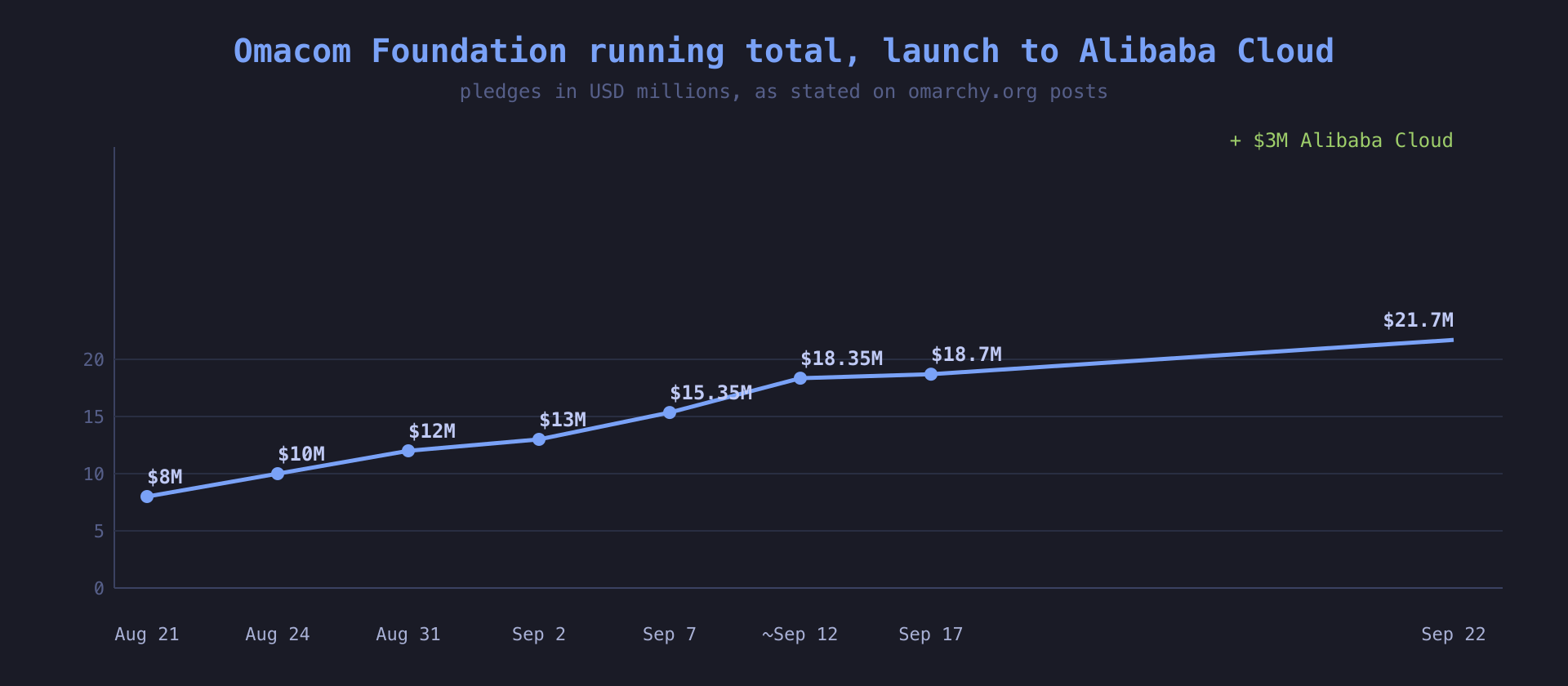
On September 22, 2026, Alibaba Cloud joined the Omacom Foundation as a Founding Corporate Patron, committing $1 million a year for three years. The patrons page now lists it in the founding-corporate tier alongside DigitalOcean and Meta Superintelligence Labs, and the post puts total backing at approximately $21.7 million. DHH announced it at 07:56 ET with a tweet; Tobi Lutke’s reply was one word, “Nuts.”
The money matches DigitalOcean’s pledge exactly. What does not match anything else in the foundation’s six weeks of patron announcements is the second half: Alibaba Cloud and the Omarchy project will “work together on making Omarchy the ideal agentic operating system” for Qwen Book, the agent computer Alibaba announced the same day at its Apsara conference in Hangzhou. A Linux distro incubated in Copenhagen is now the stated OS target for a Chinese hardware product built by a ~150-person team.
What the announcement actually says
The post commits Alibaba Cloud to three things: the $3M, help building “Omarchy China” (local CDN, hosting, website, meetups, and community), and the Qwen Book collaboration. DHH closes by thanking “CTO LI feifei, who made this possible” and posts a PS: he speaks at GOSIM on October 17, attends the Omarchy Meetup in Shenzhen, and visits Alibaba in Hangzhou and Beijing.
The Qwen Book description in the post is Alibaba’s own, verbatim, and it is the part a local-AI reader should read closely:
Qwen Book aims to create a native AI agent computer. Its core philosophy, “OS as Harness,” simply put, involves deeply integrating models, the operating system, applications, cloud services, and hardware. This builds a computing environment that agents can understand, invoke, remember, and run in continuously, upgrading the computer from a passive tool into a constantly evolving personal assistant.
The Qwen Book system is compatible with both ARM and x86 architectures, with the first release based on the ARM architecture. At the system level, we have built a low-power Agent Engine and a Continuous Context Engine. With the Qwen model family as the intelligent foundation, we provide model services for the Qwen Book system through cloud-device integration.
That is vendor copy, and most of it is unverifiable until hardware ships. Two claims in it are falsifiable and worth tracking: ARM-first (the first release runs on ARM, x86 later), and “cloud-device integration” (the models are Qwen family, served partly from the cloud). Treat the Agent Engine and Continuous Context Engine as product names with no published specs, not as measured capabilities.
The ARM thread, resolved and not
The predecessor piece closed on “No ARM yet”: Quattro is x86_64 only, a 6,600-line aarch64 pull request had been closed in July, and follow-on work lived in the omarchy-iso repo. The state of that work, checked today:
- omarchy-iso PR #129, “Boot and install Omarchy on Snapdragon X ARM64 systems,” was merged on September 13. Omarchy installs on Snapdragon X laptops now.
- PR #149, “Build a generic aarch64 ISO,” was closed unmerged on the same day. There is still no official ARM ISO you can download.
- Issue #172, open, documents the current aarch64 failure mode: a kernel upgrade on an installed ARM system leaves the Limine boot menu pointing at removed modules, so the machine boots with no drivers.
So the resolution of “No ARM yet” is partial and goes in one direction: ARM boots and installs on specific hardware, but the distribution step (a downloadable generic ISO) is not done. Qwen Book’s ARM-first release gives the omarchy-iso work its first named hardware target, which the fork ecosystem never had. Whether the “ideal agentic operating system for that computer” claim becomes a merged ARM ISO or stays a press-release sentence is checkable in the repo, and that is where to watch.
What Qwen Book is, per the reporting
The announcement is a partnership; the product facts come from reporting on leaked details. TechNode, citing LatePost via DoNews: Alibaba Cloud’s Wuying team is building QwenBook as a tablet-shaped agent computer, ~150 people, hardware defined in-house, currently wired to Qwen3.8-Max and Qwen3.8-Flash. Planned apps: meeting transcription, a wiki, smart folders, email, MyNote and MyZone, with Kingsoft working on WPS integration. A demo version shows at the Yunqi conference; the full product may not arrive until late 2026 or early 2027.
The product page (Chinese, reachable from outside China, HTTP 200) adds the commercial layer: a “Day One” tester program, 100 seats, open through October 31, with 1 trillion tokens included. The ecosystem slide lists partners by category: WPS Office, Intel and Qualcomm Snapdragon chips, Logitech mice, Alipay AI Pay, Deli printers, and UGREEN NAS private cloud. Alibaba’s own framing on the page: “OS as Interface,” “OS as Context,” “OS as Capability,” “OS as Runtime.” That is a taxonomy, not a specification; nothing on the page publishes memory budgets, model sizes, or latency targets for the on-device portion.
omarchy.cn: what I can and cannot verify
omarchy.cn resolves. A plain fetch from this box (outside China) returns the real Omarchy site, lang="zh-CN", Plausible analytics keyed to omarchy.org, 347KB of HTML. The response headers show Alibaba’s ESA edge: Server: ESA, via: ens-cache...l2hk12, an OSS request id, and a HEAD request to the same host returns 403 from the edge while GET succeeds. I cannot verify what the site serves inside mainland China, whether the CDN is configured for China-only delivery, or who holds the domain registration; those checks need a vantage point in China. What the fetch proves is that Alibaba’s edge infrastructure is serving the Omarchy property today, which is consistent with the “Omarchy China” CDN commitment being real rather than announced.
The same-day context: models and chips
The announcement landed in the middle of Alibaba’s Apsara conference stack. Same-day coverage (TrendForce, citing ijiwei and EE Times China): Alibaba’s T-Head unveiled the Zhenwu V900, a training-and-inference chip with 216GB of memory, FP8 and FP4 support, mass production scheduled for Q1 2027. Eddie Wu said Qwen 4 is in training and the Qwen 4.5/Qwen 5 series will target 5 to 10 trillion parameters, up from 2.4T in today’s Qwen3.8-Max. None of that lands on a desk; it all lands in Alibaba’s data centers, which matters for the next section.
What it changes for the local-AI reader
Three things, and they pull in different directions.
The compositor-layer money is unchanged. The predecessor piece tracked where the foundation’s cash lands: Hyprland, Quickshell, mise, and since then four hires (kernel and security staff, per the September posts). The Alibaba money splits the same way: China infrastructure and a hardware collab. No foundation post funds llama.cpp, LM Studio, or Ollama directly. The AI manual still recommends LM Studio and Ollama in that order, unchanged as of September 22.
The model story tightens in one specific way. Omarchy’s agent stubs today assume API accounts: Claude Code, Codex, and the rest, with a usage panel that tracks plan limits. Qwen Book’s “cloud-device integration” inverts the default: the Qwen family is the “intelligent foundation,” and a continuous-context engine keeps state on your behalf. If you own the hardware and want a different model on it, the question becomes what the Agent Engine actually exposes. That is the question tokenstead’s model pages exist for, and today the site tracks ten Qwen entries from Qwen3 4B to Qwen3.8-Max; none of them documents an on-device runtime contract.
The ARM-first fact is the one with a date on it. A first release on ARM means the Omarchy-on-ARM work (merged for Snapdragon X, ISO still pending) gets a production consumer, and it means the sizing question shifts: which Qwen checkpoint fits in unified memory on an ARM laptop, at what tokens per second. Nobody has published those numbers, including Alibaba. When a device ships, they are the first numbers to measure.
The backdrop is not neutral
Two things happened in the four weeks before this announcement, and the contrast is the context. Anthropic’s $150,000 token pledge, made September 3, was scrubbed from the patrons page; a post from davidcelis on xoxo.zone that week noted the removal, and a foundation site commit attributed it to pending legal review. DigitalOcean drew criticism for canceling a ~$50/month VM sponsorship of GNOME and Flathub infrastructure in the same month it pledged $3M (Linuxiac tallied the arithmetic; Bart Piotrowski of Flathub confirmed the cancellation). A corporate patron exiting quietly while a new one triples the corporate total is a pattern readers will weigh differently depending on which side of the Stop Omarchy argument they started on. The piece covers the pattern because the numbers are public, not because either side has the better argument.
Sources
- url: https://omarchy.org/news/2026/09/alibaba-cloud-joins-as-founding-corporate-patron
- url: https://www.qianwenai.com/product/qwenbook
- url: https://technode.com/2026/09/22/alibaba-reportedly-testing-qwenbook-as-a-tablet-like-agent-computer/
- url: https://omarchy.org/patrons
- url: https://x.com/dhh/status/2102366320369016915
original-facts: - omarchy-iso PR #129 (Snapdragon X ARM64 boot and install) was merged September 13, 2026, while PR #149 (generic aarch64 ISO) was closed the same day unmerged: verified via GitHub API on September 22. - omarchy-iso issue #172 (open) documents an aarch64 kernel-upgrade failure where limine-entry-tool misses new kernels, leaving an installed ARM system to boot with no drivers; observed on DGX Spark hardware. - omarchy.cn was fetched from outside China on September 22 and serves the real Omarchy site (lang=”zh-CN”, Plausible keyed to omarchy.org) from Alibaba’s ESA edge (Server: ESA, ens-cache via headers); plain HEAD requests to the same host return 403 at the edge while GET succeeds. - The Qwen Book product page was fetched from outside China (HTTP 200) and shows a 100-seat “Day One” tester program open through October 31 with 1 trillion tokens included, plus a partner list (WPS, Intel, Snapdragon, Logitech, Alipay AI Pay, Deli, UGREEN) that the Omarchy announcement does not mention. - The Omarchy AI manual’s local-model menu is unchanged as of September 22: LM Studio and Ollama, in that order, no llama.cpp entry; the foundation’s funded work remains compositor-layer plus four staff hires, with no local-model tooling funded. - The running-total trace ($8M to $21.7M) was reconstructed from six separate omarchy.org posts (launch, $10M, $12M, $13M, DigitalOcean $18.35M, Cartmell $18.7M), each checkpoint stated on its own page rather than taken from the announcement post. - The announcement photo on omarchy.org, fetched and inspected directly, is an Apsara Conference stage slide in Hangzhou reading “Founding Corporate Patron” and “Qwen Book x Omarchy OS” with a “Coming Soon” tag on the OS panel.
Discussion
Be the first to commentStart a discussion
Got a take on this, a rig to show off, or a benchmark that says otherwise? Sign up and start the thread - your comment publishes instantly once you're in.