TLDR: Stripe acquired OpenRouter today, more than two months after the deal was announced on August 19. It enables a payments company to sit between developers and every model provider at once, deciding which request goes where and billing for it. The difference between this and a normal infrastructure purchase is that OpenRouter’s product is the choice itself: 400 models from 80 providers, routed per request on price, speed and reliability, now owned by the company that also sells the billing.
What closed
OpenRouter posted on Tuesday: “OpenRouter is officially part of @stripe today!” Stripe’s own account said the same thing in one line, and added the strategic claim: “Stripe is building the economic infrastructure for AI.”
Founder and chief executive Alex Atallah posted his own version four minutes later, and it is the clearest statement of the argument the deal rests on:
“No single lab will build all the intelligence the world needs. We’re building OpenRouter so every developer and business can choose the best of it, wherever it comes from. Every model stays on equal footing.”
Caption: The Stripe post that OpenRouter quote-posted, carrying the lockup that went out with the close. Image: Stripe via X.
That ends a process that started in August. Stripe’s newsroom announced on August 19, 2026 that it had “agreed to acquire OpenRouter.”
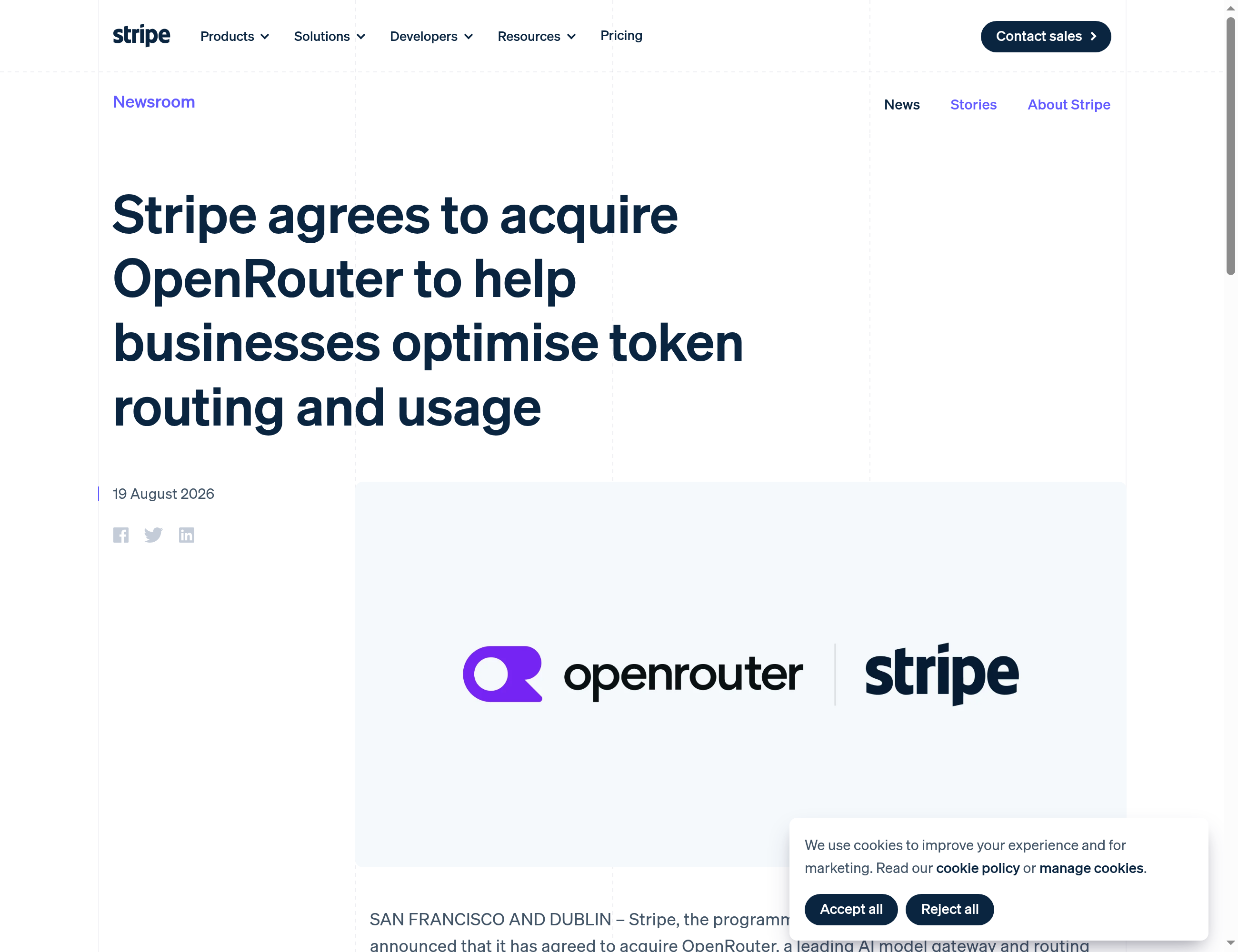
Caption: The August announcement, which described the target as “a leading AI model gateway and routing platform” serving 400+ models from more than 80 providers. Screenshot: Stripe Newsroom.
What the price actually is
Stripe has not disclosed terms. The reporting splits three ways, and it is worth keeping them apart:
- The New York Times reported $7.5 billion, citing sources.
- Axios reported more than $8 billion in cash and stock.
- Bloomberg reported the agreement with no terms disclosed.
The honest sentence is: agreed in August, reported between $7 and $8 billion, never confirmed by either company.
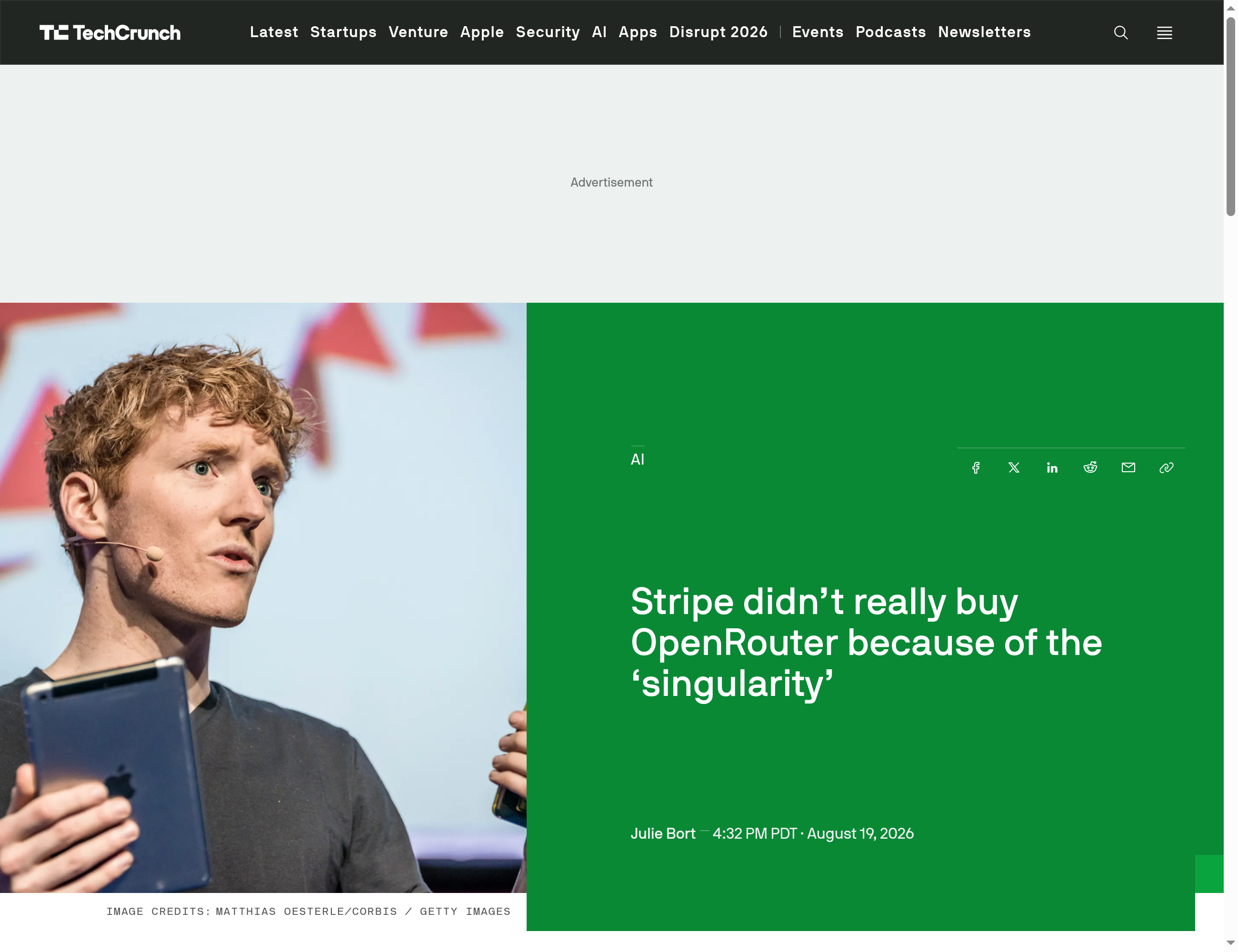
Caption: TechCrunch’s framing on announcement day, which pushed back on the grander story: this was a payments company buying a meter, not a bet on a machine god. Screenshot: TechCrunch.
What Stripe bought
OpenRouter’s own numbers, from its announcement post:
- 400+ models from 400+ AI models and more than 80 providers
- 10+ trillion tokens per day
- over 10 million developers and companies
- “at least 10x growth in inference volume every year” since founding in early 2023
Stripe named three customers in its release: NVIDIA, Zoom and Lovable.
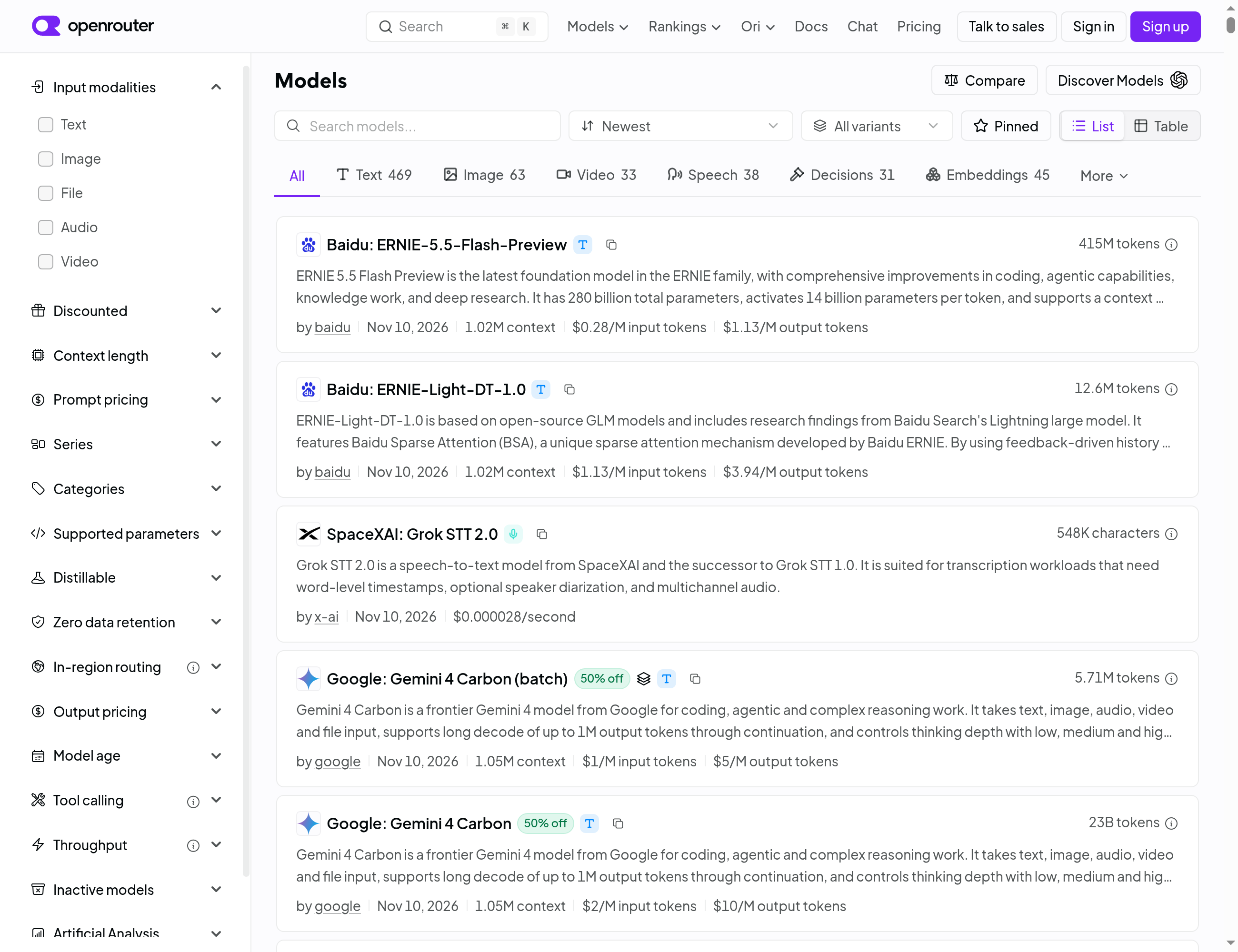
Caption: The product in one screen: a single interface over every model, with per-token prices from many providers competing on the same page. Screenshot: OpenRouter.
That page contains the business. A developer does not pick a lab, they pick a price and a latency, and OpenRouter decides which provider’s copy of the model serves the request.
Why a payments company wants it
Stripe’s argument, in Patrick Collison’s words: “Tokens are the central currency for companies building with AI, and it’s clear that the real-world economic potential will depend on making good use of scarce compute resources.”
Stripe had already built the boring half of this. It launched Token Billing last year, which meters usage and turns it into an invoice. Buying OpenRouter adds the other half: the routing decision that determines what gets metered.
Put together, Stripe can price a request, choose the model, execute it, and bill it on one meter. That is a materially different position from being the processor at the end of the pipe.
The neutrality question
OpenRouter’s promise, published in August and repeated since, is that nothing changes:
“OpenRouter will continue to operate as it is: same mission, same name, same product, same roadmap… That commitment is core to how we operate, and it doesn’t bend to any model, any provider, or any parent company.”
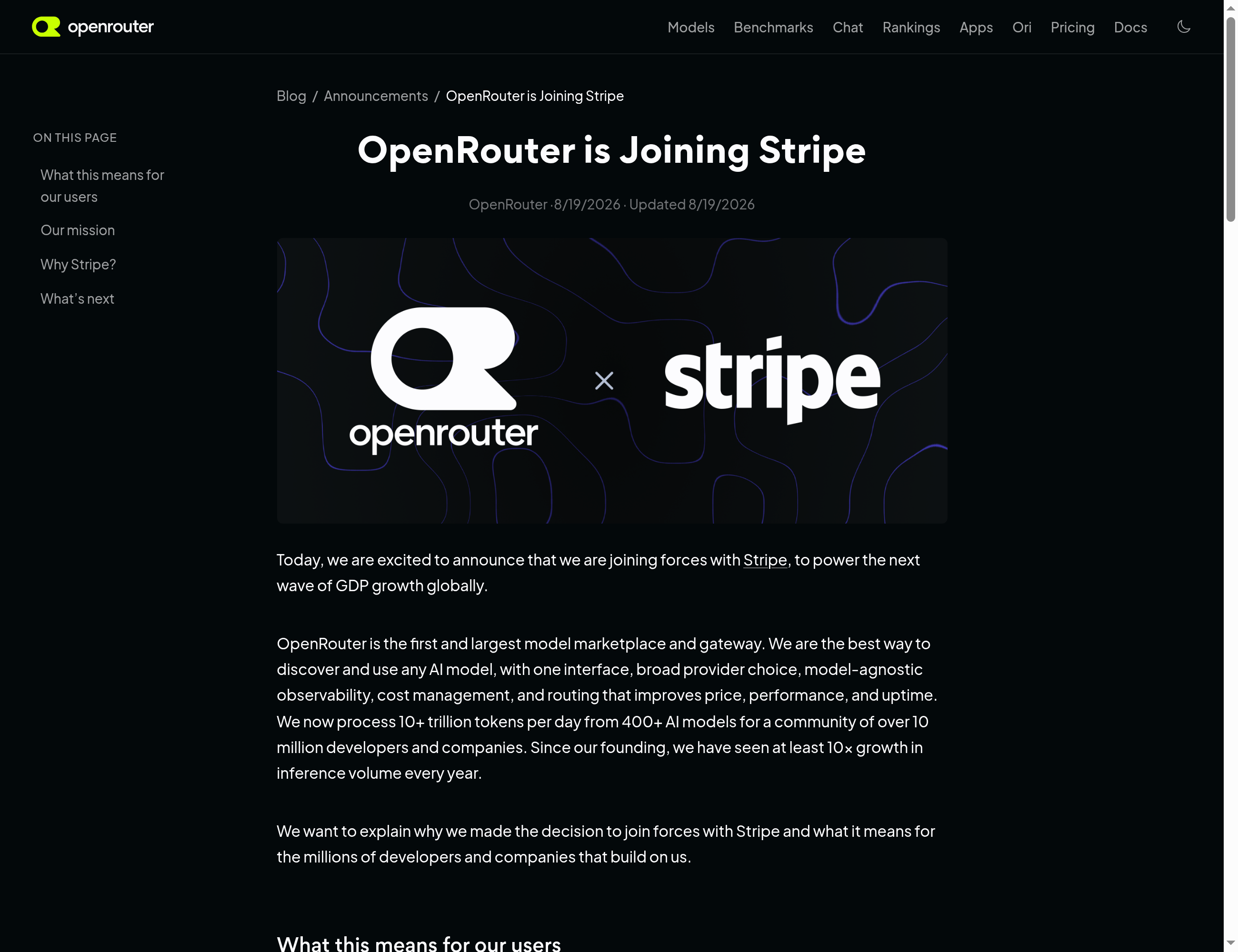
Caption: The August post that made the neutrality promise explicit, including the line about not bending to any parent company. Screenshot: OpenRouter.
The tension is not that the promise is insincere. It is structural. A router that recommends the cheapest adequate provider is only valuable if developers believe the recommendation is not shaped by who is paying the router. Stripe’s commercial relationships with the labs, and its own incentive to grow the total spend it processes, both point at the same number: more tokens, more often.
Alex Atallah’s answer is that intelligence will be multi-model and developers need “a neutral layer to orchestrate and manage them all.” That is true, and it is also the argument for a neutral layer being independent.
The regulatory record
Australia’s competition regulator logged a notification for the acquisition with an effective date of October 2, 2026, and its assessment is recorded as completed.
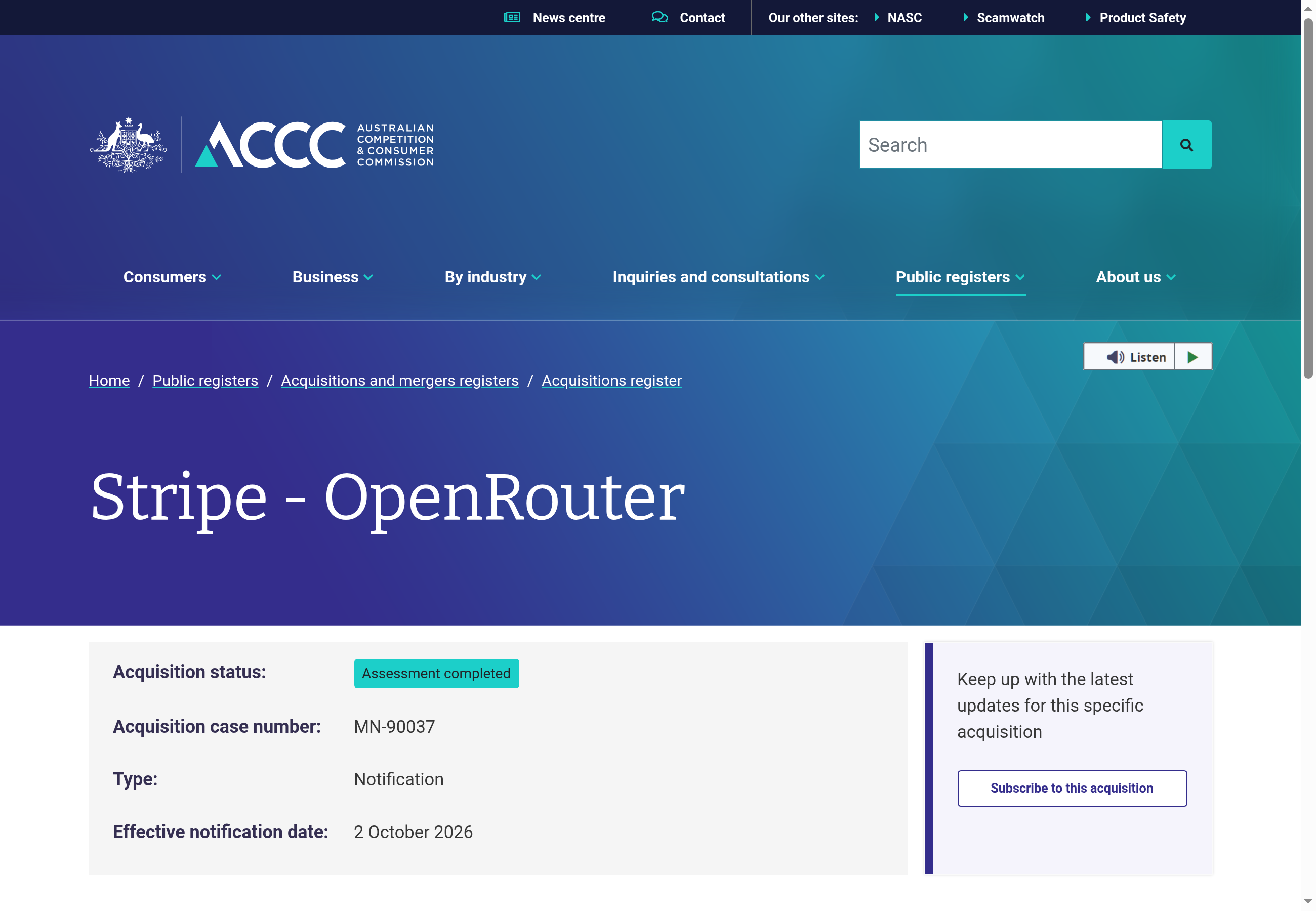
Caption: The ACCC acquisitions register entry, which is the only formal filing record of the deal in public view. Screenshot: ACCC.
That is a small detail that matters for how such deals get cleared: the largest AI infrastructure purchase of the year went through a merger register in one jurisdiction and a press release everywhere else.
The gatekeeper question
A payments company owning the switchboard makes people nervous for a reason, so it is worth putting the actual record next to the worry.
Stripe has cut off a political customer before. In January 2021 it stopped processing payments for the Trump campaign’s fundraising apparatus after the Capitol riot, on the grounds that the campaign had encouraged violence in breach of its high-risk policy. The Wall Street Journal broke it; CNN, NBC, Axios and TechCrunch confirmed within a day. CNN reported the campaign had paid Stripe more than $1.8 million during the 2020 cycle.
That same month, the Journal reported the ban was not absolute: a campaign site was steering donors to a page whose payments were still running through Stripe. Enforcement is a contract, and contracts have edges.
The record also moves both ways. In November 2025 Stripe moved firearms from prohibited to restricted, limited availability, which lets eligible gun retailers apply again. That is not the behaviour of a company enforcing an editorial line.
Stripe’s own prohibited list gives the reason for its existence in one sentence: requirements that apply to it as a processor, requirements from its financial partners, and its own risk exposure. It is a risk document, not a values document, which is exactly why it can change direction when the pressure does.
What that means for OpenRouter users is narrower than the doom version and more specific than “nothing changes”:
- The lever Stripe holds is the merchant agreement, not the model catalogue. It can decide whether OpenRouter may sell access. Deciding which of 400 models you may call is a different act, and one that would destroy the product’s only advantage.
- The realistic risk is concentration of visibility. One company would hold the billing relationship with 10 million developers and the routing telemetry showing which models they actually pick. No censorship is required for that to be the most detailed map of AI demand anyone owns.
- The test is observable. Models disappearing from the catalogue without a provider-side reason, regional blocks on specific model families, or terms of service gaining language about acceptable model use. Any of those is evidence. A general suspicion is not.
What it means if you build on OpenRouter
Nothing changes today, which is exactly what the announcement is for. Same API, same keys, same model list.
What to watch instead:
- The routing defaults. If OpenRouter’s “auto” starts preferring providers that are cheaper for Stripe to settle with, rather than cheapest overall, the neutrality claim gets tested in the only place it can be measured.
- Token Billing bundling. A single invoice that covers model usage and payment processing is convenient, and convenience is how infrastructure becomes default.
- The next acquisition. Stripe now owns the meter and the switchboard. Anyone selling observability, evals or context management to the same buyers is a candidate.
The blunt version: the models are getting commoditised faster than anyone expected, and the durable business is the layer that decides which commodity you buy. Stripe just bought that layer for somewhere between seven and eight billion dollars, and today it is theirs.
Discussion
Be the first to commentStart a discussion
Got a take on this, a rig to show off, or a benchmark that says otherwise? Sign up and start the thread - your comment publishes instantly once you're in.