TLDR
Twenty one cryptographers launched the Cryptography Incident Review Group at cirg.org. Its stated purpose is to review cryptanalytic advances and advise on disclosing a break, informing affected parties and planning a migration.
Its first statement page exists and reads, in full, that the statement has not been published yet.
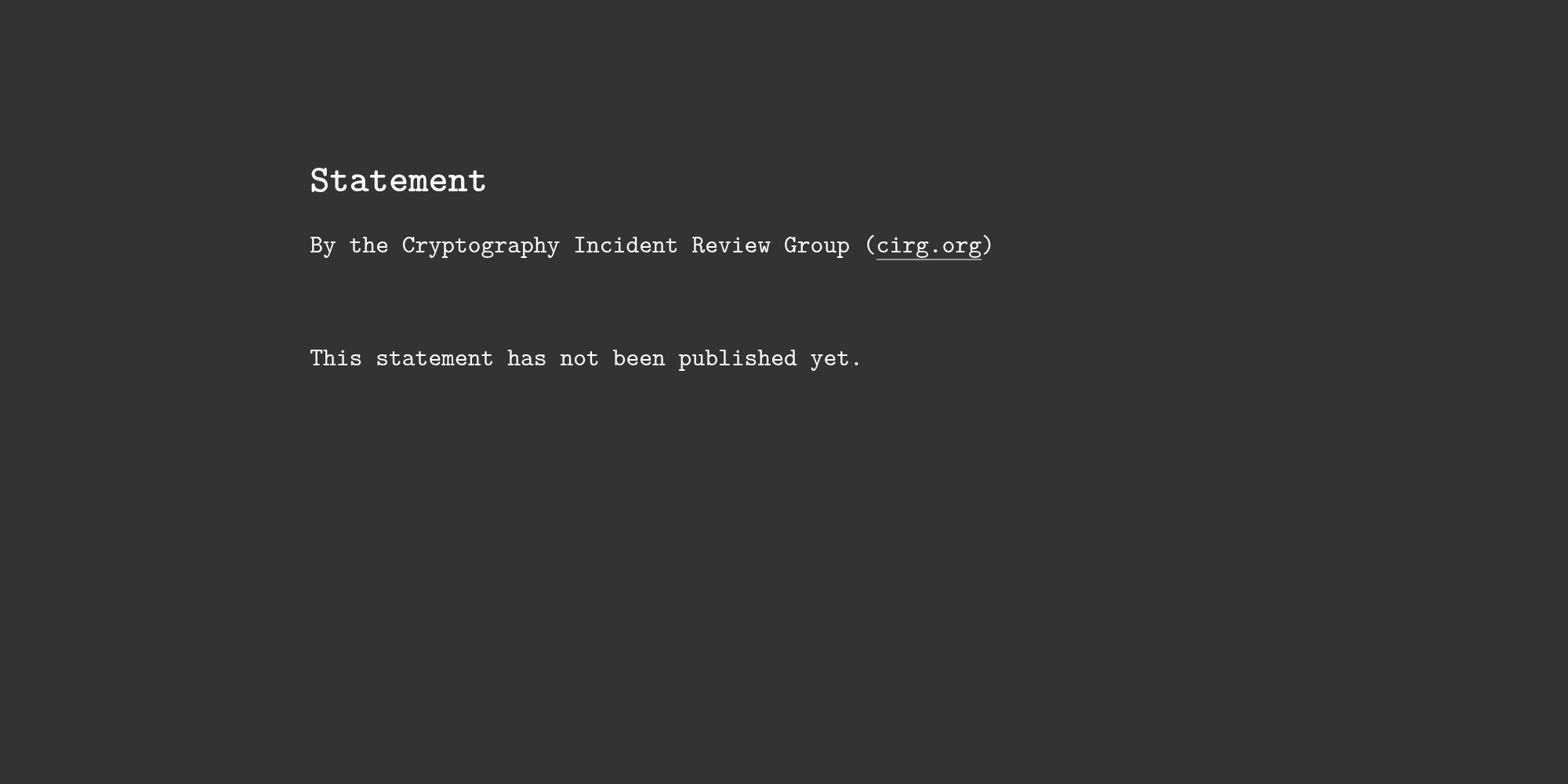
Caption: The CIRG statement page at cirg.org/statements/1, captured 29 November 2026. The body of the page reads, in full: This statement has not been published yet. Screenshot: cirg.org.
That is the whole public record. No break, no target, no timeline. The group is the news, and the group is all there is.
What it says
From the site itself: “The CIRG is a group of cryptographers aiming to review and help navigate cryptanalytic advances. We advise on how to disclose a break, communicate with those affected, and plan for cryptographic resilience.”
That is a description of an incident process. It presumes breaks happen, the way a fire department presumes fires. It does not say one has.
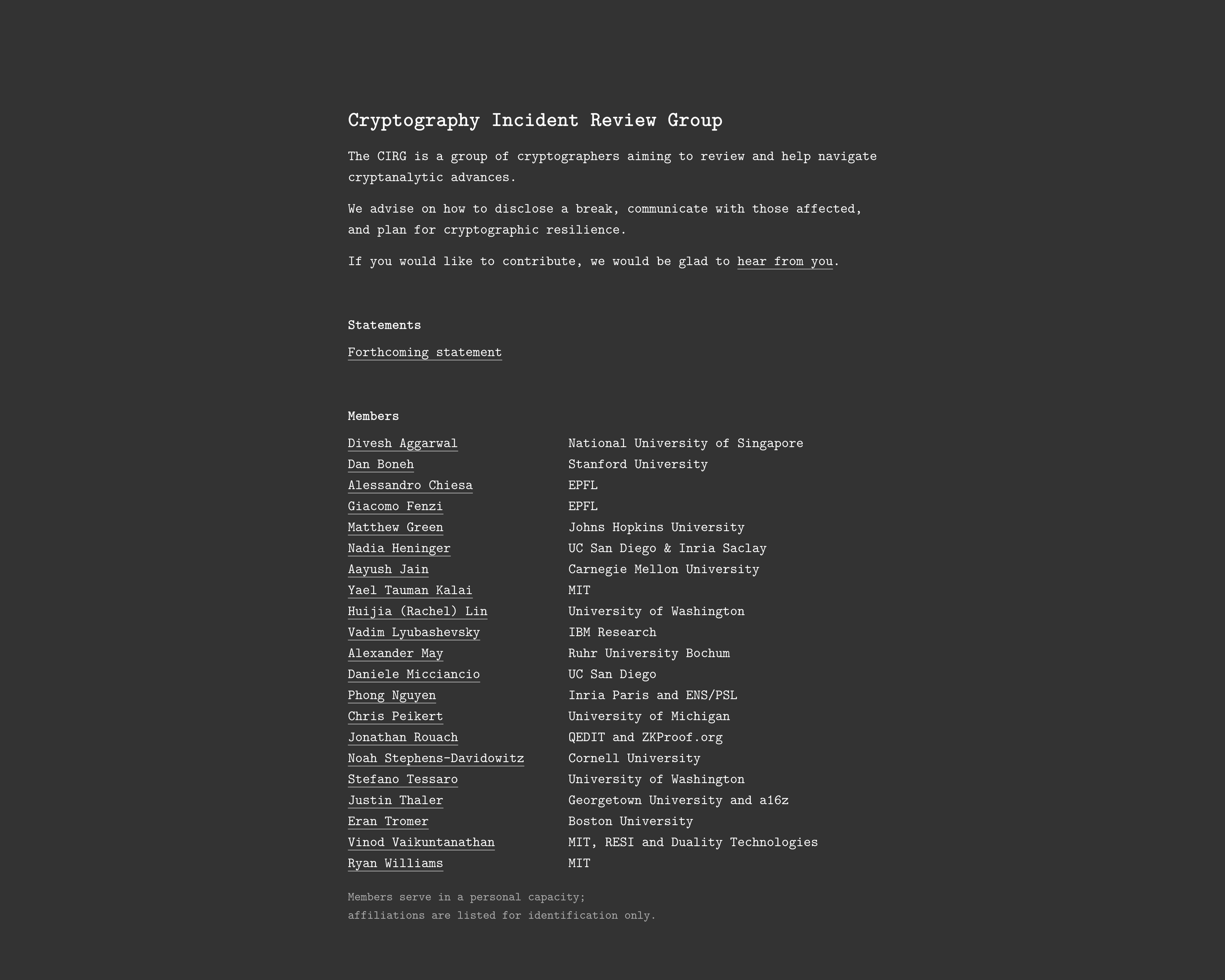
Caption: The CIRG homepage at cirg.org, captured 29 November 2026. The mission sentence sits above the roster of 21 members and their affiliations. Screenshot: cirg.org.
Who is on it
Twenty one people, serving in a personal capacity, with affiliations listed for identification only. The names include Dan Boneh of Stanford, Matthew Green of Johns Hopkins, Nadia Heninger of UC San Diego and Inria Saclay, Yael Tauman Kalai and Vinod Vaikuntanathan and Ryan Williams of MIT, Aayush Jain of Carnegie Mellon, Chris Peikert of Michigan, Vadim Lyubashevsky of IBM Research, Daniele Micciancio of UC San Diego, Phong Nguyen of Inria Paris, Stefano Tessaro and Huijia Lin of Washington, Divesh Aggarwal of the National University of Singapore, Alexander May of Ruhr University Bochum, Noah Stephens-Davidowitz of Cornell, Justin Thaler of Georgetown, Eran Tromer of Boston University, Alessandro Chiesa and Giacomo Fenzi of EPFL, and Jonathan Rouach of QEDIT.

Caption: Dan Boneh’s page at Stanford, where he is Professor of Computer Science and Electrical Engineering and co-director of the Stanford Computer Security Lab. Screenshot: Stanford University.
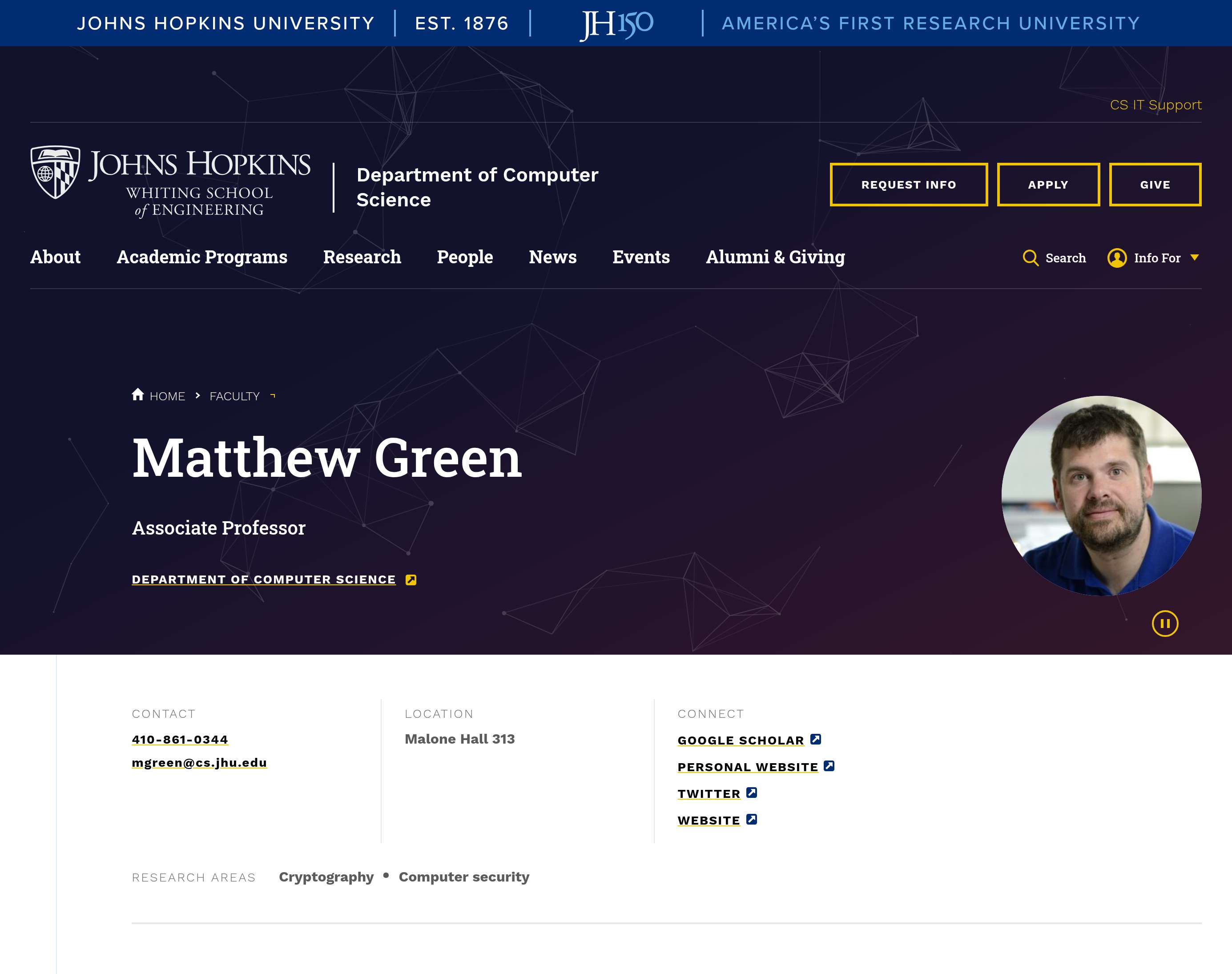
Caption: Matthew Green’s faculty profile in the Johns Hopkins Department of Computer Science, where he is an associate professor. Screenshot: Johns Hopkins University.
Read as a list rather than a headline, one property stands out. A large share work on lattices: Peikert, Lyubashevsky, Micciancio, Nguyen, Aggarwal, Jain and Stephens-Davidowitz. Lattice hardness is the assumption under the post quantum schemes that standards bodies have spent years choosing and deploying. Add Heninger, whose work is breaking deployed RSA and elliptic curve systems, and May, who works on factorisation, and the group spans exactly the mathematics that underpins what is running on the internet today.
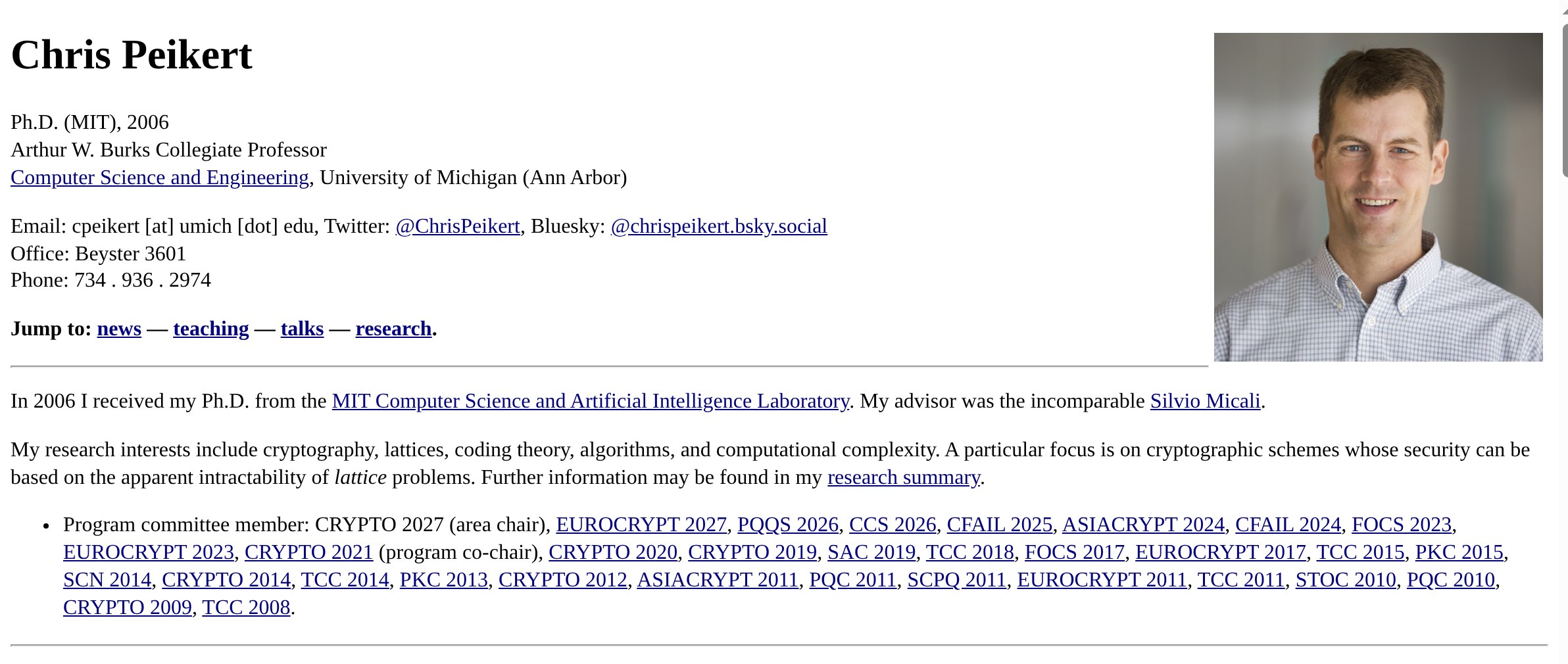
Caption: Chris Peikert’s page at the University of Michigan, describing a focus on schemes whose security rests on lattice problems. Screenshot: University of Michigan.
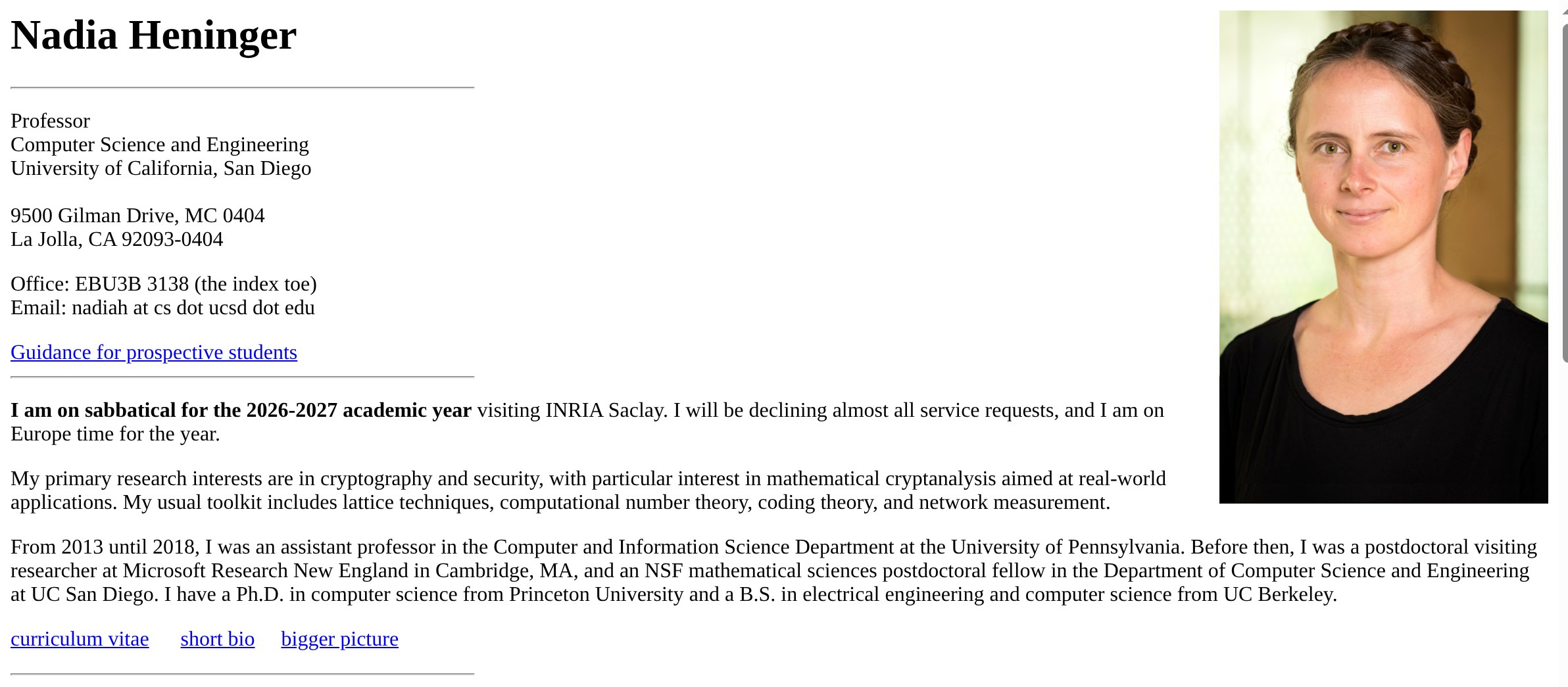
Caption: Nadia Heninger’s page at UC San Diego, describing cryptanalysis aimed at real world applications and lattice techniques among her tools. Screenshot: UC San Diego.
That is an observation about the roster, not a statement of intent, and the group has said nothing to connect the two. But a body assembled to review cryptanalytic advances, staffed heavily with the people who study the hardness assumptions behind current standards, is a body that is watching those assumptions.
What is not known
Everything else.
Whether the group formed because of a specific result, or in anticipation of one. Whether any deployed system is affected. Whether the concern is a mathematical advance, an implementation flaw, or tooling that makes search cheaper. Whether anything will be published this week or this year. The site gives no email list, no schedule, no indication of scope beyond the sentence about disclosure.
A statement page that reads “has not been published yet” is a placeholder, not a teaser. It does not mean something is imminent. It means the page is built.
Why the formation is still worth reporting
Because disclosure is the hard part of cryptography, and nobody has owned it.
When a break lands, the questions arrive faster than answers. Who tells the vendors. Who tells the operators who cannot patch quickly. How much is published before users can protect themselves. What the migration path is for a system whose keys are already in the wild. Those questions have historically been answered ad hoc, by whoever found the break and whoever they knew. A standing group with a process is new, and its existence is a statement about expectations.
It is also a coordination signal in the other direction. Researchers who suspect something serious now have somewhere to take it that is not a conference deadline or a vendor’s inbox.
What to do with it
Nothing, yet, beyond watching.
Cryptographic migration is not a same day activity even under a real break, and it is certainly not something to start on the evidence of an empty web page. What a reader can do is the same work that pays off either way: know which libraries your stack actually uses, know whether your TLS is on a hybrid post quantum key exchange or not, and know who would have to act if one algorithm in that chain weakened.
The other discipline is about rumour. If a serious break surfaces, the primary sources will be the group’s own statement page, the affected standard’s maintainers, and coordinated advisories. Not a thread, and not a screenshot of a chart.
When the statement is published, this page will say so.
Discussion
Be the first to commentStart a discussion
Got a take on this, a rig to show off, or a benchmark that says otherwise? Sign up and start the thread - your comment publishes instantly once you're in.