On October 17, the AI lab Odyssey posted 4.8 million views’ worth of a claim: “We placed the fruit fly brain inside Odyssey-3, a frontier world model. The lil’ guy is now flying around totally imagined, simulated worlds all by itself.” Tobi Lutke quote-tweeted it with “Somehow this is incredible and depressing at the same time. The Matrix (1999),” and Ethan Mollick called it “viscerally unsettling.”
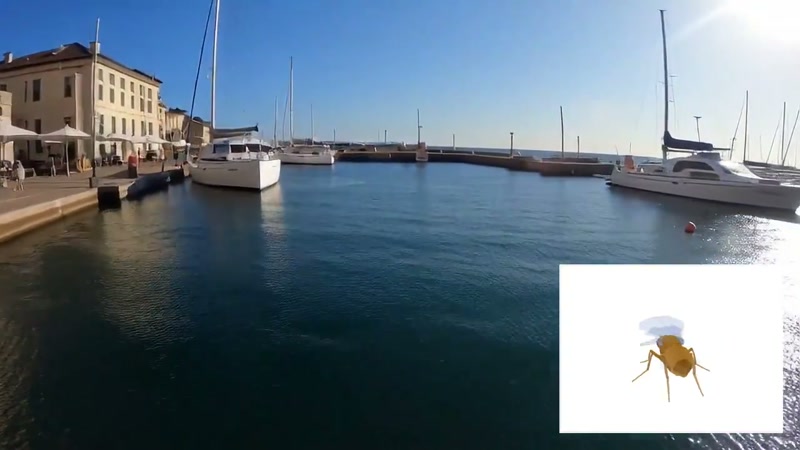
The video shows a photo-real simulated harbor morphing from open water to a stone quay while a fly-shaped avatar flies through it. Nothing in the video or the post identifies which connectome ran inside the avatar, how neural activity became motion, or whether any published fly-brain map was involved at all. No paper, no code, no evaluation. Digg’s technical read is accurate: a connectome is a wiring diagram, not a working brain.
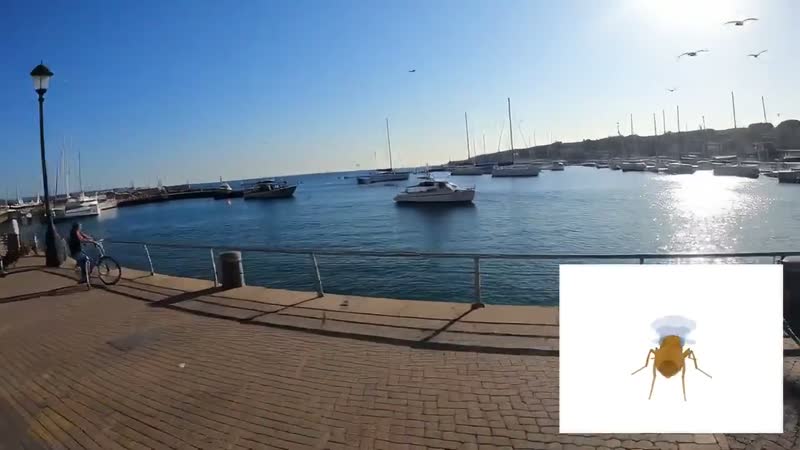
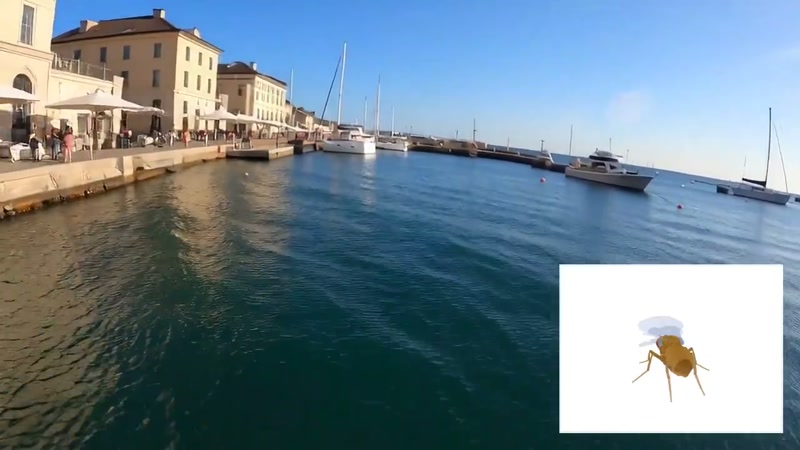
That distinction is exactly why the fly’s real research record matters before reacting to the demo: this year’s other fly-brain agents ship with their mechanisms published, and the year’s most rigorous one walked before Odyssey’s flew.
How the map got made
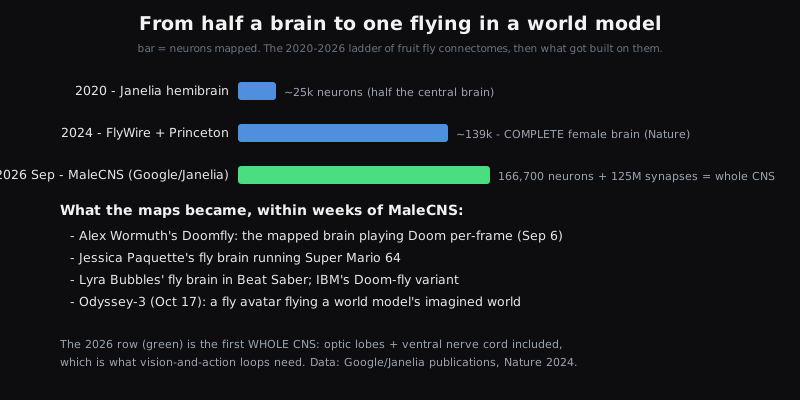
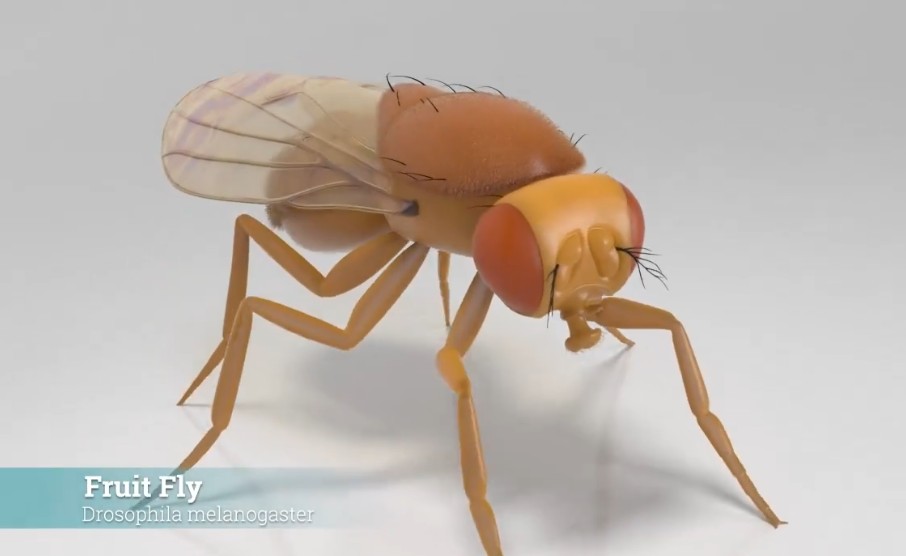
FlyWire, the map most of these projects build on, is the work of nearly a decade on one fly that died years ago: about 7,000 slices, each roughly 2,000 times thinner than a human hair, photographed around 21 million times under an electron microscope, then traced by hundreds of people by hand until 139,255 neurons and 54.5 million synapses were wired. Google Research and HHMI Janelia’s September 2026 MaleCNS release extended the approach to the male fly’s whole central nervous system (166,700 neurons, about 125 million synapses), adding the optic lobes and nerve cord that vision and motion run through: a brain without lobes sees nothing, a body without a cord moves nothing. Google’s framing of why start small: with roughly 86 billion neurons in a human brain, the fly is the largest organism where a complete wiring diagram is currently possible.
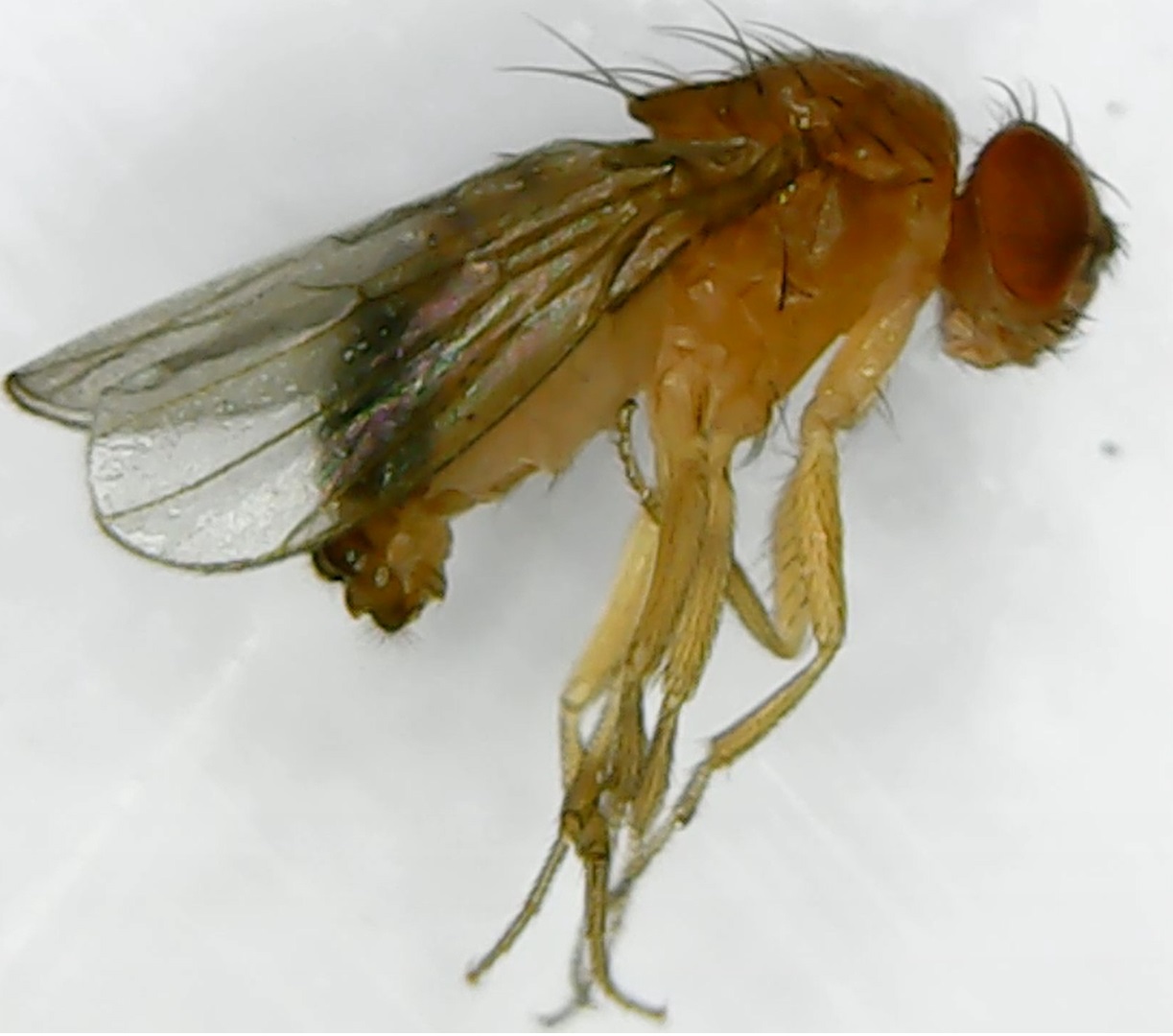
The fly that walked: Eon’s whole-brain emulation
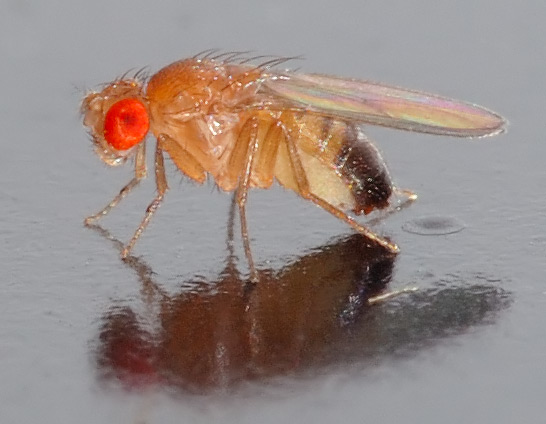
The year’s most technical fly has no marketing video. In March, a small team at Eon Systems led by Philip Shiu took the FlyWire connectome, applied a simple neuron model published in Nature in 2024, and put the result inside a MuJoCo-simulated body, closing the loop from neural activation to physical action. “We’ve uploaded a fruit fly,” the post begins. The upload walked, groomed, and foraged.
The headline number is 91% behavior accuracy, achieved from four ingredients: the connection graph, synapse counts as connection weights, a map of which neurons excite versus inhibit, and leaky-integrate-and-fire dynamics. No behavior was trained into it: the walking came out of the wiring. The team’s caveats are the honest part. The motor neurons could not be traced because the fly’s body was never scanned, so brain-to-body connections were wired by hand from what the brain does when it wants to move; and leaky-integrate-and-fire has no plasticity rules, so this fly cannot form long-term memories. Eon’s framing: “a real uploaded animal” whose experience nobody knows, in an environment worth making rich.
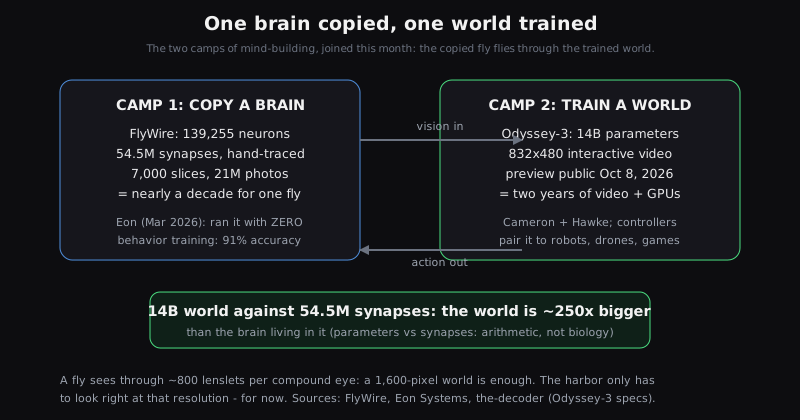
The two camps joined: the copied brain (FlyWire’s 139,255 neurons, zero behavior training) inside the trained world (Odyssey-3’s 14 billion parameters from video). The 250x ratio compares parameters with synapses: arithmetic, not biology. (Figure: tokenstead.ai)
The games wave
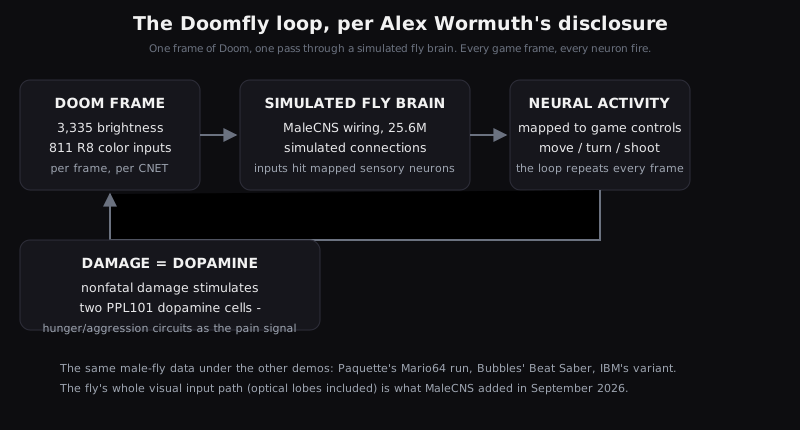
September 2026 turned the connectome into a battery of game-playing flies. The clearest-built is Alex Wormuth’s Doomfly: each frame of Doom generates 3,335 brightness inputs and 811 R8 color inputs, fed to specific sensory neurons in a simulated brain with 25.6 million connections; neural activity maps to game controls, the loop repeating every frame; and nonfatal damage stimulates two PPL101 dopamine cells, the neurons that carry hunger and aggression signals in real flies, as the reinforcement signal. Wormuth’s site streams the raw telemetry: sensory input, neural activity, and a 3D view of the fly shooting demons. The same week, Jessica Paquette’s fly learned Super Mario 64, Lyra Bubbles’ took up Beat Saber, and IBM ran its own Doom variant.
How a 14-billion-parameter world hosts a 54.5-million-synapse brain
Odyssey-3, the world flying the viral fly, is real machinery with real specs: 14 billion parameters generating 832x480 interactive video in real time ( Odyssey-3 Pro does 1280x720 and scored 66.1 on the Physics-IQ Verified benchmark), a research preview public since October 8, and founders Oliver Cameron and Jeff Hawke positioning it for robots, drones, and game characters through paired controllers. It is the trained camp: no microscope, just video and compute.
The numbers line up as arithmetic: 14 billion parameters against 54.5 million synapses, the world about 250 times bigger than the brain living in it. Two different units, honestly not comparable as biology - but the asymmetry behind the ratio is real and measured. FlyWire took the better part of a decade and a small army of tracers for one fly; the world model ballooned in a couple of years on GPUs. There is a fairness problem the other way, too: a fruit fly sees through about 800 lenses per compound eye, a 1,600-pixel world against the roughly million-fiber feed one of your eyes sends your brain. A harbor convincing across 1,600 pixels is a low bar, and it is being cleared. The fake world will look real enough for human eyes long before anyone slices a human brain - all 86 billion neurons - into 2,000-times-thinner-than-hair sections.
The verified fact underneath all of this month’s virality: the wiring diagram exists as a usable artifact, at a scale small enough to simulate on a workstation and complex enough to walk, groom, and play Doom with its mechanisms written down. Whether Odyssey’s fly runs any of it stays their claim to substantiate.
Sources: Odyssey launch post - Google Research: the complete male fruit fly connectome - Eon Systems: We’ve uploaded a fruit fly - Wormuth’s Doomfly (CNET’s mechanism write-up) - The Decoder: Odyssey-3 specs and preview - Digg’s technical read of the Odyssey demo - FlyWire
Related on this site: Hermes Agent ships on NVIDIA’s RTX Spark launch - Twenty-one ways to run a model locally: the engine catalog - DeepSeek V4.1 Flash (model page)