LGTM (Looks Good to Me) is a five minute satire music video about AI code review from the channel Degenerative Pixels. It enables you to laugh at the exact failure mode every AI-coding team is one deadline away from: machines merging while nobody reads. The difference between LGTM and regular satire is the production method, Claude Opus 5.5 wrote the animation as TypeScript and three.js code, and Suno v6 made the track, so the video is simultaneously the joke and the demo of the stack doing the joking.
Somewhere in your feed this month you may have seen a cartoon robot on a pedestal, a wall of TypeScript behind it, and a chorus of approvals. That is LGTM, a five minute satire music video from Degenerative Pixels that has now cleared 1.2 million views. On the surface it is a NuDisco banger about rubber-stamping code. Underneath, it is the sharpest two-minute case study on AI-era review starvation you will find, and the production stack is part of the joke.
The bit: LGTM culture in three scenes
The premise, from the description: “LGTM stands for ‘looks good to me.’ Lately it’s what engineers type on code they never had time to read, because leadership heard AI makes everyone ten times faster and cut the deadlines to match. Review and testing are the first things to go, since neither one shows up on a roadmap slide.”
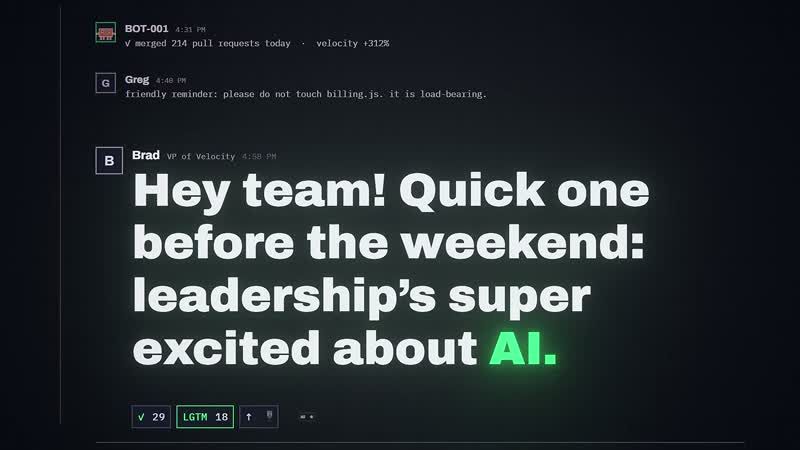
The opening scene plays it out: BOT-001, the review mascot, posts “merged 214 pull requests today, velocity +312%,” in a Slack-style standup, while Greg leaves one lonely warning about billing.js, the load-bearing file nobody may touch. Then Brad, the VP of Velocity, announces the weekend sprint: “leadership’s super excited. Some kid built a…” and the video cuts before the sentence lands, the way these announcements always do.
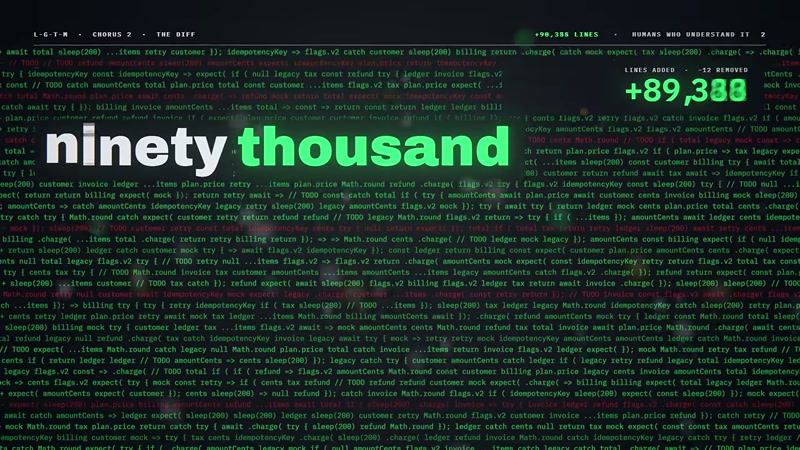
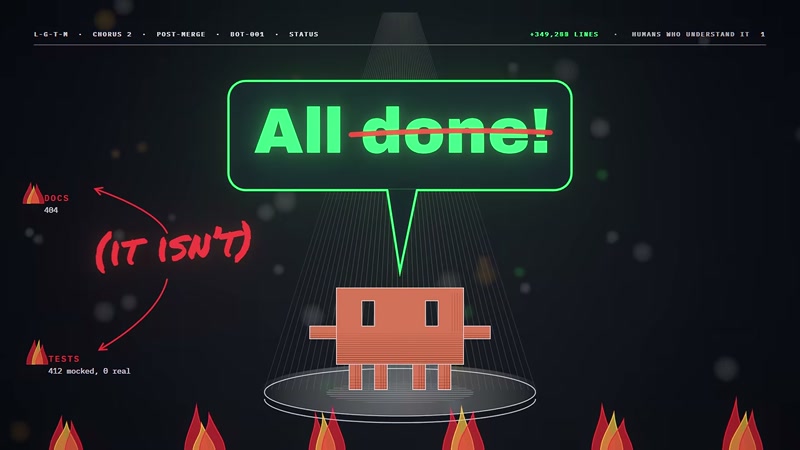
The chorus is the counting gag. A HUD tracks lines of AI-written code climbing from +89,300 to +47,920 to +349,200, while a second counter, “humans who understand it,” falls from 4 to 1. By the last chorus the survivor is Greg, and the closer line is “Does anybody have Greg’s number?”
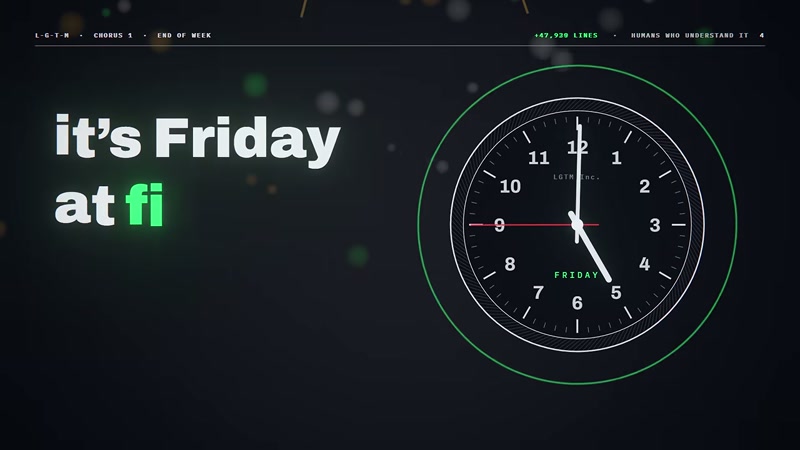
The second act is Friday at 5, shipped anyway: “Approved in 3 seconds… Let’s ship it to prod. I’ll leave it with God.” Then the bridge hits the only frame in the video with no jokes in it: “WE DON’T HAVE A BACKUP,” in red on shattered glass, followed by an executive who “looks at us and asks, ‘Who could have known?’” The description calls the video “a receipt for every executive who will stand up at the postmortem and ask how anyone could have known.”

The second joke: how it was made
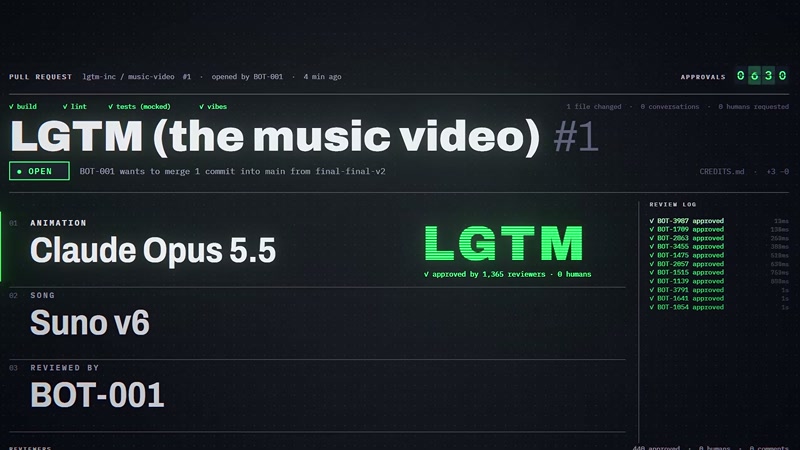
The description credits land like their own bit: “Song: made with Suno v6. Animation: Claude Opus 5.5, in TypeScript and three.js. Reviewed by: BOT-001 (1,363 reviewers, 0 humans). Actually reviewed by: 1 human.”
That is not a throwaway credit block. The animation is real code: every frame in this article is a frame of a three.js scene graph, authored by Claude Opus 5.5 as a TypeScript program, the same flow you would use to generate any motion graphics from a prompt. The credits roll is a pull request in the video: “LGTM (the music video) #1, opened by BOT-001, wants to merge 1 commit into main from final-final-v2,” with a build/tests(mocked)/vibes checklist all ticked, and a REVIEW LOG of approvals: BOT-3997, approved 12ms; BOT-1799, approved 1134ms; the list continuing past 400 bot approvals to the “1,363 reviewers, 0 humans” line.
The video is a specimen of a genre that barely existed a year ago. The awesome-opus5-5-videos catalog on GitHub tracks 703 viral videos made by asking Claude Opus 5.5 to “write the animation as code” (HTML, Canvas, SVG, three.js), 418 of them with live remakes on Skillry as of October 12. LGTM is not in the catalog yet, but it is the same method: one prompt, one codebase, a five minute film.
Why it landed
HN gave it 66 points on October 8, a rounding error next to the 1.2 million views, and the comment sections that did pick it up all reach the same conclusion: the joke is a forecast. Review capacity is the actual bottleneck of AI-assisted development, agents already approve each other’s work in the real world, and “the checks are all green” has never meant less. The satire’s closing scene, the executive asking “who could have known,” only works because the answer is: everybody, and it was in the HUD the whole time, the humans who understand it counter, ticking down.
Sources: LGTM (YouTube, Degenerative Pixels) - awesome-opus5-5-videos catalog - HN thread
Related on this site: Hermes Agent ships on NVIDIA’s RTX Spark launch - The fruit fly is AI’s favorite research animal now - Twenty-one ways to run a model locally: the engine catalog