Z.ai announced GLM-5.4 on 23 November as its first Loop Transformer, a 750B model that reaches what the company calls intelligence comparable to 2T-3T parameter models without adding parameters. The mechanism: 28 layers of the GLM-5 base run twice per forward pass, refining the hidden state on the second trip.
The announcement has no benchmark table for the 750B, and the weights are not out. Z.ai’s post says only that it plans to “open-source the model weights responsibly after completing necessary safety hardening”, with no date, and the API is listed as coming soon.
The architecture, though, is not a promise. It shipped in open weights this week.
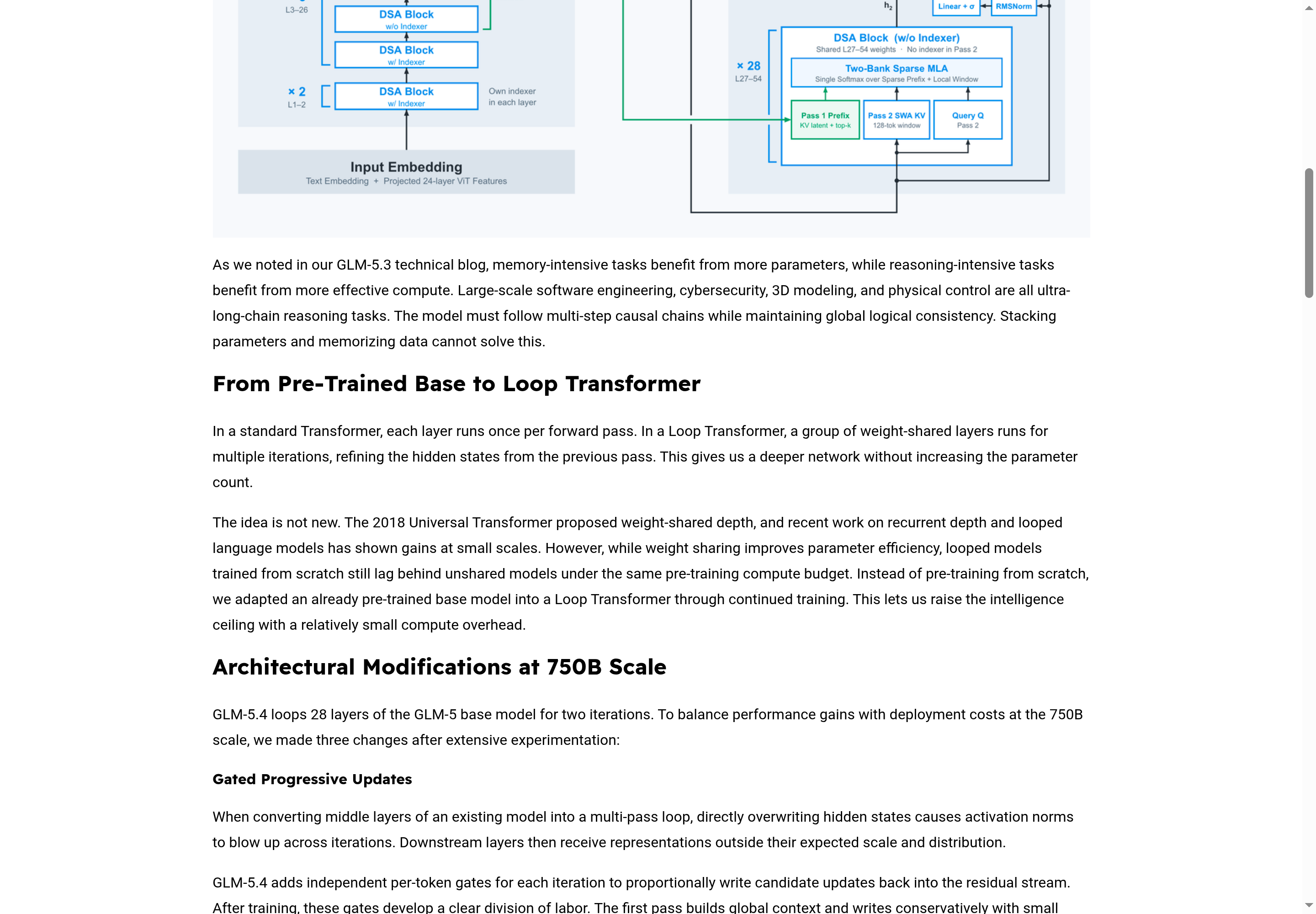
Z.ai’s description of the loop, its 2018 Universal Transformer precedent, and the 750B modifications. Screenshot: Z.ai.
What looping actually is
Here is what changes when you load one. You give a looped model the same prompt you would give any other, and before it answers, it sends that prompt through a shared block of layers more than once, so the later passes re-read the model’s own first attempt. The file on disk stays the same size. You spend tokens per second instead of gigabytes, and on the benchmarks further down it scores better for the spend.
Z.ai’s post is candid about the prior art, citing the 2018 Universal Transformer, and about why it works for them: models trained from scratch as looped tend to lag unshared models at equal compute, so they converted an already-trained base instead.
Three engineering fixes make it deployable at 750B. Per-token gates that write small updates on the first pass and full ones on the second. A hybrid KV cache where an extra loop costs one sliding window rather than a full context cache. And sparse attention indices reused from the first pass, so the second adds no indexing work.
Turning the dial yourself
Thinking Machines published something more useful than any flagship: TML-d24-varloop-research, the same architectural idea with the pass count exposed as a setting, and a table of what each setting buys.
On SWE-bench Verified, the same weights scored 56.3% at one pass, 76.5% at two, 78.7% at three, 79.3% at four and 79.6% at five. On DeepSWE v1.1 the swing is violent: 0.7% at one pass, 28.3% at two, 47.4% at three.
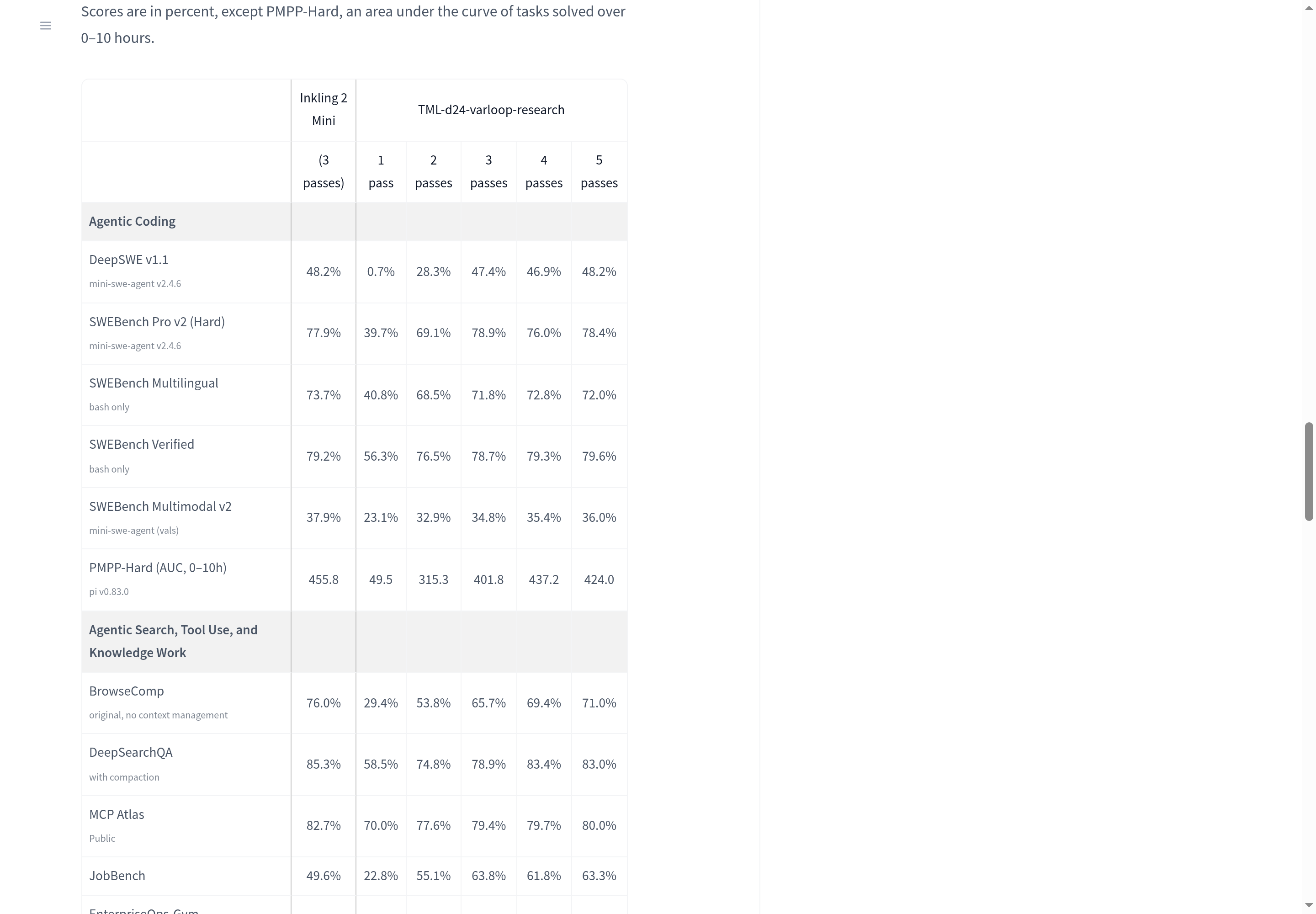
The pass-count table on the model card, with Inkling 2 Mini’s three-pass result in the first column for comparison. Screenshot: Hugging Face.
Each extra pass adds roughly 1.0B effective active parameters per token without adding a byte of weight memory. That is the trade a consumer rig wants: you pay in compute, which a GPU has plenty of, instead of in capacity, which it does not.
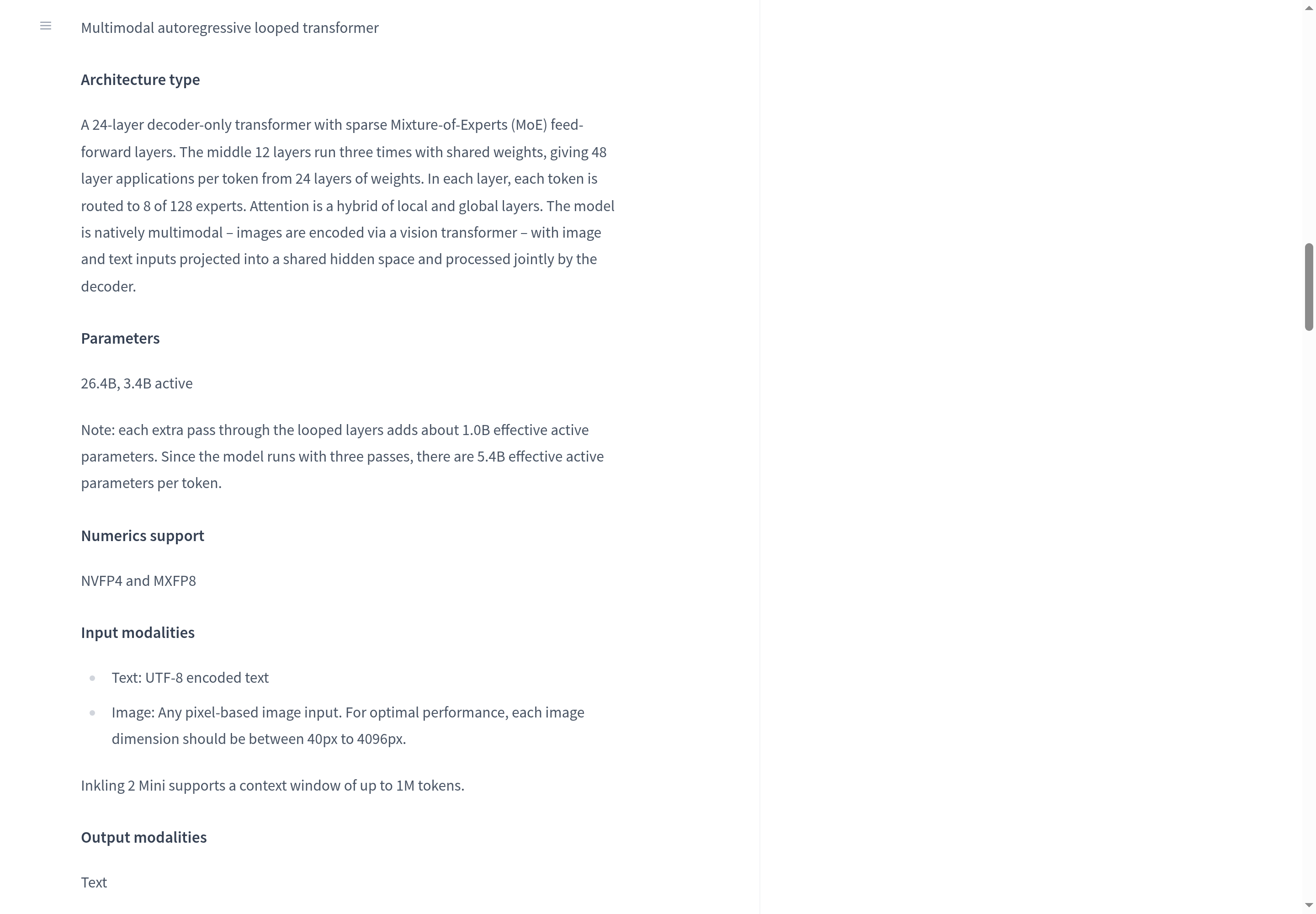
Inkling 2 Mini’s parameter note, explaining how three passes produce 5.4B of effective active parameters from 3.4B. Screenshot: Hugging Face.
What you can run today
Inkling 2 Mini is Apache 2.0, 26.4B total with 3.4B active, running three passes for 5.4B effective. It ships as a single ~20GB checkpoint in NVFP4 or MXFP8, targets a DGX Spark or a 32GB Mac, and holds a 1M context. Unsloth’s GGUF repo has 1,292,888 downloads in the last month, with builds from 9.1GB.
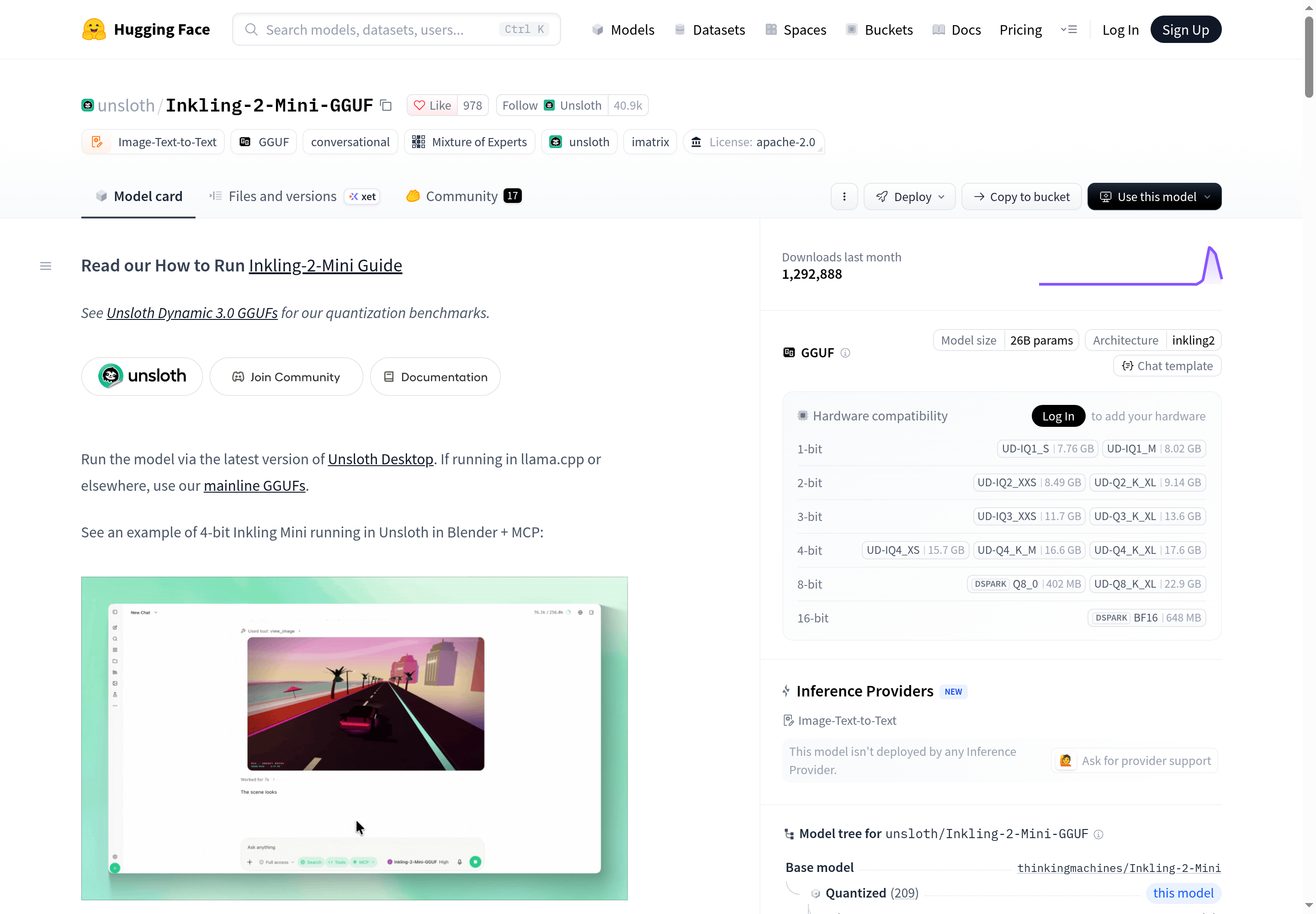
Unsloth’s quantised builds sit at 1.29 million downloads for the month. Screenshot: Hugging Face.
SenseNova-Loop-9B is the same trick at 9.4B under Apache 2.0, running 24 of its 32 layers twice, with official AWQ and GGUF builds and a documented ~15 GiB footprint at a 256K context.
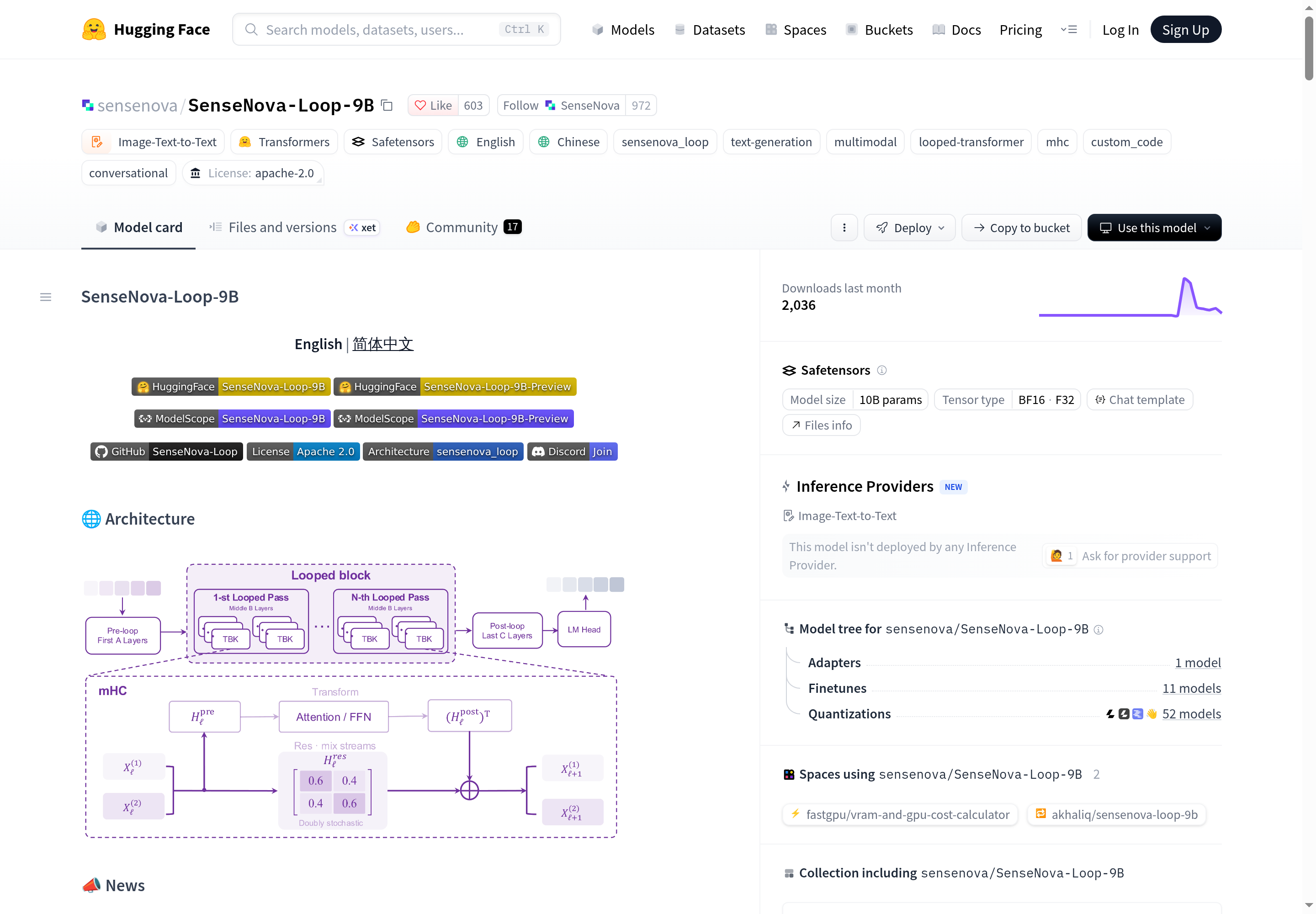
SenseNova’s looped 9B, with operator and architecture notes on the card. Screenshot: Hugging Face.
The catches
Your runtime may not load it. Inkling 2 Mini needs a patch for mainline llama.cpp, so stock builds can fail. Looped models are new to every inference stack, and speed varies by runtime.
The vendor’s own warnings are unusually blunt. Inkling 2 Mini’s card says it can get stuck in long reasoning loops when debugging code and can take destructive actions such as deleting files without confirmation. Z.ai admits GLM-5.4 gets caught in “marathon thinking” loops, though it argues that improves accuracy past its parameter count.
The flagship’s numbers do not exist yet. Everything quantitative about looping at scale comes from a 30B iso-parameter ablation or from the 26B open model, not from the 750B.
Why this direction fits your desk
For two years the way to get a better model was to buy more VRAM. Looping changes the exchange rate: the same weights, run more times, score higher, at the cost of tokens per second rather than gigabytes. A 32GB card can run the 26B. Nothing on the market can run the 750B, and that gap is exactly the one this architecture starts to close.
Sources: Z.ai: GLM-5.4 - TML-d24-varloop-research - Inkling 2 Mini - SenseNova-Loop-9B
Related on this site: Qwen promises open weights for smaller Qwen4 models
Discussion
Be the first to commentStart a discussion
Got a take on this, a rig to show off, or a benchmark that says otherwise? Sign up and start the thread - your comment publishes instantly once you're in.