TLDR: Jensen Huang resigned as Nvidia’s chief executive on Thursday, and the part of his job nobody priced was the advocacy: he signed a letter with 25 companies telling Washington not to over-restrict open-weight models, pushed Nvidia’s own open Nemotron line, and was mid-way through a reported $13 billion purchase of Hugging Face. It enables a genuine question for anyone who runs local models, which is whether the loudest voice arguing their corner in US policy just walked out with no replacement named. The difference between this and a normal executive departure is that a strategy survives a handover and a personal argument in front of regulators does not.
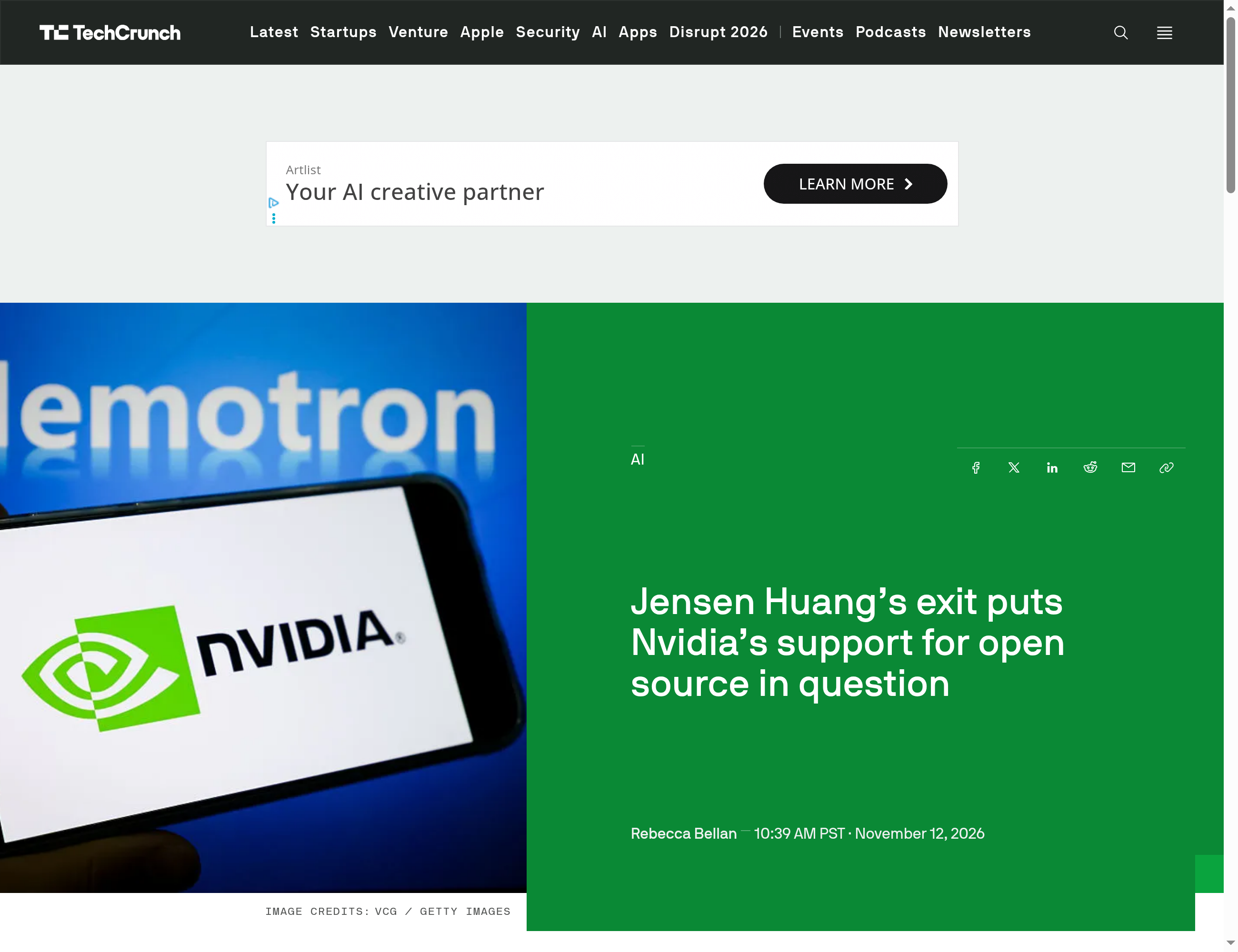
Caption: TechCrunch’s framing on Thursday afternoon, which put the open-source question at the centre of the resignation rather than at the edge of it. Screenshot: TechCrunch.
What actually happened
Huang resigned as president, chief executive and board member, effective immediately, with Colette Kress, the chief financial officer, stepping in as interim. The release offers no reason. It also contains nothing in his own words, which is unusual for a founder leaving after 33 years. The resignation itself is covered in detail separately.
What matters here is narrower and less discussed: a large part of Nvidia’s public position on open models was his personal position, stated in his own name.
The record he leaves behind
Four things, all documented:
The letter. Earlier this year Huang wrote an open letter, signed by 25 companies including Microsoft, Meta, IBM and Palantir, urging the US government not to over-restrict open-weight AI models, many of which come from China. The letter was a response to a Washington debate over allegations that Chinese labs are taking intellectual property from American ones, with Anthropic and OpenAI reportedly lobbying directly for stronger protections.
The models. Nvidia ships the Nemotron family of open-weight models under its own name. The Hugging Face organisation currently lists 1,040 models, with the most downloaded text models running into millions of downloads.
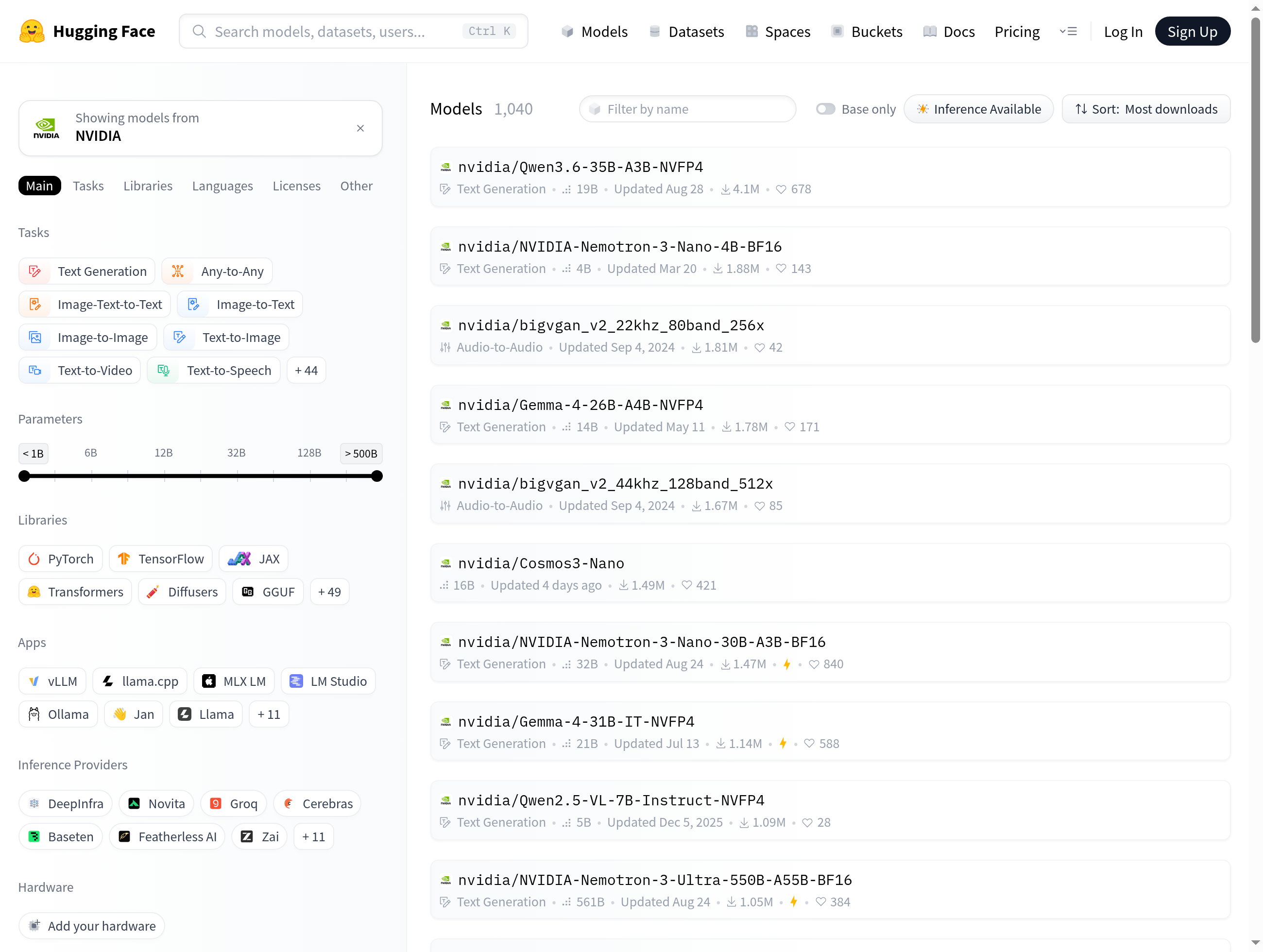
Caption: Nvidia’s model list on Hugging Face, sorted by downloads: Qwen3.6-35B-A3B in NVFP4 at 4.1 million, Nemotron-3-Nano-4B at 1.88 million, Nemotron-3-Ultra-550B at 1.05 million. Screenshot: Hugging Face.
The paper. Nvidia published “Open Weights and American AI Leadership” in July 2026, arguing that the US should judge AI not by one frontier model but by the strength of an open ecosystem, and that open weights broaden competition and keep gains from concentrating in a few hands.
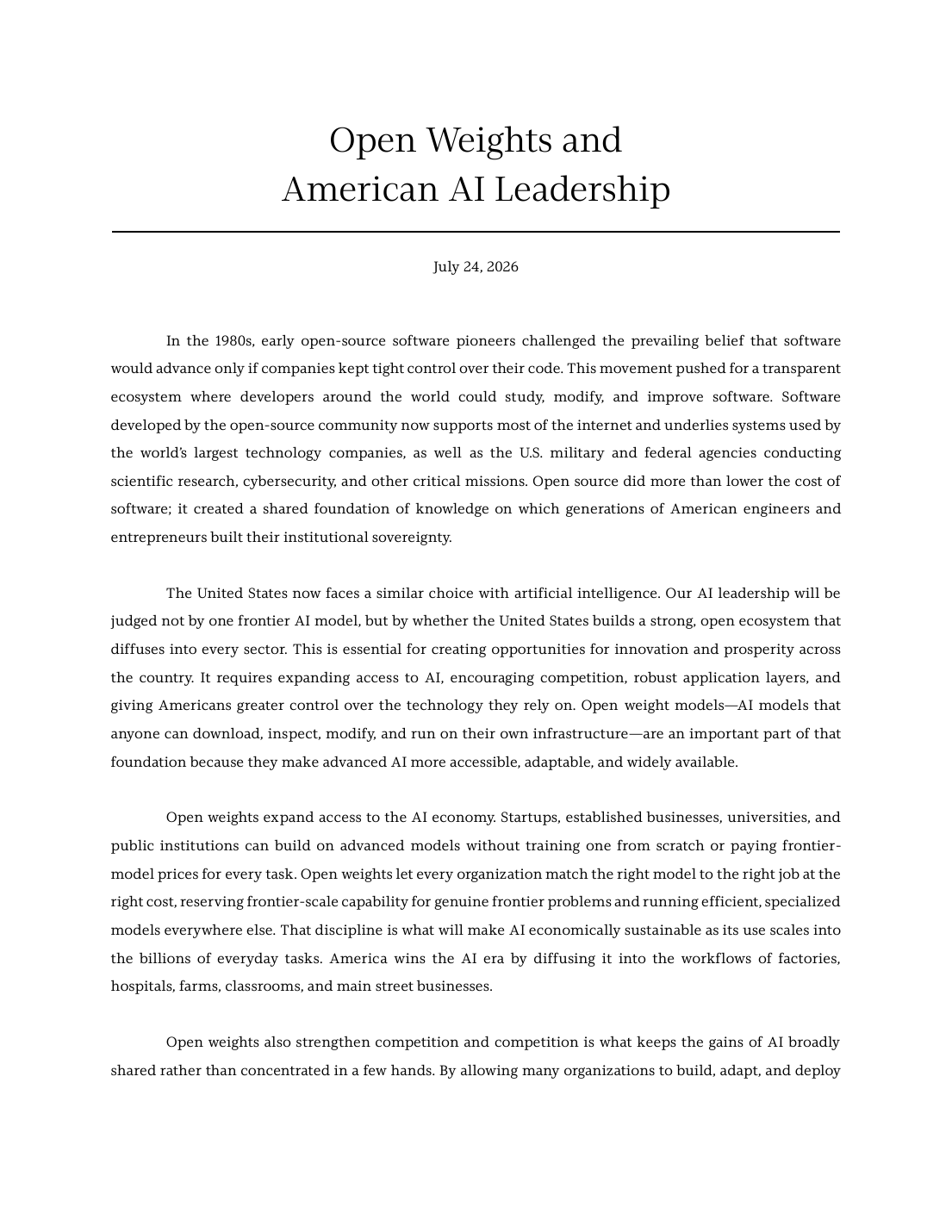
Caption: The opening of Nvidia’s own position paper, July 24, 2026, which frames open weights as an American competitiveness argument rather than a licensing debate. Screenshot: NVIDIA.
The money. Nvidia has a reported $13 billion deal to acquire Hugging Face that has not been finalised, and has agreed to pay $6 billion for a non-exclusive licence to Poolside’s coding technology. Huang also backed companies built around open models, including Reflection AI and Thinking Machines Lab.
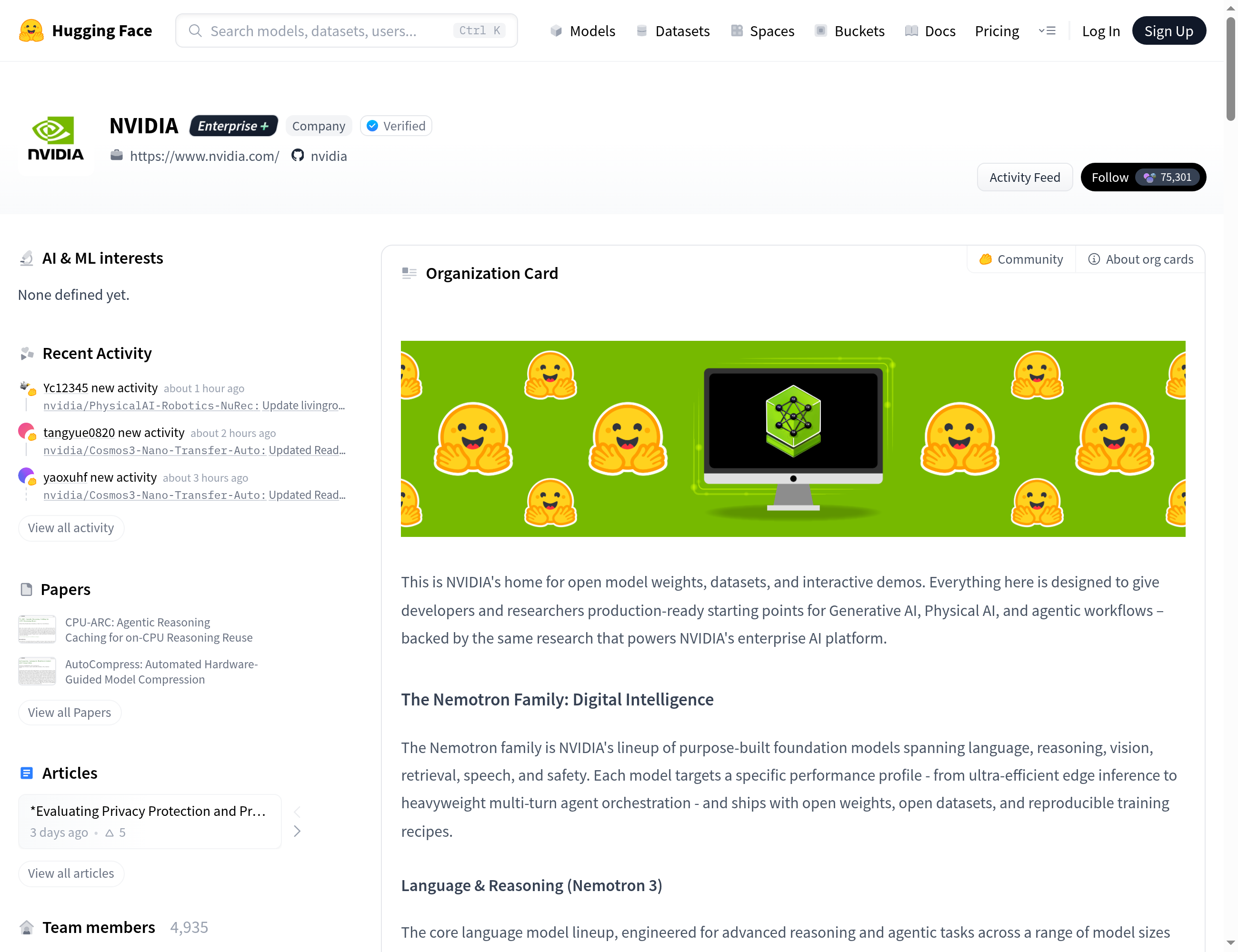
Caption: Nvidia’s organisation page, which describes the Nemotron family as open models with open weights, open datasets and reproducible training recipes. The pending acquisition would put the repository itself under Nvidia. Screenshot: Hugging Face.
The panic, and what it is worth
Within hours, two things happened on X that are worth separating from the reporting.
DHH told people to “make sure you have a few open-weight models backed up and some basic gear to run them”, adding that the world “just lost one of free AI’s biggest proponents”. Mia AI Lab posted: “I’m downloading all the weights I can and care about. I suggest you do the same… even if you can’t run them.”
Both are reacting to a real thing. Neither is evidence of a policy change, because none has been announced.
The case against panic:
- The Hugging Face deal is pending, not dead. An interim chief executive does not typically cancel a $13 billion strategic acquisition in week one, and cancelling it would need a board decision with a stated reason.
- A company insider told TechCrunch they do not expect the leadership change to affect Nemotron development. That is one source, and it is the kind of source that says what the company wants said, but it is more than the panic has.
- Hugging Face’s chief executive Clem Delangue said the company would keep fighting for open source regardless, which is the position of someone who expects the deal to close.
- Nvidia’s commercial interest in open weights is structural, not sentimental: every organisation that wants to own its own model is a customer for chips.
The case for concern is narrower and more serious than “they will take your weights away”. Advocacy in Washington is personal capital. A letter signed by a founder carries weight that a letter signed by an interim finance chief does not. If the administration moves on restrictions for Chinese-derived open models in the next quarter, the industry’s most credible voice on the other side of that argument will not be in the room.
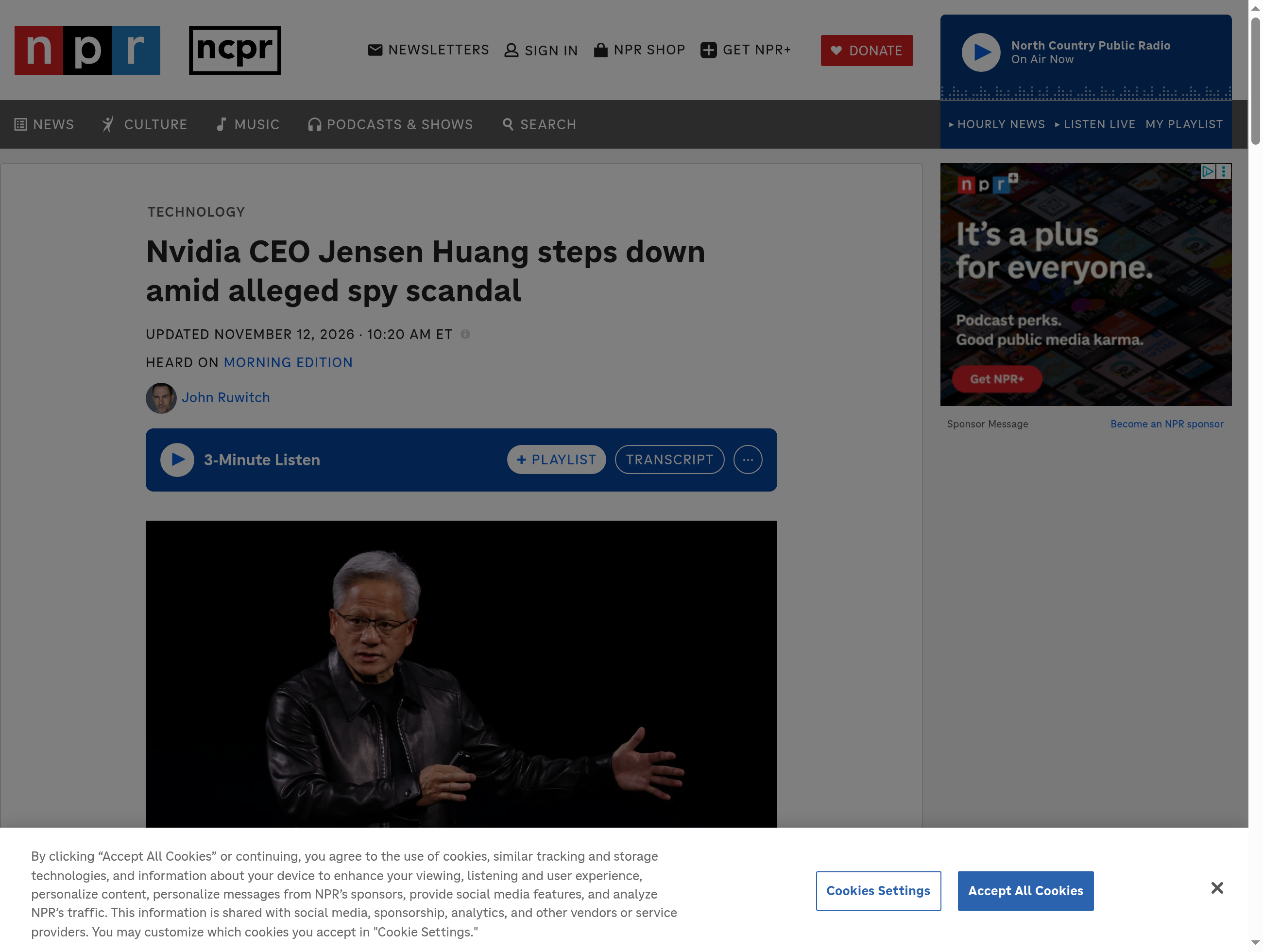
Caption: NPR’s coverage, which is the version most people will read: the resignation as a spy scandal, with the open-model question nowhere in the headline. Screenshot: NPR.
If you want to hedge, do the arithmetic first
“Download everything you care about” is a disk budget decision disguised as a political one. Real sizes:
- A 27B model at 4-bit is roughly 15 GB, which fits on any machine that can run it.
- A 35B mixture-of-experts at NVFP4 is around 18 GB.
- Nvidia’s own Nemotron-3-Ultra-550B in BF16 is about 1.1 TB, before quantisation, and will not run on hardware most people own.
A sensible archive is four or five models you can actually run, not everything you have ever downloaded.
What actually protects you:
- Keep the weights file and the licence together. A model you cannot legally redistribute is not a backup, it is a copy with an expiry date set by someone else’s lawyers.
- Record the checksum and the exact revision you downloaded, so you can prove what you have and fetch a known-good copy later.
- Store one copy off the machine that runs it. The most common loss is not a takedown, it is a dead disk.
- Prefer GGUF or MLX builds of models you use daily, since those are the ones a local runtime can actually load.
What to watch
- The Hugging Face filing. A $13 billion acquisition will produce paperwork. If it gets renegotiated or withdrawn, that is the signal, not a tweet.
- Any policy action in Washington on Chinese-derived open models, and who argues against it. Watch whether Nvidia still shows up with the same name attached.
- Nemotron’s next release. A shipped model is a stronger statement than a quote from an insider.
- The permanent chief executive. Whoever the board picks tells you whether open weights keep their internal sponsor.
The honest summary: nothing has been taken away, and nobody has announced anything. But the argument for open weights in America was being made by a specific person who is now not there, and the repository it most depends on is mid-acquisition. That is worth a check on your own archive, and not worth a panic.
Discussion
Be the first to commentStart a discussion
Got a take on this, a rig to show off, or a benchmark that says otherwise? Sign up and start the thread - your comment publishes instantly once you're in.